Securing raw materials vital for Hanoi’s handicraft export growth
Hanoi’s craft villages, central to Vietnam’s heritage and exports, face material shortages, making stronger regional supply chains vital to sustain growth and global competitiveness.
THE HANOI TIMES — Enhancing the supply of raw materials for Hanoi-based craft villages will ensure the city’s craft sector continues to generate millions of dollars in export revenue each year, heard a conference on August 2.
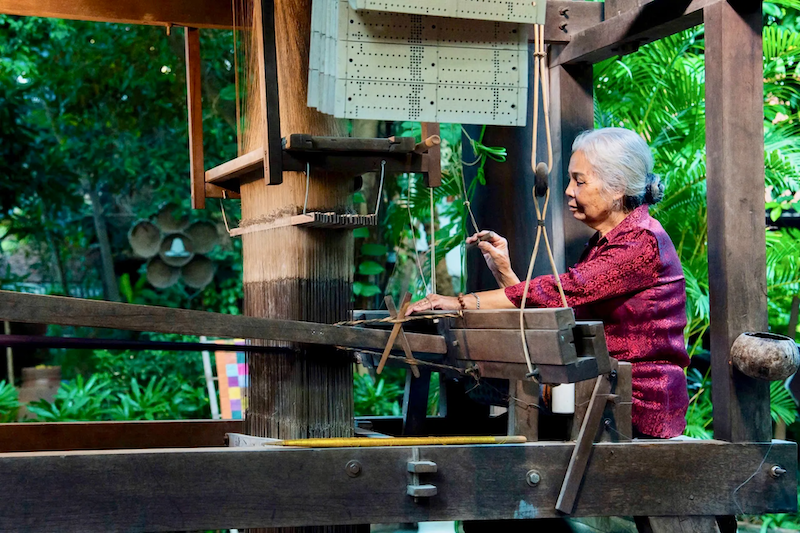
Silk weaving at Van Phuc Village, Ha Dong Ward, Hanoi.
Hanoi is home to more than 1,300 craft villages. These villages preserve cultural heritages, create jobs for local residents and play an important role to the capital’s socio-economic growth.
According to local wards and communes, Hanoi earned a revenue of VND20 trillion (US$758 million) from craft production and sales. Many communes have earned substantial income from selling craft products.
Hanoi’s craft production also contributes to Vietnam’s rapid export growth. Vietnamese craft products are now available in 163 countries and territories with exports reaching $3.5 billion per year. Craft exports have been growing by 10% per year.
According to Vuong Dinh Thanh, Deputy Director of the Hanoi Center for Industrial Promotion and Development Consultancy, there is still room for Hanoi craft producers to improve their operations and production.
Unstable supply of raw materials is one of the main factors that has hindered Hanoi’s craft production and exporting, he said.
A recent survey by the center found that demand for raw materials is immense. Craft producers each year consume some 6,800 tons of rattan and bamboo, 620,000 tons of clay and kaolin, 4,000 tons of lacquer, and one million cubic meters of timber.
Most of the clay, kaolin, feldspar, quartz and color glazes are purchased from suppliers operating in the northern provinces of Phu Tho, Quang Ninh and Lao Cai, said Dao Viet Binh, Chairman of the Kim Lan Pottery Association.
“We rely on intermediaries when purchasing these input materials. Purchasing prices depend on supply volumes, while quality remains uncertain,” he said.
“Some special materials such as zircon and metal oxides are imported at high cost,” Binh added.
Nguyen Vinh Quang, Chairman of the Phu Xuyen Commune’s Pearl Inlay Association, said that local production depends on the supplies of shells, which mostly come from nature.
“Years of overexploitation, climate change and stricter rules on biodiversity preservation have disrupted supply and increased input costs,” he said.
Binh and Quang, representing craft producers in Hanoi, urged local authorities to take measures to secure the supply and quality of input materials for their operations.
According to the two association chairmen, Hanoi government needs to provide training programs, financial incentives and technological assistance so craft producers can cut costs and upgrade their product quality.
One critical measure is that local craft villages should be able to form their partnerships with material suppliers from other provinces and cities, and such partnerships should be long-term.
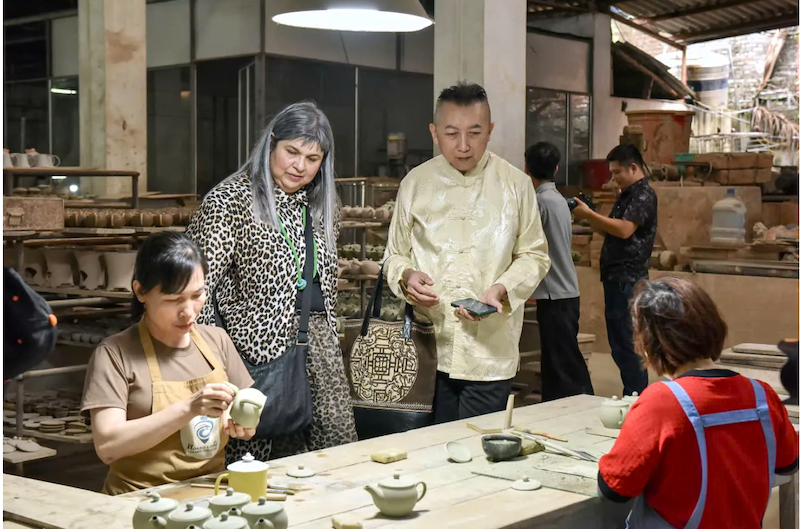
World Crafts Council members visit Hanoi's Bat Trang Pottery Village in late 2024.
Hanoi government should also organize B2B meetings and conferences to connect its craft businesses with material sellers so that such partnerships will flourish.
Initiatives under development
Nguyen Anh Duong, Deputy Director of the Hanoi Department of Industry and Trade, said that the city wants handicraft exports to account for 3%-5% of its total in 2030 with 6-10 product groups directly reaching international markets.
“Hanoi is seeking broader collaborations with foreign suppliers, including those from Laos and Cambodia, to establish sustainable raw material regions,” she said.
“The city may also build a wholesale market for raw material trading and develop a specialization model on raw material production to increase and sustain supplies for local craft producers.”
Le Hoang Tai, Deputy Director of the Vietnam Trade Promotion Agency under the Ministry of Industry and Trade, stressed the importance of long-term contracts and improved logistics infrastructure to stabilize raw material supply chains.
Craft expert Vu Huy Thieu called on the city government to strengthen land management and develop concentrated raw material zones.
He also urged Hanoi authorities to expand its partnerships with neighboring provinces and cities to build proper supply chains.
Le Ba Ngoc, Secretary General of the Vietnam Handicraft Exporter Association, suggested that Hanoi and other provinces and cities develop their public-private-community partnerships, focusing on specialized raw material plantations to secure consistent, export-standard inputs.
For example, bamboo should be sourced from the central coastal province of Thanh Hoa, rattan from the central coast city of Danang and silk from the Central Highlands province of Lam Dong, he said.
Deputy director Thanh from the Hanoi Center for Industrial Promotion and Development Consultancy proposed investing in concentrated raw material zones and adjusting land rents for production facilities in industrial clusters.