How Vietnam modernizes its army
Since 2017, naval power has been the priority of Vietnam’s military modernization program.
Vietnam was able to transform the military from a battle-hardened and technologically deficient force into the relatively modern and capable military at present.
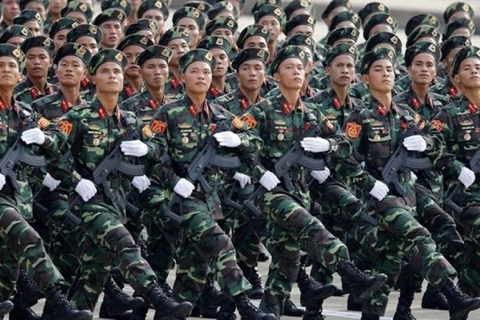
| Vietnam's defense modernization tells a story of decades-long transformation. Photo: Reuters |
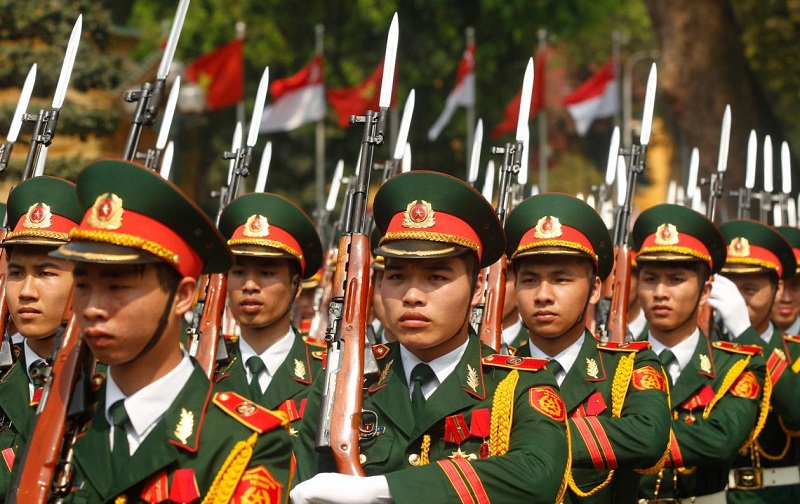
The country’s military expenditure increased by some 687% between 2003 and 2018 but the transformation itself will tell the full story of Vietnam’s defense modernization.
Bich T. Tran, Ph.D. candidate at the University of Antwerp, described the military modernization was planned shortly after the establishment of the Socialist Republic of Vietnam in 1976, with the reunification of the North and the South of Vietnam after the Vietnam War ended.
In February 1979, China sent hundreds of thousands of troops over Vietnam’s northern border, following Vietnam's overthrow of the Beijing-backed Khmer Rouge regime in Cambodia the month before. The brief but devastating war cost tens of thousands of lives, including untold numbers of civilians.
When Vietnam launched the Doi Moi policy to reform and open its economy in 1986, the country’s leaders emphasized the need to strengthen border security and to modernize its military, Ms. Tran, who is a visiting research fellow at the Global Affairs Research Center in Kyoto and a former Asia Studies Visiting Fellow at the East-West Center in Washington, wrote in an article for The Diplomat.
They aspired to build the Vietnam People’s Army into a regular, reasonably organized, balanced, compact, and robust force in order to protect the nation’s hard-won national sovereignty and maintain the security of its borders, airspace, islands, and surrounding waters.
It was during that period, in March 1988, China used force to seize several features in the Spratly Islands from Vietnam, in a violent incident that led to the death of 64 Vietnamese personnel.
In 1991, Vietnamese leaders admitted that the aggregate quality of the armed forces did not meet the requirements of the situation in which the nation found itself. For example, the military’s combat power, combat readiness level, and training quality of some units remained low. Again, Vietnam aimed to modernize its army with the interest of protecting its national interests, especially from a China that was now growing increasingly wealthy and powerful.
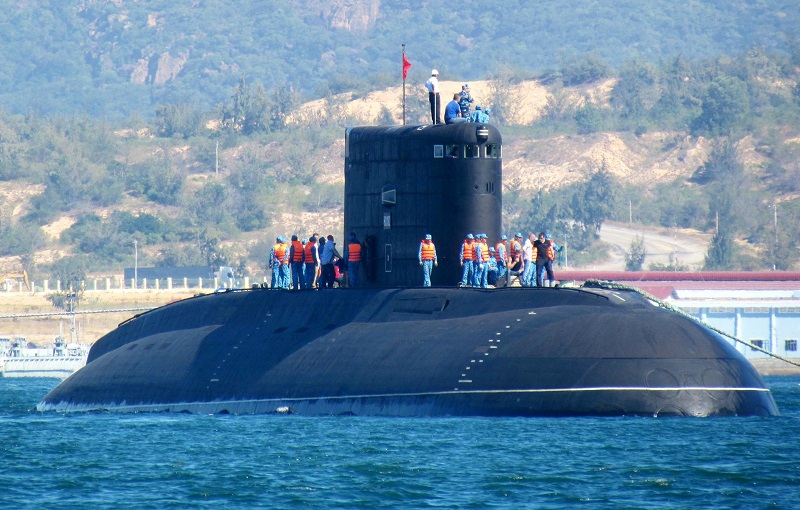
| By the time it commissioned the last of six submarines in 2017, Vietnam possesses the most modern submarine fleet in Southeast Asia |
Emphasizing a foreign policy of independence and self-reliance, Vietnam first responded to the China threat by initiating a modest program to improve its naval and air forces in the mid-1990s. Between 1995 and 1999, Hanoi ordered six fighter aircraft, six fighter/ground attack aircraft, and 40 anti-ship missiles.
It wasn’t until 2001 that the country’s leaders decided to make appropriate investment in the defense industry and equip the military with modern technologies.
From 2001 to 2005, Vietnam equipped itself with an arsenal that included two surface-to-air missile (SAM) systems, 75 SAMs, 50 portable SAMs, 50 short range air-to-air missiles, 100 air-to-surface missiles, 270 anti-ship missiles, two patrol craft, four fighter/ground attack aircraft, and eight fast attack craft.
All of these were procured from Russia, testifying to the continued salience of the Cold War-era ties between Hanoi and Moscow. In addition, Vietnam purchased two maritime patrol aircraft from Poland and 13 fighter/ground attack aircraft from Czechia and Ukraine.
In 2006, the country's leaders attempted to turn Vietnam into a strong regional marine economy. The plan entailed developing a system of seaports, sea transportation, oil and gas exploitation and processing, and marine products and sea services. Accordingly, Vietnam needed to formulate and implement a comprehensive strategy both for economic development and for ensuring control over the surrounding maritime areas.
In 2006-2010, Vietnam doubled its defense budget from US$1.28 billion to US$2.67 billion. The country further strengthened its defense by acquiring two coastal defense systems, five more SAM systems, 200 anti-ship missiles, 200 guided rockets and guided bombs, 160 torpedoes, six patrol craft, six submarines, and 20 fighter/ground attack aircraft.
Notably, after China had attached a map showing the so-called “nine-dash line” to its note verbale to the United Nations in May 2009, Hanoi signed a US$2 billion contract with Moscow to buy six Kilo-class submarines.
These state-of-the-art submarines, said to be the quietest in the world, gave Vietnam the ability to conduct anti-submarine, anti-ship, and general reconnaissance, as well as patrol missions.
Strengthening naval capacity
In January 2017, by the time Vietnam had commissioned the last of the six submarines, it possessed the most modern submarine fleet in Southeast Asia. Hanoi also equipped its Kilos with Russian anti-ship and land attack 3M-14E Klub supersonic cruise missiles.
Since then, naval power has been the priority focus of Vietnam’s military modernization program.
In 2011, the leaders pledged to ensure armed forces were gradually equipped with modern equipment, “first of all for navy, air defense, air force, security forces and intelligence.”
From 2011 to 2015, Hanoi added to its arsenal two frigates, four patrol craft, four air search systems, 30 air search radars, 12 FGA aircraft, five more SAM systems, and 30 anti-ship missiles, among other acquisitions.
This period also coincided with increasing turbulence in the South China Sea. Since 2014, China has undertaken the large-scale reclamation and militarization of contested features in the Spratly Islands, or Truong Sa in Vietnamese. It has also deployed a wide array of missiles and military assets on its artificial islands, which could be used to deny other countries access to the maritime and air domains of the South China Sea.
Furthermore, in May 2014, Beijing deployed a state-owned oil rig in contested waters some 222 kilometers off the coast of Vietnam.
In 2016, Vietnamese leaders made it clear that it was necessary to increase the resources available for defense and create the material and technical foundations for the People’s Army to meet the requirements and tasks of protecting the country.
After the oil rig incident in 2014, there was also a shift in Vietnam’s strategy. In addition to self-help efforts, Vietnam has intensified defense cooperation with major powers.
The United States, Japan, South Korea, and others have helped Vietnam improve its law enforcement capability and maritime security.
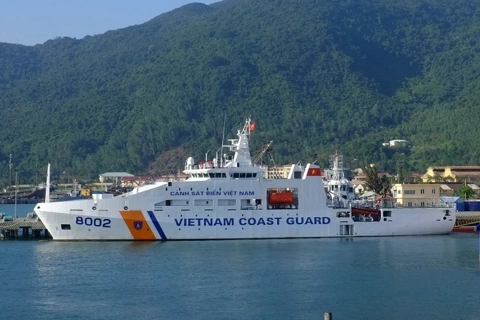
Among the big items, South Korea agreed to transfer a Po Hang corvette to Vietnam in 2017, which was delivered the following year. The US Coast Guard transferred a Hamilton-class cutter to the Vietnam Coast Guard in May 2017 and promised to deliver a second one sometime in 2020.