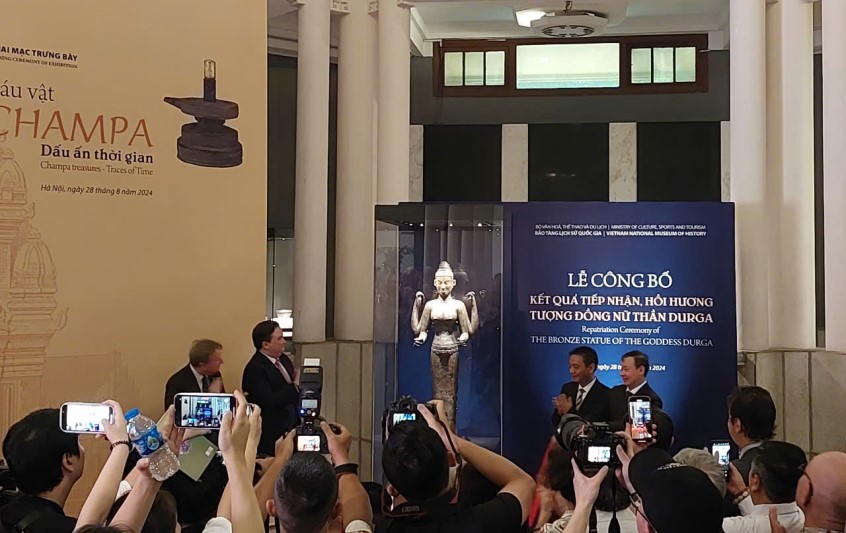
Statue of Goddess Durga unveiled to the public since repatriation
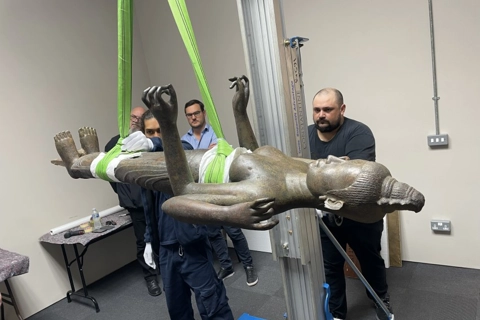
The statue of Goddess Durga with four arms, a typical artifact of the Champa culture, was repatriated in June after being smuggled abroad.
In the National History Museum has displayed, for the first time, the public will have access to the bronze statue of Goddess Durga that was once trafficked to the US and UK.
According to Dr. Nguyen Van Doan, Director of the National Museum of History, upon receiving the statue, the museum set up an appraisal council composed of leading experts in the fields of history, archaeology, culture, art and antiquities to evaluate the statue.
And the verdict: This is a statue of Goddess Durga with four arms, with a large mass, (total height 191cm with the main part measuring 157cm and weight 101kg), dating from the 7th century, in a relatively intact condition. The statue is of Vietnamese origin and belongs to the Champa cultural art style. However, information about the exact location where the Goddess Durga statue was found still needs further research.
| The four-armed statue of Goddess Durga was unveiled to the public for the first time. Photo: Ngo Minh/The Hanoi Times |
"This is the largest bronze statue, a typical and unique representative of Champa cultural art discovered to date, a rare antique of great value to Vietnamese culture and fine arts throughout historical periods," Doan said.
The statue is on display at the exhibition Champa Treasures - Marks of Time, organized by the National Museum of History in cooperation with collector Dao Danh Duc.
The exhibition features more than 60 precious objects made of gold and silver during the 17th and 18th centuries. Many of these remarkable objects are on public display for the first time.
It is divided into two sections - one featuring religious statues and sacred antiquities, and the other highlighting jewelry and objects imbued with both religious significance and royal authority.
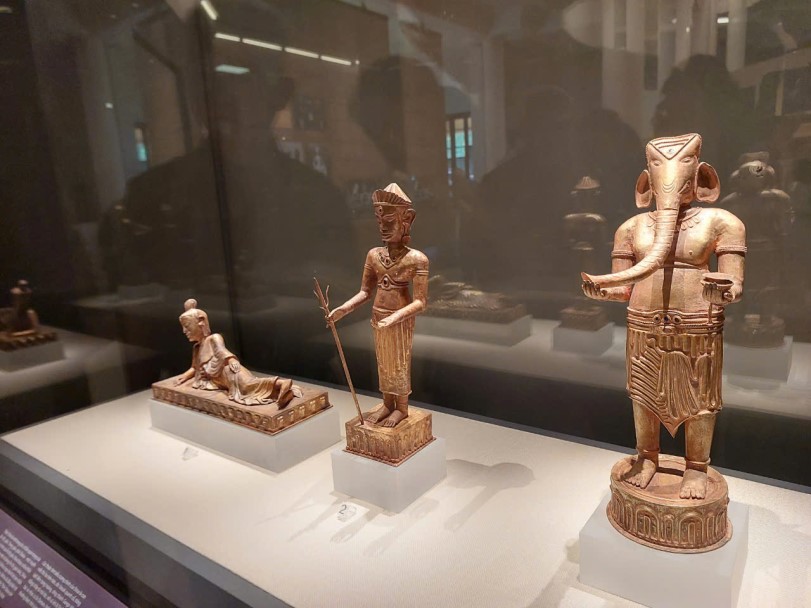
In the first part of the exhibition, visitors will encounter a captivating array of statues depicting the god Shiva, the elephant-headed god Ganesha, the serene Buddha, the compassionate bodhisattva Avalokitesvara, as well as the sacred linga, yoni and kosa linga - all crafted in gold and silver and adorned with precious gems.
| In the first part of the exhibition, visitors will encounter a captivating array of statues depicting gods. Photo: Ngo Minh/The Hanoi Times |
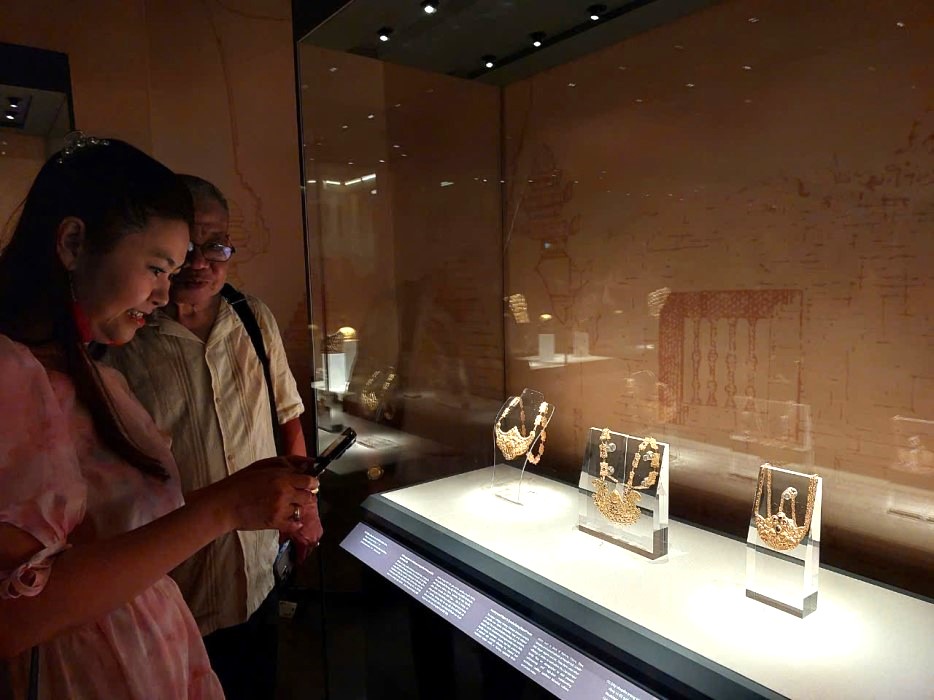
The second section reveals a dazzling selection of Champa jewelry and royal artifacts.
These treasures include earrings, rings, necklaces, hairpins, combs, bracelets, and belts. Notably, these pieces bear intricate symbols rooted in Champa religious and traditional beliefs. Hindu deities - Brahma, Vishnu, Shiva, Ganesha - take center stage alongside revered creatures such as the sacred bull Nandin, the divine bird Garuda, and the serpent god Naga.
The National Museum of History presents this exhibition with a dual purpose - to allow both local and foreign visitors to marvel at valuable historical, cultural and artistic pieces from Champa's lesser-known past - and to deepen their understanding of this rich heritage.
Champa, an ancient kingdom that flourished from 192 to 1832, once occupied the region that is now central Vietnam. Its rich cultural heritage was shaped by a fascinating blend of Indian and Javanese influences, interwoven with unique Champa creations.
Numerous temple ruins and sculptural remains survive today, serving as tangible evidence that both Hinduism and Buddhism were the primary religions of the ancient kingdom.
Champa reached its zenith in the 9th and 10th centuries. However, after the 15th century, as time marched on, a gradual southward shift occurred in the heart of the Champa kingdom, accompanied by transformative changes.
Specifically, from 1692 (when Lord Nguyen founded the Thuan Thanh fortress in Champa territory) to 1832 (the year Champa was formally conquered by Dai Nam (the former name of present-day Vietnam) under Emperor Minh Mang), there has been comparatively little scholarly focus on the historical, cultural, and artistic dimensions of Champa.
That's why the Museum of History, in cooperation with the Vietnam Cultural Heritage Association and antique collector Dao Danh Duc, has selected more than 60 typical artifacts from this historical period to present to the public.
The exhibition is on display at the National History Museum, 1 Trang Tien Street, Hanoi until the end of October 2024.
| Visitors admire the collection of fine jewelry. Photo: Ngo Minh/The Hanoi Times |