Social Affairs
Three scenarios for high-speed railway development in Vietnam
However, experts said that the third scenario proposed by the Ministry of Transport implies several risks and negative impacts on the development capital investment.
The consortium of consultants TEDI – TRICC – TEDIS, which conducted the pre-feasibility study on the high–speed railway project running through Vietnam, has presented three scenarios basing on the hypotheses of low, average and high development.
The first scenario - the low development one - focuses on upgrading and improving the existing single track gauge of 1,000 mm for both passenger and freight trains.
The National Assembly has approved the allocation of VND7 trillion (US$305 million) to gradually upgrade the line according to a plan.
Under this scenario, the cost will be not too high, the operational speed will be 80-90 km/h for passenger train and 50-60 km/h for freight train but it will not improve the transportation capacity of the North-South railway by 2030.
In the second scenario of average development, the available single track will be upgraded to the dual-track with a gauge of 1,435 mm compatible for both: passenger train with operational speed of 200 km/h and freight service train with operational speed of 120 km/h.
That both passenger and freight trains run on the same high-speed rail is considered a problem if this scenario comes into being. Accordingly, as passenger trains run faster than freight trains, it will pose huge problem in working out an operating schedule.
According to consultants, upgrading and expanding railway route is hard due to excessive expense for land clearance and other transformation costs. It will also negatively affect normal operation of existing trains in the North-South route.
This scenario, they said, will not respond to the huge transportation demand on the North-South corridor and still put an increasing burden on the road, waterway, and aviation modals.
The last scenario, which is high development option, includes two independent tracks, of which one will be upgraded from the existing 1,000 mm mainly for freight train and a high-speed railway will be built anew exclusively for passenger train with a maximum speed of 350 km/h.
After the upgrade, the freight train will be able to operate in its own rail with a maximum capacity of 25 pairs of freight trains per day which is equivalent to around 12-15 million tons of goods per year while 90 pairs of passenger trains will run in its exclusive high-speed rail, overcoming the timetable shortcomings.
Besides, the faster the train runs, the more market share in transportation the railway grasps.
Regarding time, if the train travels at 320 km/h, its running time would be one hour from Hanoi to Vinh while that of a flight including accessing to the airport and security check may take three hours. It will take 5.5 hours to for the high speed train to run from Hanoi to Ho Chi Minh city, just one hour longer than by plane.
The ticket price of a high-speed train is around 75% of the average flight ticket.
However, experts said that the third scenario proposed by the Ministry of Transport implies several risks and negative impacts on the investment capital.
There is a risk of suspending all transport infrastructure constructions nationwide to put all resources into the North-South high-speed railway project in 30 years or more as the project investment would reach a gigantic amount of some US$58 billion.
Furthermore, Vietnam's actual poor expertise on railway construction and operation will lead to passive implementation of the project, dependence on foreign technologies and poor protection of Vietnam’s interests.
Thus, the Ministry of Planning and Investment said that the high-speed North-South railway should be the one with broad gauge in which both freight and passenger trains run with operational speed of 200 km/h. In this way as a result, the total investment will be reduced to US$26 billion from some US$58 billion proposed by the Ministry of Transport.
“With this speed, the travel time from Hanoi to Ho Chi Minh City is eight hours and it makes sense”, the Ministry suggested.

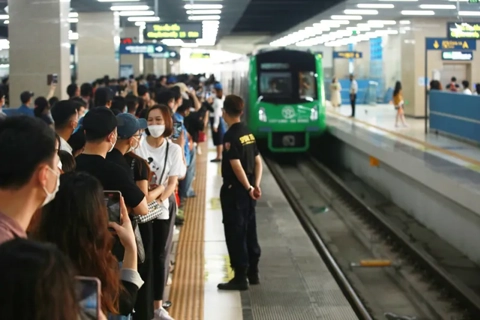
Illustrative photo.
|
The National Assembly has approved the allocation of VND7 trillion (US$305 million) to gradually upgrade the line according to a plan.
Under this scenario, the cost will be not too high, the operational speed will be 80-90 km/h for passenger train and 50-60 km/h for freight train but it will not improve the transportation capacity of the North-South railway by 2030.
In the second scenario of average development, the available single track will be upgraded to the dual-track with a gauge of 1,435 mm compatible for both: passenger train with operational speed of 200 km/h and freight service train with operational speed of 120 km/h.
That both passenger and freight trains run on the same high-speed rail is considered a problem if this scenario comes into being. Accordingly, as passenger trains run faster than freight trains, it will pose huge problem in working out an operating schedule.
According to consultants, upgrading and expanding railway route is hard due to excessive expense for land clearance and other transformation costs. It will also negatively affect normal operation of existing trains in the North-South route.
This scenario, they said, will not respond to the huge transportation demand on the North-South corridor and still put an increasing burden on the road, waterway, and aviation modals.
The last scenario, which is high development option, includes two independent tracks, of which one will be upgraded from the existing 1,000 mm mainly for freight train and a high-speed railway will be built anew exclusively for passenger train with a maximum speed of 350 km/h.
After the upgrade, the freight train will be able to operate in its own rail with a maximum capacity of 25 pairs of freight trains per day which is equivalent to around 12-15 million tons of goods per year while 90 pairs of passenger trains will run in its exclusive high-speed rail, overcoming the timetable shortcomings.
Besides, the faster the train runs, the more market share in transportation the railway grasps.
Regarding time, if the train travels at 320 km/h, its running time would be one hour from Hanoi to Vinh while that of a flight including accessing to the airport and security check may take three hours. It will take 5.5 hours to for the high speed train to run from Hanoi to Ho Chi Minh city, just one hour longer than by plane.
The ticket price of a high-speed train is around 75% of the average flight ticket.
However, experts said that the third scenario proposed by the Ministry of Transport implies several risks and negative impacts on the investment capital.
There is a risk of suspending all transport infrastructure constructions nationwide to put all resources into the North-South high-speed railway project in 30 years or more as the project investment would reach a gigantic amount of some US$58 billion.
Furthermore, Vietnam's actual poor expertise on railway construction and operation will lead to passive implementation of the project, dependence on foreign technologies and poor protection of Vietnam’s interests.
Thus, the Ministry of Planning and Investment said that the high-speed North-South railway should be the one with broad gauge in which both freight and passenger trains run with operational speed of 200 km/h. In this way as a result, the total investment will be reduced to US$26 billion from some US$58 billion proposed by the Ministry of Transport.
“With this speed, the travel time from Hanoi to Ho Chi Minh City is eight hours and it makes sense”, the Ministry suggested.