Towards greener and sustainable development: Nordic model for Vietnam
The successful model is believed to base on political determination and a multi-stakeholder approach.
Vietnam’s focus on greener and sustainable development has been much inspired by Nordic model in which the capital city help the country on how to grow in a green, innovative and sustainable manner.
| Nordic ambassadors to Vietnam (from left: Kim Højlund Christensen from Denmark, Grethe Løchen from Norway, Ann Måwe from Sweden, and Kari Kahiluoto from Finland). Photo: Nordic Embassies in Hanoi |
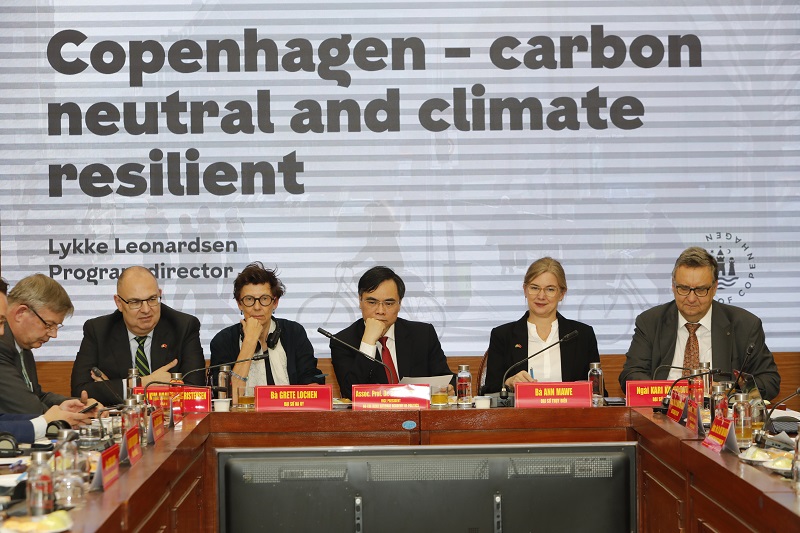
The ambassadors of the four Nordic countries of Denmark, Finland, Norway and Sweden said at a seminar in Hanoi on March 23 that they are very happy to share their Nordic knowledge and experience with Vietnam, hoping that the country will find them inspirational and helpful for the ongoing efforts to lead the country and its cities in the transition towards green and sustainable development.
The event is part of the Nordic countries’ support to Vietnam’s achievement of the UN’s Sustainable Development Goals (SDGs), in particular SDG 11 on the importance of making cities inclusive, safe, resilient and sustainable.
For that reason, the seminar is aimed to facilitate and promote exchange of knowledge, experience and good practice between the Nordic countries and Vietnam in terms of leadership, governance, sustainability and innovation in green growth.
The model that four capital cities Copenhagen, Helsinki, Oslo and Stockholm have is that economic security must go hand in hand with social and environmental security.
Over the last decade, the capitals have made bold political and administrative decisions to address urbanization, climate change and environmental challenges, according to Nordic Ambassadors to Vietnam.
The transition to green and sustainable way in the Nordic capital cities to secure and improve the quality of life for their residents and create opportunities for innovation, jobs and green growth requires long term planning and a multi-stakeholder approach.
Professor Dr. Duong Trung Y, vice president of the Ho Chi Minh National Academy of Politics, said that the model for Vietnam’s reference is the Nordic countries’ persistent approach to a sustainable development model, which focuses on the close connection between economic growth and social equity. From which, incredible economic growth goes together with advanced welfare systems, protection of the environment and maintaining cultural values and identities.
In addition, the Nordic experience in governance and development will provide helpful recommendations for big cities in Vietnam in general and for Hanoi in particular.
At the seminar, experts from the four capitals addressed the importance of involving local political decision makers, municipality agencies, private sector, environmental and climate organizations as well as mobilizing ordinary citizens, saying they are key in setting targets and implementing policies.
| Nordic green growth - model for Vietnam. Photo: Nordic Innovation |
Copenhagen targets to become the world’s first carbon-neutral capital city by 2025. Its population growth by 20% in the next decade will enable the city to combine growth, development, innovation, job creation and enhanced quality of life with lower CO2-emissions.
The pursuit of climate goals over the past decades has helped. In 2009, Copenhagen launched its first Climate Plan and has already achieved major CO2-reductions. The city also has Environmental Policies in place as clean air, less noise, clean drinking water from the tap and many green spaces increase people’s health and well-being significantly.
Helsinki is the first city in Europe to launch a Voluntary Local Review (VLR) to set out strategic plans for the effective implementation of the UN’s Sustainable Development Goals (SDGs).
In reality, the Helsinki City Plan, approved in 2016, with a sustainable direction for the city’s growth over the next 30 or so years, aims to make every part of the city easily reached by public transport.
Accordingly, walking and cycling will be given top priority, and the urban structure of the city must be such that everyday services can be obtained nearby. A dense urban structure and sustainable transport play a key role in Helsinki’s climate ambitions.
Helsinki’s goal is to be a carbon neutral city by 2035.
Oslo has ambitious climate goals on both mitigation and adaptation. In 2020, it adopted a new ambitious climate strategy, of which the main aim is to reduce climate gas emissions from the city with 50% in relation to 1990-level within 2020 and with 95% within 2030, not by buying quotas but by implementing actual emissions cuts.
In 2017, it operated a first climate budget as a groundbreaking governance tool. The budget is a means to show municipal agencies where emission must be cut and who is responsible in the public transport and construction sectors.
Stockholm was appointed the first European Green Capital in 2010 thanks to its cut carbon emissions and ambitious climate goals.
In 2016, the city adopted the goal to be fossil free in 2040. Since 1990 up until today, the city has cut its carbon emissions by 50% per citizen. In the beginning of October 2019, Stockholm launched an initiative called the Global Green New Deal aiming to gather those willing to deliver reductions in carbon emissions in line with the 1.5 degree goal set out in the Paris Agreement.