Typhoon Fengshen at level 11 to cause heavy rain in central Vietnam
Meteorologists warn that Typhoon Fengshen would maintain a complicated track over the next few days, strengthen as it nears the coastal region of Vietnam, with widespread rain and flooding risks.
THE HANOI TIMES — Typhoon Fengshen, which is forecast to reach level 11, might cause heavy rain in central Vietnam from October 22, according to the National Center for Hydro-Meteorological Forecasting.
At 2 PM on October 20, the storm’s core was located at 17.5 degrees North latitude and 117.2 degrees East longitude, about 540 km northeast of Vietnam's sovereignty over Hoang Sa (Paracel). The strongest winds were at level 9 of 75-88 km per hour (kph), with gusts reaching level 11. It was moving northwestward at about 25 kph.
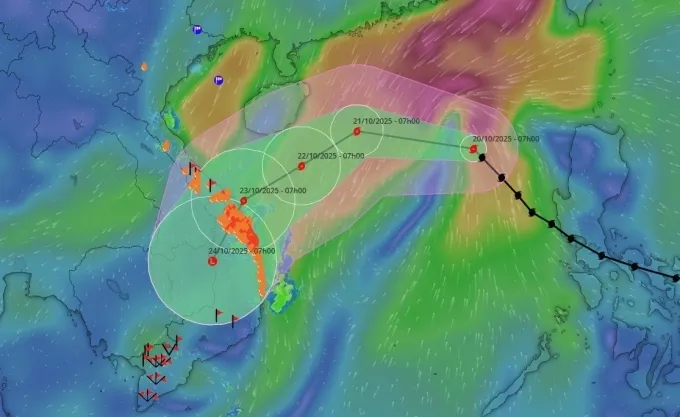
The anticipated trajectory of Typhoon Fengshen toward central Vietnam. Source: National Center for Hydro-Meteorological Forecasting
In the next 72 to 96 hours, Fengshen is expected to move mainly southwestward at about 10 kph, gradually weakening into a tropical depression.
Its impact will cause very rough seas. The affected areas of the northern East Sea (including Hoang Sa) are at risk from thunderstorms, whirlwinds, strong winds and high waves.
On the mainland, Fengshen’s circulation, combined with a cold air mass, is forecast to bring widespread and prolonged heavy rainfall to the central provinces of Ha Tinh to Quang Ngai between October 22 and 27. Some areas are likely to experience prolonged downpours, posing a high risk of flash floods and landslides in mountainous regions.
Amid the complicated weather conditions, local authorities are requested to prepare flood-response measures, as river levels from the central province of Quang Tri to Quang Ngai could reach or exceed level 3 flood warnings.
The National Civil Defense Steering Committee on October 19 asked the coastal provinces from Quang Ninh to the Central Highlands province of Lam Dong, along with relevant ministries and national media outlets, to take proactive measures in response to the typhoon.
The committee tasked authorities with closely monitoring Fengshen’s evolution, strictly managing vessels going out to sea, preparing rescue forces and equipment and enhancing communication to ensure timely updates on its progress to residents and vessel owners to timely respond.
Since the beginning of 2025, the East Sea has recorded 12 storms and four tropical depressions. Among them, Wutip, Wipha, Kajiki, Nongfa, Ragasa, Bualoi and Matmo have caused severe flooding and damage in northern and central Vietnam.
These natural disasters have left 241 people dead or missing and 389 injured; damaged 261,000 houses and flooded 594,000 hectares of crops, 30,800 livestock and 2.7 million poultry, with estimated economic damage of VND53.8 trillion (US$2.1 billion).
|
By 4 AM on October 21, Fengshen is expected to be about 180 km north-northeast of Hoang Sa, with maximum wind speeds at level 11, gusting up to level 13, moving west-northwest at around 20 kph and likely to strengthen further. By 4 AM on October 22, it will be located about 180 km northwest of Hoang Sa, maintaining level 11 winds with gusts up to level 13 and moving southwestward at around 10 kph. Affected areas include the western part of the northern East Sea (including Hoang Sa) and the waters off the central provinces of Thua Thien-Hue to Quang Ngai. By 4 AM on October 23, the typhoon is forecast to be in the waters from Hue to Quang Ngai, with winds decreasing to level 8 and gusts up to level 10, moving southwestward at about 10 kph and likely to weaken. |