UNFPA, MRI explore best models for Vietnam’s old persons
The partnership will expand a network of Vietnamese and Japanese entities to promote the development of care and support for the elderly.
A new partnership between the United Nations Population Fund (UNFPA) in Vietnam and the Mitsubishi Research Institute (MRI) is believed to promote the rights of old persons in Vietnam amid the country’s fast ageing.
Representatives of the United Nations Population Fund (UNFPA) in Vietnam and the Mitsubishi Research Institute (MRI) sign MOU in Hanoi on August 26. Photos: UNFPA |
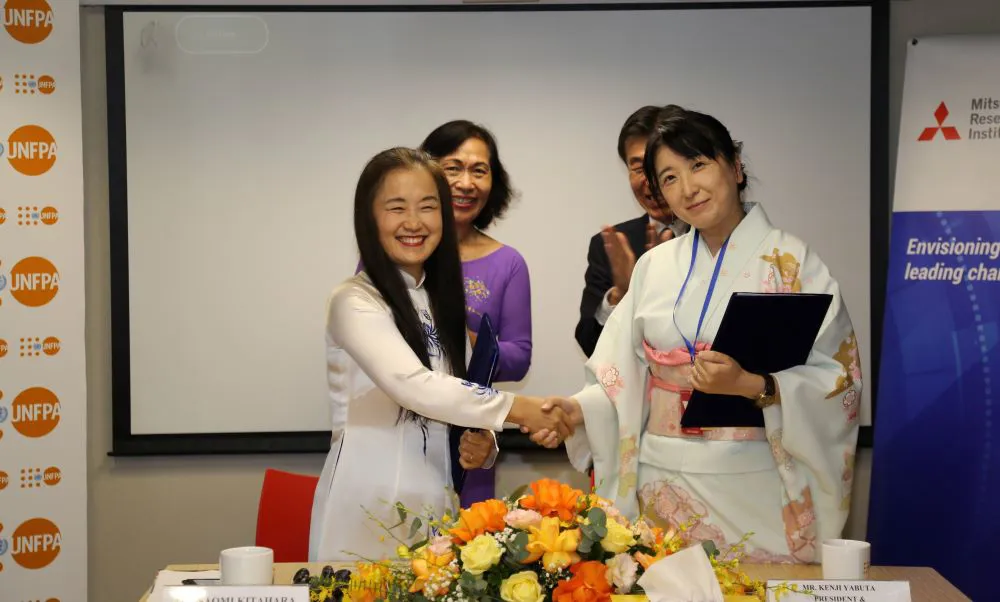
Under the memorandum of understanding (MOU) signed on August 26 in Hanoi, both UNFPA and MRI are committed to working closely together in joining hands with the Government of Vietnam and the international community to effectively address population ageing and other emerging population issues in the Southeast Asian country which has officially entered the “ageing phase” since 2011.
The partnership will focus on the issues of ageing and other population matters, such as sexual and reproductive health and rights, health care for young people, and gender equality, with the following key activities, among others:
It will conduct joint research and communications, consult and support project execution, and organize events for public sharing of research findings; develop personnel training and exchange programs; promote public-private partnerships in the light of population aging and emerging population trends; and expand a network of Vietnamese and Japanese entities to promote the development of care and support for the elderly.
The things to do will matter a lot for Vietnam, which is projected to become an “aged” society by 2036. Currently, the number of older persons (60 years or over) is 12.6 million, accounting for 12.8% of the total population, and is expected to increase to 22 million by 2038, or 20% of its population.
According to Dr Nguyen Trung Anh, Director of the National Geriatric Hospital, Vietnam is one of the 10 most rapidly ageing countries in the world. In Vietnam, the elderly increases both in number and proportion in the population. Between 2009 and 2019, the number of elderly increased from 7.45 million to 11.4 million. It will take less than 20 years for the proportion of people aged 65 and over to increase from 7% to 14%.
As the population ages, the elderly are more likely to develop chronic diseases and become disabled, necessitating appropriate supportive measures, Prof. Pham Thang, Head of Vietnam Association of the Elderly, told The Hanoi Times, adding that medical costs for the elderly are 7-10 times higher than for the young because the elderly consume up to 50% of all medicine.
For good and thorough support, it is necessary to have studies to assess the needs of elderly care to promote the development of the geriatric system and network, including a long-term care system with a focus on nursing homes, especially nursing homes with medical care (for Alzheimer's patients for instance), an apartment complex for the elderly, and daycare centers providing social services for the elderly, the health expert said.
Representatives at the signing ceremony. |

For that reason, the support by UNFPA and MRI will result in a lot of opportunities for innovation and thought leadership as they will be working closely together to “promote the rights and dignity of older people through improving health and social care services and creating the enabling environment for the elderly,” as stated by Naomi Kitahara, UNFPA Representative in Vietnam.
She believed that following the signing, the plan is for both sides, UNFPA and MRI, to “explore the best models for Vietnam in providing for older persons, and prepare young generations for the future in which all ages are celebrated and no one is left behind.”
Addressing the signing ceremony, Kenji Yabuta, MRI President said they are very pleased to sign the MOU with UNFPA in Vietnam and feel that UNFPA is truly acting as a bridge between Japan and Vietnam – the two countries sharing one issue – ageing.
He argued that in Japan, the population has been ageing rapidly since the 1980’s, and the proportion of the elderly out of the total population is now the highest in the world at over 28%. Over the past 30 years, MRI has undertaken the trial and error of trying to create a society where everyone can live comfortably through measures to address the ageing population in Japan, such as the introduction of a long-term care insurance system and support for private long-term care providers.
As such, the Mitsubishi Research Institute, Inc. (MRI), a Japanese think tank founded in 1970, is taking on a mission to resolve societal issues both in Japan and throughout the world through research, consulting, and ICT capabilities. Meanwhile, UNFPA’s mission is to “deliver a world where every pregnancy is wanted, every childbirth is safe and every young person’s potential is fulfilled”. It aims at achieving the transformative results of Zero preventable maternal deaths, Zero unmet need for family planning, and Zero gender-based violence and other harmful practices. UNFPA currently implements its 10th country program for Vietnam from 2022 to 2026.
Hanoi, the second most populous city in the country, is facing a rapidly aging population which has led to an increasing proportion of elderly people in the community. In the past 20 years, the rate of the “old” population in Hanoi has doubled and now the average life expectancy is the highest in the country (75.5 years old). The city’s Party Committee has issued solutions to cope with population aging such as replicating long-term healthcare models for the elderly, giving priority to caring models in the community, and creating a friendly environment for the elderly by promoting the movement of communes and wards suitable for them. The city also regularly organizes communication campaigns to integrate family planning services and improve population quality for women of childbearing age. |