Vietnam acknowledges US “Limits in the Seas”
In its latest study, Washington rejects both Beijing’s geographic and historic claims in most of the resource-rich sea.
Hanoi said it appreciates the US’s detailed study “Limits in the Seas” on Beijing’s maritime claims in the South China Sea.
| Spokesperson Le Thi Thu Hang of Vietnam's Ministry of Foreign Affairs. Photo: MOFA |

“Vietnam acknowledges the US Department of State’s publication of Report No. 150 on maritime boundaries regarding the disputes in the East Sea (referred to the South China Sea),” Spokesperson Le Thi Thu Hang of the Ministry of Foreign Affairs said on January 14, two days after the release of the document.
“Vietnam has repeatedly affirmed its consistent and clear position, both within the bilateral and multilateral frameworks, according to which Vietnam always opposes and does not accept all related claims that are inconsistent with international law, including the 1982 United Nations Convention on the Law of the Sea (UNCLOS),” Hang said in a statement.
“On this occasion, Vietnam once again asked relevant parties to respect Vietnam’s sovereignty, sovereign rights, and jurisdiction in the East Sea, respect diplomatic and legal processes, and make active contributions to maintaining peace, stability, security, and freedom of navigation and overflight in accordance with UNCLOS and the rules-based order,” she stated.
The “Limits in the Seas” study, which was issued by the Office of Ocean and Polar Affairs, and the Bureau of Oceans and International Environmental and Scientific Affairs, examines China’s maritime claims in the South China Sea. It said that China’s expansive maritime claims in the South China Sea are inconsistent with UNCLOS.
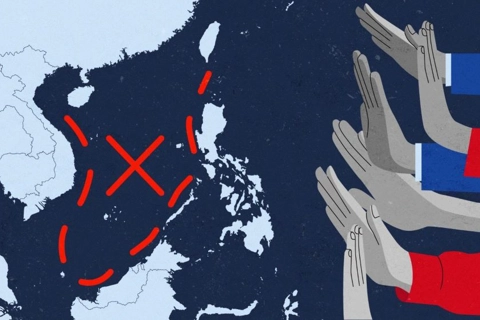
This study builds on Limits in the Seas No. 143 (2014), which analyzed China’s ambiguous “dashed-line” claim in the South China Sea. The document in 2014 concluded that China’s dashed-line claim was neither a valid national boundary nor a valid claim to historic rights in the South China Sea.
In 2016, having considered China’s dashed-line claim, an arbitral tribunal convened in accordance with the UNCLOS (Convention) reached a similar conclusion in The South China Sea Arbitration (The Philippines v. China). The arbitral tribunal issued a unanimous decision, which is final and binding on the Philippines and China, finding that:
“China’s claims to historic rights, or other sovereign rights or jurisdiction, with respect to the maritime areas of the South China Sea encompassed by the relevant part of the ‘nine-dash line’ are contrary to the Convention and without lawful effect to the extent that they exceed the geographic and substantive limits of China’s maritime entitlements under the Convention [and that] the Convention superseded any historic rights, or other sovereign rights or jurisdiction in excess of the limits imposed therein.”
Washington rejects China’s both geographic and historic claims, saying they are “unlawful”, gravely undermining the rule of law in the oceans and numerous universally-recognized provisions of international law reflected in UNCLOS.
For this reason, the United States and numerous other States have rejected these claims in favor of the rules-based international maritime order within the South China Sea and worldwide.