Vietnam draws int’l partners for Just Energy Transition
International partners stressed the importance of “just” aspects of the energy transition while advancing national energy transition agendas and goals with the support of finance and action plans.
Representatives from the International Partners Group (IPG), the Glasgow Financial Alliance for Net Zero (GFANZ), and development partners were brought together at a workshop to enhance cooperation, encourage knowledge transfer, and promote experience sharing in the just energy transition for Vietnam.
Notably, the workshop convened senior government representatives from the three countries with Just Energy Transition Partnerships (JETPs) – South Africa, Indonesia, and Vietnam – as well as representatives from another seven developing countries with a strong interest in the energy transition, to create a forum for them to learn from one another.
Held by Vietnam’s Ministry of Foreign Affairs, this high-level event seeks to strengthen international coordination, particularly emphasizing South-South collaboration in the just energy transition. Furthermore, it aims to promote mutual understanding of finance among diverse stakeholders, including donors, financing entities, the private sector, and governments.
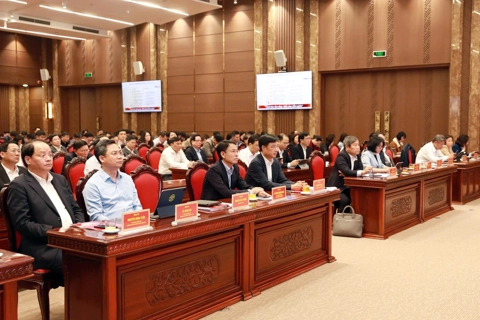
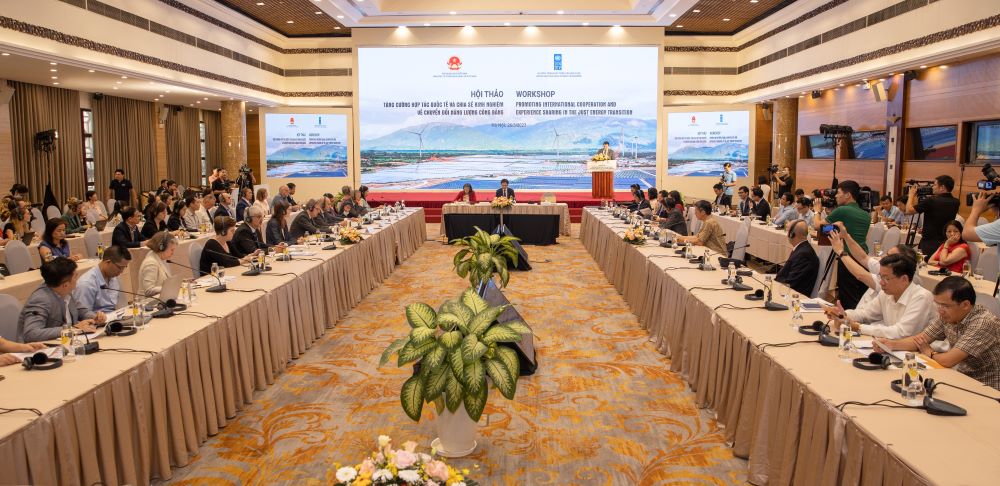
| The hybrid international workshop gathers more than 300 participants from Vietnam and abroad. Photos: UNDP Vietnam |
The need for “just” energy transition
In partnership with the United Nations Development Programme (UNDP), the workshop also emphasizes the importance of the “just” aspects of the energy transition, and ambitions to support energy transition efforts across nations while advancing national energy transition agendas and goals.
Addressing the imperative of limiting the global average temperature increase to 1.5°C above pre-industrial levels as the Paris Agreement mandates, the event emphasizes the need for innovative, equitable, and sustainable approaches to decarbonize economies and achieve climate and development objectives.
Notably, the concept of a just energy transition is recognized as a catalyst for achieving the Sustainable Development Goals (SDGs), fostering job creation, enhancing access to clean energy, and building resilience.
To realize the just energy transition, developing countries require multi-faceted international support in the form of finance, technology, knowledge, and capacity building to effectively decarbonize their economies and establish low-carbon development pathways.
Regarding governance, planning and investment for Just Energy Transition Partnerships (JETPs), representatives from South Africa and Indonesia shared challenges facing their countries and the importance of international support in making plans for energy strategies to pursue climate commitments and fulfill development goals.
In terms of public finance, Marcus Winsley, Deputy Head of Mission, British Embassy in Vietnam, gave an overview on the issue of just energy transition partnership. At the same time, Alice Carr, Executive Director for Public Policy, The Glasgow Financial Alliance for Net Zero (GFANZ), highlighted private finance.
Meanwhile, Jonas Kuehl, Energy program, International Institute for Sustainable Development (IISD), stressed considerations for a socially just and equitable energy Transition.
However, Simon Benmarraze, Renewable Energy Analyst, Project Navigator, the International Renewable Energy Agency (IRENA), emphasized the best available technologies (BAT), research and development (R&D) in the countries pursuing their climate commitments.
Jonathan Coppel, Head of Energy Investment Unit, International Energy Agency (IEA), addressed key findings of the World Energy Investment Report, 2023 for a broader view of the issues.
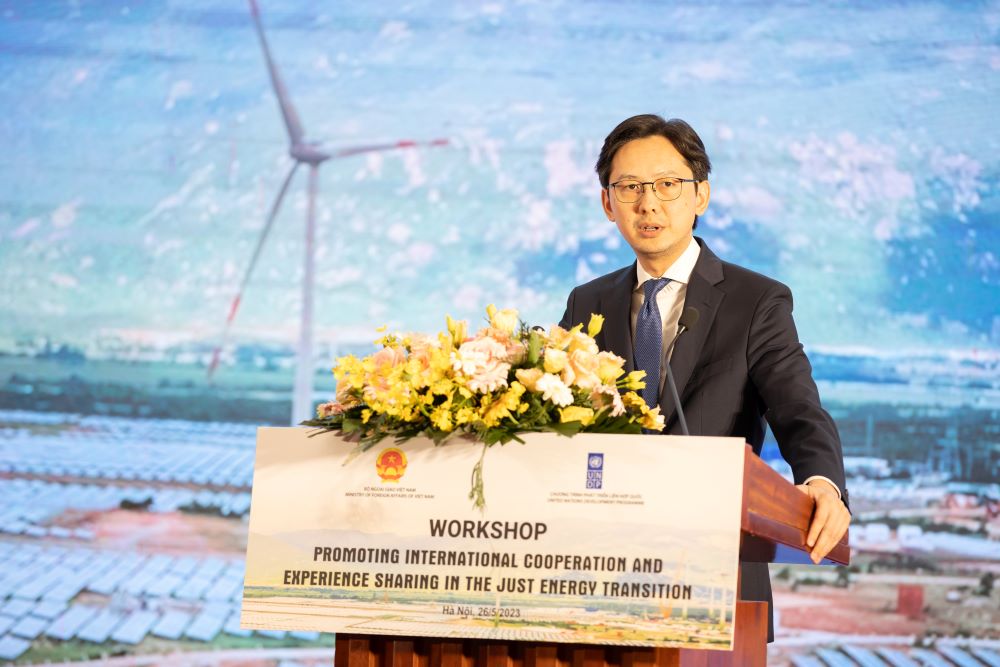
| Do Hung Viet, Vietnamese Deputy Minister of Foreign Affairs, speaks at the event. |
Vietnam’s situation and the need for international support
Sharing at the event, Do Hung Viet, Vietnamese Deputy Minister of Foreign Affairs, said Vietnam is one of the countries most affected by climate change, often hit by floods, droughts, sea level rise, and extreme weather events.
He affirmed that Vietnam’s central development policy has always been to consistently build a green, circular, and eco-friendly economy.
He pointed out that although just energy transition will bring many benefits, it will also pose many difficulties and challenges for developing countries, including Vietnam. These challenges include ensuring socio-economic development; ensuring the interests of the state, of our people and businesses; ensuring employment and incomes for workers suffering from job losses. These difficulties are also in terms of technology, capital, and capacity.
According to him, just energy transition and the implementation of JETP is new, requiring comprehensive transition in various sectors, fields, and levels. Therefore, it is extremely necessary to exchange and share experiences among countries, and to share knowledge of experts on issues related to energy.
“To ensure a successful transition, besides domestic efforts and resources, we really need multifaceted support from the international community,” said the diplomat.
| Ramla Khalidi, UNDP Resident Representative in Vietnam, addresses the event. |
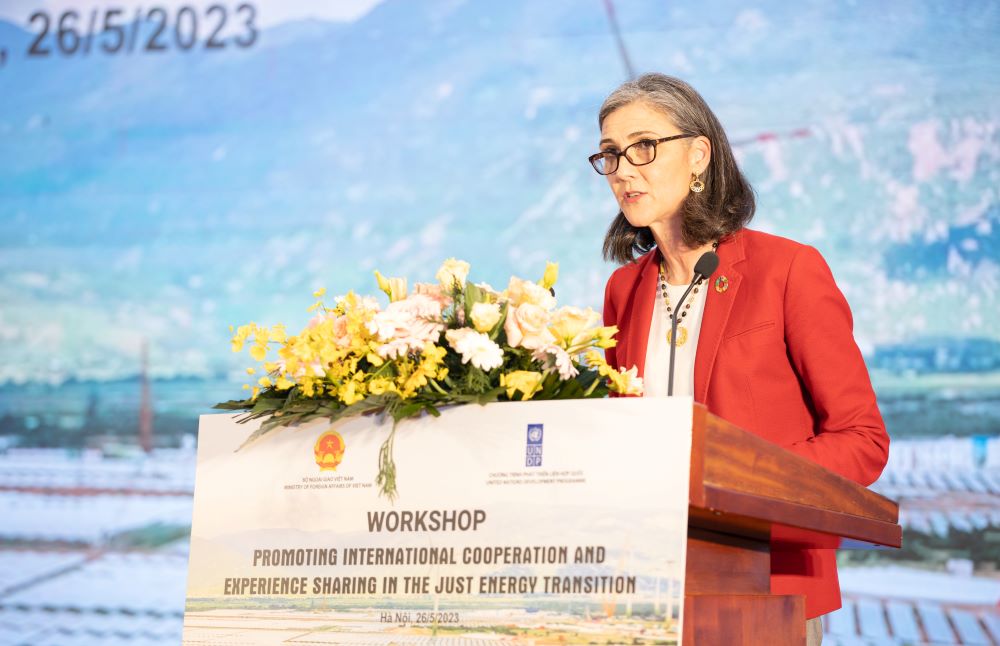
Ramla Khalidi, UNDP Resident Representative in Vietnam, believed that climate and innovative finance – both domestic and foreign, and both private and public - is of paramount importance in the energy transition.
For that reason, governments can create favorable conditions for private investment by putting in place forward-looking and transparent regulatory and pricing regimes, and through strategic public investments in essential infrastructure, she noted.
In this regard, the energy transition needs to be fair and equity-driven for developing countries to transition sustainably to low-carbon economies and establish climate-resilient trajectories, while realizing their sustainable development objectives.
“The energy transition must be just and inclusive for workers, local communities, and affected people through the creation of new economic opportunities, job creation, and reskilling, capacity-building, and enhancing social safety nets,” Ramla Khalidi emphasized.
On this occasion, the hybrid format of the workshop enabled over 300 participants from diverse sectors engaged in the energy transition; representatives from the Central Committee of the Communist Party of Vietnam, National Assembly, ministries, and 63 provinces of Vietnam; high-level government officials and Ambassadors of developing countries; private sector stakeholders; and development partners to participate both physically and virtually.
The workshop agenda included three sessions focusing on governance, planning and investment in the context of the implementation of JETPs, including the establishment of the JETP Secretariat in Indonesia, the development of the JETP Investment Plan in South Africa, and overall prioritization.
It also delved into finance, technology, and the “just” considerations and social aspects of the energy transition. In addition, it offered a platform for plenary discussions in which diverse views and perspectives from different stakeholders can be shared, presenting an opportunity for discussion on the way forward as we work to collectively realize an equitable and inclusive energy transition.