Vietnam holds advantages as investors look beyond China: Experts
Vietnam holds a number of advantages against other countries at a time when investors are looking to exit China, according to experts.
On May 3, the Japanese government said it would spend US$2.2 billion of the country’s economic stimulus package to help firms shift production out of China. Meanwhile, the Economic Times reported India has reached out to 1,000 US firms seeking relocation from China.
Chief Representative of the Japan External Trade Organization (JETRO) in Hanoi Takeo Nakajima told Hanoitimes the move would help firms to mitigate impacts from a disruption to the global value chains during the Covid-19 pandemic, which came as a direct result of a high concentration of the production bases.
For Japanese firms, the above-mentioned policy package would encourage them to strengthen their supply chain resilience, he said.
Nakajima referred to a survey conducted by JETRO last year highlighting that Vietnam was the second-highest country in the “business expansion” ranking among the Japanese respondents.
“They valued the country’s market size, friendliness to Japan, and the quality labor force,” Nakajima explained.
However, as Japan is now struggling for recovery from the pandemic, the JETRO head expected Japanese businesses to scale down their activities for a foreseeable future.
| Jason Yek, senior Country Risk Analyst at Fitch Solutions. |

Sharing the same view, Jason Yek, senior country risk analyst at Fitch Solutions, in an exchange with Hanoitimes said the hightening of the US – China trade war, which spanned 2018 and 2019, and China’s lockdowns during the first quarter of 2020, which severely disrupted supply chains in the region, have exposed the perils of being too exposed to one manufacturing hub.
“On this front, we believe that Vietnam will be an attractive alternative investment destination for lower value added manufacturing especially, as has already been demonstrated during the 2018-2019 period which saw an influx of companies into Vietnam from China to circumvent the US’ tariffs,” he said.
Yek went on saying compared to China, Vietnam currently has the advantages of lower labor costs and is not engaged in a trade war with the US.
In comparison with other Southeast Asian countries, in addition to low labor costs, Vietnam has a multitude of free trade agreements signed, which will facilitate trade globally, as well as a FDI-friendly business environment.
Meanwhile, compared to other low labor cost countries such as India, Vietnam benefits from having better socio-political stability and also policy stability, which includes tax rates, labor laws, and rules on investment, which are supportive of investor confidence.
Future not a bed of roses
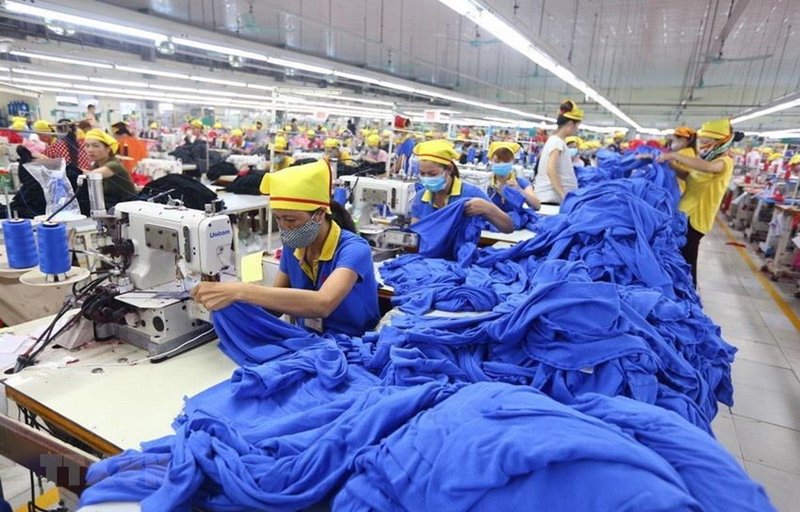
| Illustrative photo. |
While Vietnam has been highly effective in containing the Covid-19 pandemic, the country’s priority is now shifting to economic recovery, a process that Nakajima of JETRO Hanoi said ”requires different paths and tasks” than the Covid-19 fight.
According to Nakajima, the engines of the Vietnam economy are FDI, international trade, manufacturing, IT, tourism, and growing consumers.
“Most of them need a free flow of people, goods, and services across the borders. The domestic manufacturing activity remains healthy, but there are not many overseas markets active yet,” Nakajima said.
Vietnam cannot recover its economy alone, he asserted, adding 71% of the Japanese companies say that the negative effects by Covid-19 would linger on throughout 2020 according to the a survey in March 2020.
As a result, FDI into Vietnam could be slow as Korea, Japan, China, and other FDI source countries prolong their economic recovery.
Even when FDI is flowing, the question would be how much the country can absorb and turn the capital inflow into a growth contributor.
Yek of Fitch Solutions backed this point of view, saying the influx of FDI during the 2018-2019 period showed that while Vietnam was an attractive destination, the country’s logistical infrastructure was inadequate to handle the sudden influx of companies and this resulted in severe bottlenecks at the ports and traffic congestion.
A shortage of sufficiently skilled labor for the needs of foreign investors has also been a problem. “Thus, we believe that logistical and labor bottlenecks are challenges for Vietnam in terms of its attractiveness to FDI over the near term,” Yek said.
“Addressing the labor and logistical bottlenecks will be key to boosting business and investment in Vietnam. Other areas which can be improved include improving transparency of the judicial system and also the efficiency of commercial dispute resolution. A continued push in the government’s anti-corruption campaign will also augment Vietnam’s FDI attractiveness,” Yek recommended.