Vietnam, Japan sign four key cooperation agreements in PM visit
The leaders of Vietnam and Japan have pledged to strengthen their comprehensive strategic partnership.
THE HANOI TIMES — Vietnam and Japan signed four important cooperation documents on April 28, witnessed by Prime Minister Pham Minh Chinh and his Japanese counterpart Ishiba Shigeru.
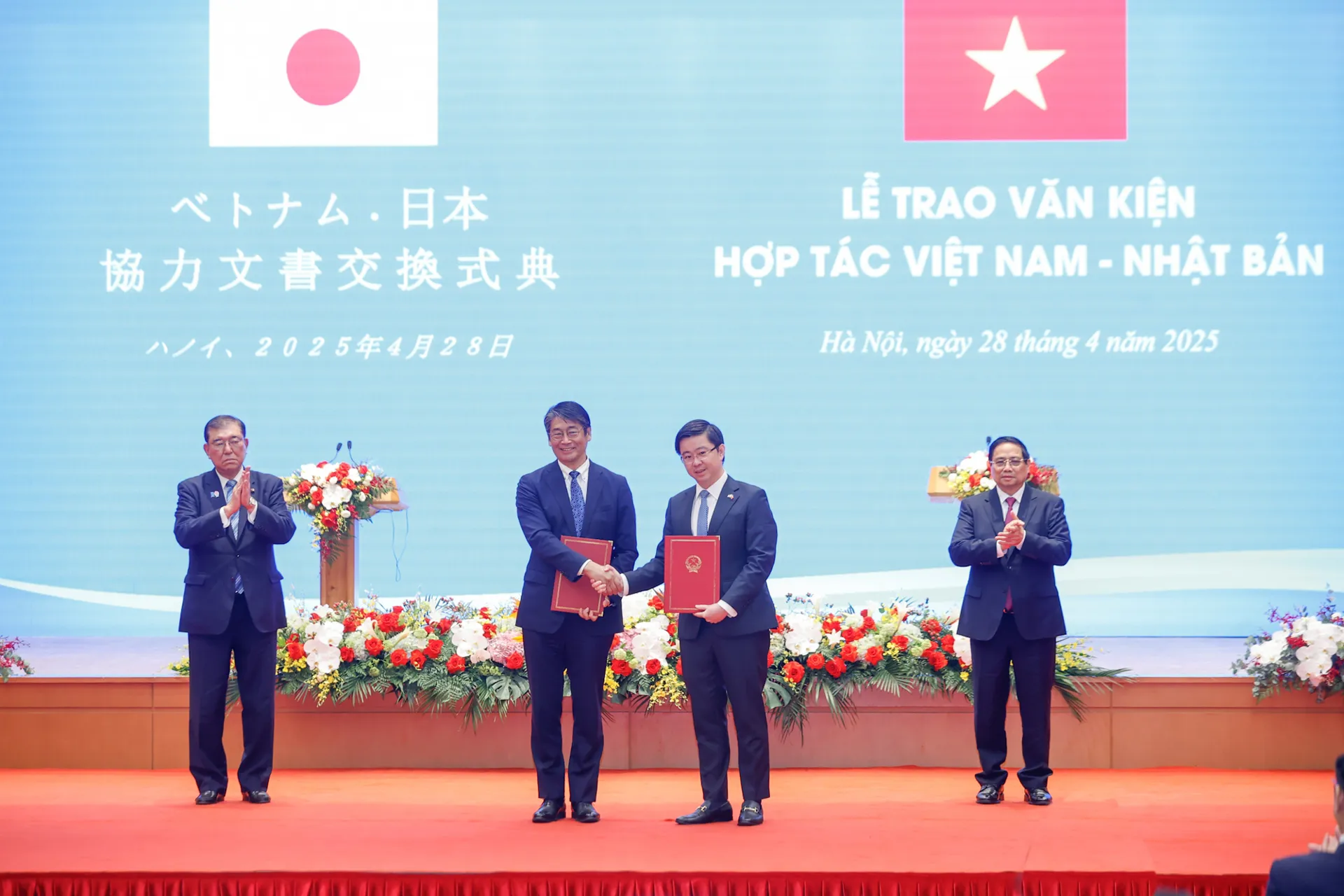
An agreement signed to strengthen the partnership between Vietnam and Japan in the semiconductor industry. Photo: VGP
The Ministry of Science and Technology of Vietnam and the Ministry of Education, Culture, Sports, Science and Technology of Japan agreed to cooperate in research and development in the semiconductor industry.
The Ministry of Education and Training of Vietnam and its Japanese counterpart decided to jointly develop human resources for the semiconductor sector. The ministry will also work with the Japanese Embassy to promote Japanese language education in Vietnamese high schools.
In another agreement, Vietnam's Ministry of Industry and Trade and Japan's Ministry of Economy, Trade and Industry pledged to boost bilateral cooperation projects in energy transition.
During their bilateral meeting, Prime Minister Pham Minh Chinh said that Japan is not only an important economic partner, but also a sincere and reliable friend of Vietnam. The recent upgrade of bilateral ties to a "Comprehensive Strategic Partnership" marks a milestone in the 50 years of diplomatic relations between the two countries.
"The two nations must unite more closely to address global challenges amid uncertainties," said Chinh.
"Vietnam pledges to support Japan's continued growth and its active role in maintaining peace, stability and development in Asia and the world," he added.
Prime Minister Chinh also expected to work with his Japanese counterpart Ishiba to outline major directions, specific measures and clear roadmaps to further develop bilateral relations for the benefit of both peoples.
For his part, Prime Minister Ishiba Shigeru said the upgraded partnership aims to contribute to peace and prosperity in Asia.
Both leaders agreed to maintain annual high-level exchanges and strengthen cooperation through all channels and at all levels to enhance political trust, which is the foundation of their bilateral relationship.
They also welcomed progress in maritime security cooperation and agreed to enhance Vietnam's maritime safety and security capabilities.
Recognizing the importance of improving the investment environment, both sides stressed the need to strengthen administrative reforms in Vietnam's new development era for enhanced economic ties.
They also agreed to explore cooperation in areas such as semiconductors, artificial intelligence, quantum science, energy, strategic infrastructure, disaster prevention, human resource development, and supply chain security.
The two leaders praised the successful bilateral projects, such as the inauguration of the Ho Chi Minh City Metro Line No. 1, a symbol of Vietnam-Japan economic cooperation, and the inauguration of the expanded Binh Hung Wastewater Treatment Plant in Ho Chi Minh City and the Yen Xa Wastewater Treatment Plant in Hanoi.
They vowed to resolve challenges in ongoing ODA and FDI projects and lay a solid foundation for new cooperation initiatives. Efforts will also be made to mobilize private capital, apply advanced technologies and diversify sources of Japan's ODA funding.
In line with Vietnam's goal to train 50,000 semiconductor experts by 2030, the two leaders agreed to strengthen cooperation between universities, technical colleges and research institutes of the two countries, including the Vietnam-Japan University.
In the field of healthcare, the two countries will advance cooperation in combating infectious diseases, cancer and non-communicable diseases, as well as in improving healthcare for the elderly and addressing population aging.
Regarding people-to-people exchanges and local cooperation, Prime Ministers Chinh and Ishiba noted the growing Vietnamese community in Japan, which reached over 600,000 people in 2024, mainly consisting of technical trainees and workers. Meanwhile, the number of travelers between the two countries has reached 620,000.
Both sides vowed to facilitate travel for citizens to promote tourism and exchanges, with a target of two million visits annually.
The two leaders reaffirmed the commitments outlined in the Joint Statement on Upgrading Vietnam-Japan Relations to a Comprehensive Strategic Partnership for Peace and Prosperity in Asia and the World, issued in November 2023.
They also pledged to strengthen cooperation on regional and international issues, including within ASEAN and in multilateral forums.
Vietnam and Japan are committed to promoting a free and open international order based on the rule of law and multilateral free trade, and actively contributing to peace, stability and sustainable development in the region and the world, the two leaders said.
Both leaders expressed satisfaction with the strong and substantial growth of the Vietnam-Japan partnership since its upgrading, and pledged to deepen their relations as they enter a new era of development.
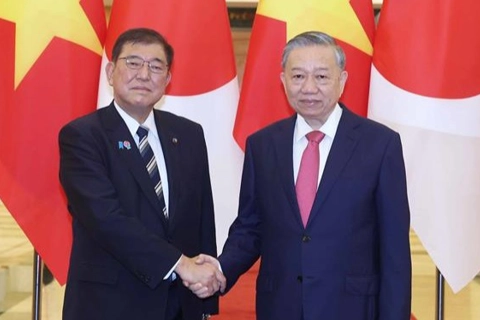
Later on April 28, Japanese Prime Minister Ishiba Shigeru met with the Chairman of the National Assembly Tran Thanh Man. On April 27, he met with General Secretary of the Communist Party of Vietnam To Lam.
The meetings mark Prime Minister Ishiba Shigeru's first visit to Vietnam since taking office, and the first visit by a Japanese prime minister after bilateral relations are elevated to a Comprehensive Strategic Partnership in late 2023.