Vietnam power system tops Southeast Asia
The energy structure is shifting in a positive direction toward green and sustainable development.
THE HANOI TIMES — Vietnam’s energy sector has recorded strong growth and now leads Southeast Asia in terms of power system scale.

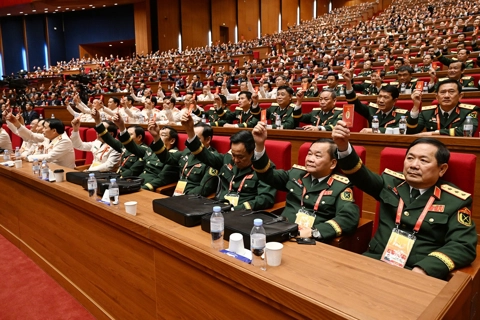
Acting Minister of Industry and Trade Le Manh Hung during the 14th National Party Congress. Photo: MoIT
Acting Minister of Industry and Trade Le Manh Hung made this statement in his policy speech on industrial and trade development at the 14th National Party Congress on January 21.
He said the industry and trade sector plays a strategic pillar role and is one of the main drivers of socio-economic development.
Over the past term, industrial production recovered strongly and posted solid growth, averaging 6.1% per year, while the energy sector expanded rapidly and rose to the top position in Southeast Asia in terms of power system scale.
“National energy security has been ensured and has basically met the requirements of socio-economic development, with the energy structure is shifting in a positive direction toward green and sustainable development.
By the end of 2025, the total installed capacity of the national power system, excluding imported electricity, reached about 87,600 MW, up around 6,400 MW from 2024. The adjusted National Power Development Plan for 2021-2030 with a vision to 2050 (PDP8), targets a sufficient power supply to support average GDP growth of 10% per year in 2026-2030 and about 7.5% in 2031-2050.
Under the plan, total domestic power generation capacity, excluding exports, is projected at 183,291-236,363 MW.
Total investment demand for power generation and transmission development is estimated at about $136.3 billion in 2026-2030 and an additional US$130 billion in 2031-2035. From 2036 to 2050, Vietnam is expected to require a further $569.1 billion for this sector.
Alongside energy, the acting minister said the processing and manufacturing sector recorded average growth of 6.9% per year, providing strong momentum for industrialization and modernization. The localization rate improved and several key industries strengthened their position in global value chains.
Exports and imports remained a bright spot, with average annual growth of 10.9%. The trade surplus was maintained at a high level, helping build foreign exchange reserves and stabilize the macro-economy.
In 2025, Vietnam’s export turnover exceeded $475 billion, up more than 17% from the previous year, equivalent to an increase of over $69 billion. This achievement is particularly notable amid slow global economic growth and mounting difficulties in trade across major markets.
The Ministry of Industry and Trade forecasts that exports will continue to rise by around 8% to $513 billion in 2026. At the same time, the trade balance is expected to remain in surplus at more than $23 billion, up 15% from 2025.
The domestic market developed positively with an average growth of 7.7% per year, serving as a key buffer that helped the economy remain resilient and recover quickly from external shocks.

The 220kV Kien Binh - Phu Quoc transmission line crosses the sea to reach the remote island, the longest 220kV submarine power line in Southeast Asia. Photo: EVNSPC
E-commerce expanded rapidly, growing at more than 20% per year and leading enterprise digital transformation. International economic integration advanced through 17 free trade agreements covering nearly six billion consumers.
Despite these achievements, the industry and trade sector still faces several limitations. Technological self-reliance and value added remain low while the green and smart transition has been slow.
Energy infrastructure has not kept pace and the power mix remains imbalanced. Exports rely heavily on imports and the FDI sector, while trade and logistics infrastructure is not yet synchronized and costs remain high.
In the coming period, Vietnam will enter a new era driven by science and technology, innovation, green transition, digital transformation and deeper international integration.
"To accelerate industrial and trade development, the Ministry of Industry and Trade will focus on improving institutions and policies, creating a more favorable business environment, removing bottlenecks and mobilizing resources for development," said Hung.
The sector aims to restructure industry and trade in close linkage with science and technology and innovation to raise productivity, quality and competitiveness.
Priority will be given to mastering emerging industries and building several large domestic enterprises capable of leading key sectors. Energy, industrial and trade infrastructure and logistics centers will be developed in an integrated, green and smart manner.
“The industry and trade sector commits to shifting from a management mindset to a facilitation mindset, standing alongside businesses and turning challenges into opportunities for breakthrough,” the acting minister stated.