Vietnam SOEs set for billion-dollar growth with 25 firms topping $1 billion
The country targets to have around 30 state-owned enterprises making annual net revenues of more than $1 billion each.
THE HANOI TIMES — Vietnam aims to raise its per capita GDP to around US$8,500 by 2030, nearly double the estimated US$4,700 in 2024.
The target is part of a series of economic development goals outlined in the Ministry of Finance’s political report presented at its first Party Congress for the 2025-2030 term, held on August 21.

Deputy Prime Minister Nguyen Chi Dung speaks at the Ministry of Finance's first Party Congress for the 2025-2030 term. Photo: The Vietnam Financial Times
Alongside raising incomes, the ministry has ambitious plans for enterprise growth.
By 2030, Vietnam is expected to have two million active businesses, or about 20 firms for every 1,000 citizens. At least 20 large enterprises will integrate into global value chains, while state-owned enterprises (SOEs) will play a stronger role, with at least 25 each reaching equity or market capitalization above $1 billion, including 10 each surpassing $5 billion.
Currently, Vietnam has 76 SOEs listed in Fortune Southeast Asia 500, with Vietnam National Industry - Energy Group (PVN) ranked in the top 20.
The private sector is set to remain a growth engine, maintaining an average annual expansion of 10%-12%.

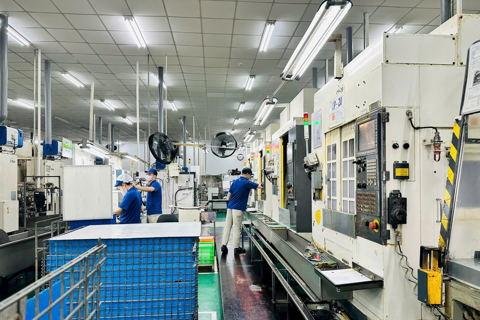
Kalotec Vietnam Co., Ltd's production line at Hanoi's Quang Minh Industrial Park. Photo: Pham Hung/The Hanoi Times
Meanwhile, foreign direct investment (FDI) inflows between 2026 and 2030 are forecast to reach $200-$300 billion in registered capital, with disbursements of $150-$200 billion.
The localization rate of production is expected to exceed 40% by the end of the decade.
Fiscal performance in recent years has supported these targets. During 2021-2025, total budget revenue is estimated at VND9.4 quadrillion ($358.2 billion), exceeding planned targets.
The budget mobilization ratio stood at 18.3% of GDP, while public debt fell from 62.7% of GDP in 2021 to around 36%-37% by 2025.
Faster disbursement has helped accelerate infrastructure development, creating new growth momentum.
In addition, the ministry has strengthened legal and administrative reforms, with 734 procedures moved online, including the “One-Stop Service”, lowering costs for citizens and businesses.
Recognized as a leader in e-government and digital government, the ministry has digitized services in taxation, customs, and treasury, while operating a transparent budget portal that enhances public financial accountability.