Vietnamese economy to remain resilient in 2025-2026: ADB
Despite global uncertainties, economic and administrative reform will bolster Vietnam's economic growth in 2025 and 2026.
THE HANOI TIMES — Vietnam’s economy would remain resilient in 2025 and 2026 thanks to strong growth in exports and imports, as well as a sharp increase in disbursed foreign investment, which boosted the economy in the first half of 2025.
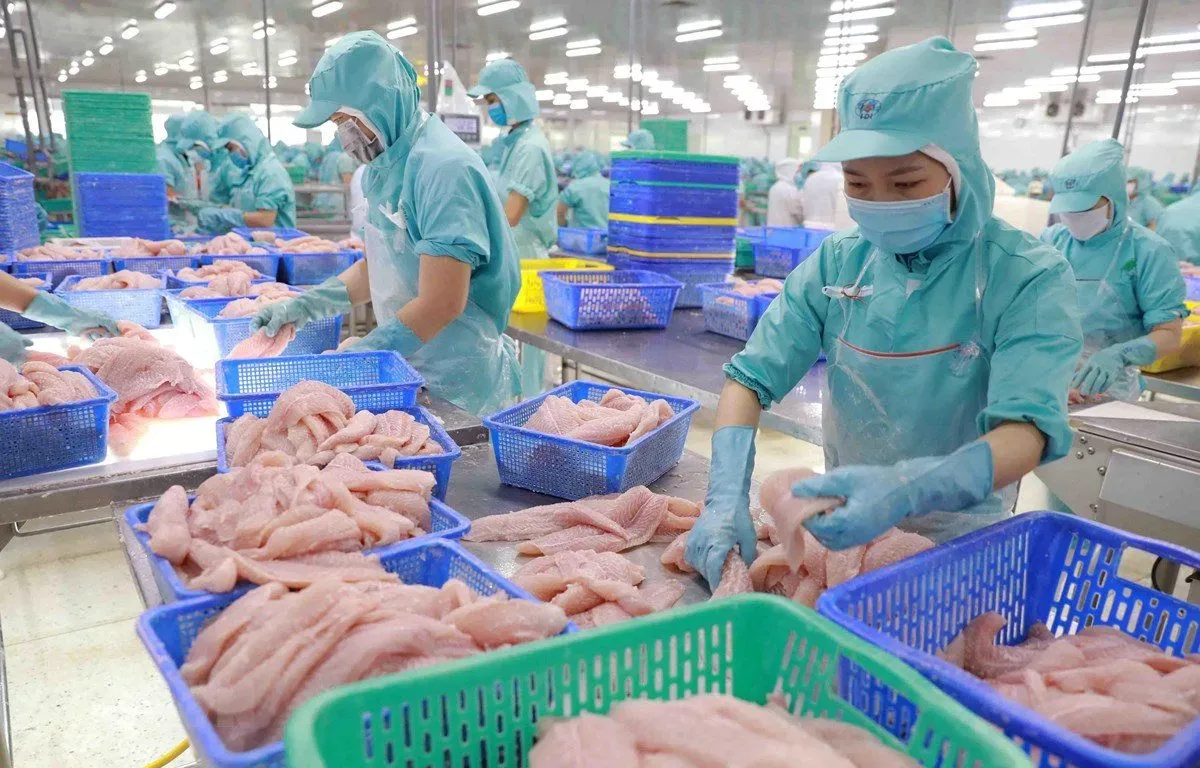
Seafoods being processed for export. Photo: Tuan Phong/The Hanoi Times
The projection was given in the Asian Development Bank (ADB)’s report released on July 23.
The report shows that foreign direct investment (FDI) commitments rose 32.6% year-on-year in the first six months of the year, while FDI disbursements increased 8.1%.
Public investment fund disbursement also reached its highest level since 2018, up 19.8% year-on-year, accounting for 31.7% of the annual plan.
The ADB said these figures reflect growing international confidence in Vietnam’s economic outlook.
It noted that Vietnam’s efforts to boost exports amid global tariff uncertainties have supported stronger trade performance.
The ADB noted that Vietnam’s efforts to boost exports amid global tariff uncertainties have supported stronger trade performance.
However, the bank warned of potential risks arising from global trade uncertainty and the possibility of higher US import tariffs, which could have negative impacts on Vietnam’s exports and investment flows.
Despite these growing risks, timely and effective implementation of domestic reforms could help Vietnam mitigate external challenges by reinforcing internal economic drivers.
For said reasons, the bank lowered its gross domestic product (GDP) growth forecast for Vietnam to 6.3% in 2025 and 6.0% in 2026. Inflation is projected to ease to 3.9% in 2025 and 3.8% in 2026.
The ADB also downgraded its growth forecast for developing economies in the Asia-Pacific region to 4.7% in 2025 and 4.6% in 2026.
This downward revision is largely due to weaker exports amid higher US tariffs, global trade uncertainty, and softening domestic demand across the region.