Vietnam targets Red River Delta as key driver of growth
Vietnam’s strategy seeks to transform the Red River Delta into a national economic powerhouse, complementing the Southeast in driving growth through innovation, resilience and sustainable progress.
THE HANOI TIMES — With Hanoi at its heart, the Red River Delta holds a uniquely strategic position for Vietnam in politics, economy, culture, society, defense and security.
The region of six cities and provinces is one of the country’s two most dynamic economic areas, a key growth engine and a decisive force for national development.
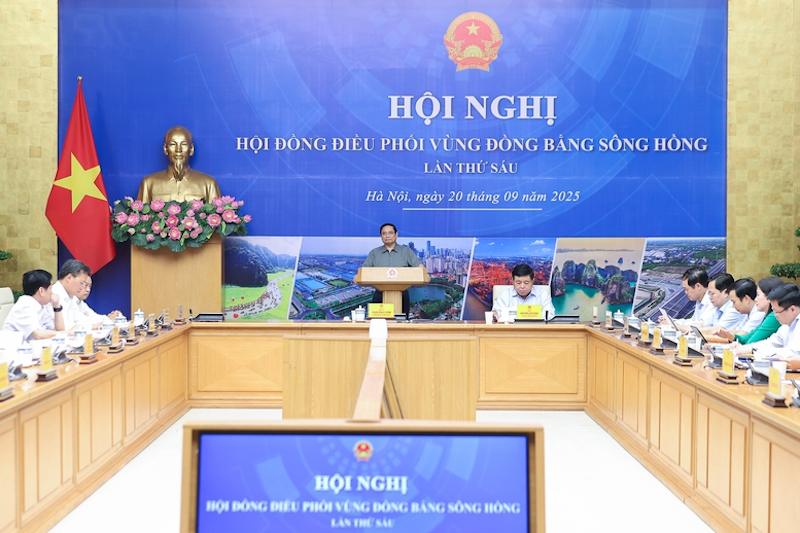
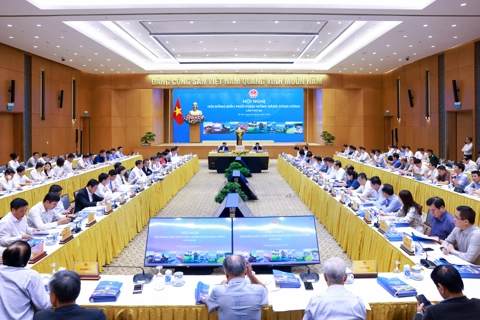
An overview of the sixth meeting of the government's Red River Delta Coordinating Council on September 20. Photos: VGP
Since the two-tier local government model was introduced in early July 2025, six major economic hubs in the Red River Delta now are Hanoi, Haiphong, Quang Ninh, Hung Yen, Bac Ninh and Ninh Binh.
Reports presented by the six municipal and provincial governments at the sixth meeting of the Red River Delta Coordinating Council on September 20 showed the region has achieved solid results despite global and domestic challenges.
In the first half of the year, the Red River Delta’s Gross Regional Domestic Product (GRDP) grew 9.32%, higher than the national average of 7.52% and the fastest among Vietnam’s six economic regions.
Several provinces and cities posted double-digit growth, including Haiphong (11.2%), Quang Ninh (11%), Bac Ninh (10.5%) and Ninh Binh (10.8%).
The Red River Delta has maintained its lead nationwide in key indicators.
In the first eight months of 2025, the region attracted US$5.4 billion in foreign direct investment (FDI), nearly half of the national total, with Bac Ninh topping the country in new inflows.
State budget revenue reached nearly VND815 trillion (US$31 billion), or 47% of the national total. Hanoi led with VND473.4 trillion (US$18 billion).
Export turnover in January–August hit US$129.3 billion, or 32.5% of Vietnam’s total, with Bac Ninh, Haiphong, Hanoi and Quang Ninh all recording strong growth.
Public investment disbursement also outpaced the national average, with the region reaching 53.6% of planned capital, led by Ninh Binh (90.5%) and Bac Ninh (64.6%).
The services sector showed clear recovery, especially tourism, with Hanoi’s travel revenue up 21% and Quang Ninh’s up 17% year-on-year.
The Red River Delta has remained Vietnam’s second-most dynamic hub for business development after the Southeast.
Nearly 42,800 new enterprises were established between January and August, one-third of the national total, with registered capital exceeding VND512.6 trillion (US$19.4 billion).
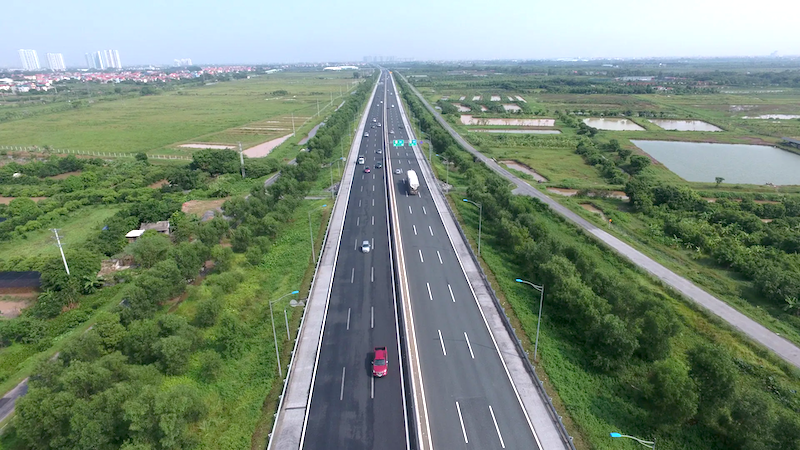
Hanoi-Haiphong Highway. Photo: Cong Hung/The Hanoi Times
At the government’s meeting, Prime Minister Pham Minh Chinh reaffirmed Vietnam’s determination to build the Red River Delta into a major growth engine that drives development across the country.
He urged the region to take bold steps in sustainable growth, economic restructuring and governance under the new two-tier local government model.
According to the prime minister, the region’s growth model still falls short of its potential. Value chains and industry clusters remain underdeveloped, coordination needs improvement and progress on key projects is slower than expected.
One priority task is to revise regulations governing regional councils with innovative approaches, Chinh said.
He stressed the need to review institutional bottlenecks in land, resources, bidding, investment and infrastructure. Local governments must compile reports to the National Assembly.
Infrastructure development in transport, telecommunications, energy, education, culture and healthcare should be advanced to benefit all six provinces and cities through stronger linkages, he added.
On natural resources, especially construction materials for major projects, Chinh said they remain state-owned assets, and management and allocation must be handled by the State to prevent hoarding and price manipulation.
“Socio-economic development plans must be improved across national, regional, sectoral and local levels, with more decentralization and simpler procedures,” the prime minister said.
“It is essential to mobilize greater resources by raising revenue, cutting unnecessary spending, expanding public-private partnerships and speeding up land clearance for key projects.”
He also highlighted the need to boost science, technology, innovation and digital transformation, while addressing long-delayed projects and procedural obstacles.
“Environmental protection, social welfare, and the development of cultural and creative industries should advance alongside efforts to expand affordable housing, particularly social housing,” PM Chinh added.
He also emphasized strengthening regional and interregional cooperation, including cross-border economic zones, and advancing smart governance, artificial intelligence and human resource development.