Red River Delta Master Plan 2021-2030 approved
A pivotal objective of the master plan is to strengthen Hanoi's position as the leading economic hub of the northern region and the entire nation and to foster international competitiveness.
Prime Minister Pham Minh Chinh has approved the plan for the Red River Delta region for 2021-2030, with a vision for 2050.
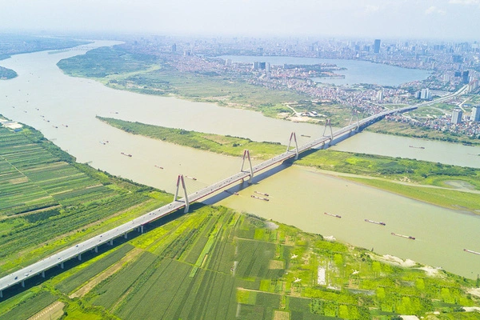
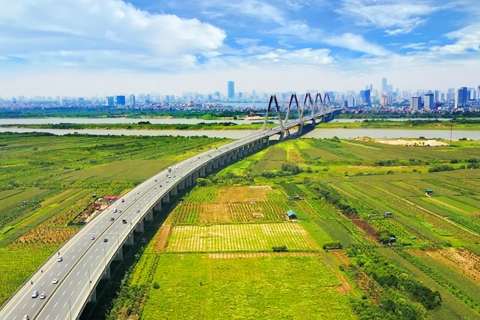
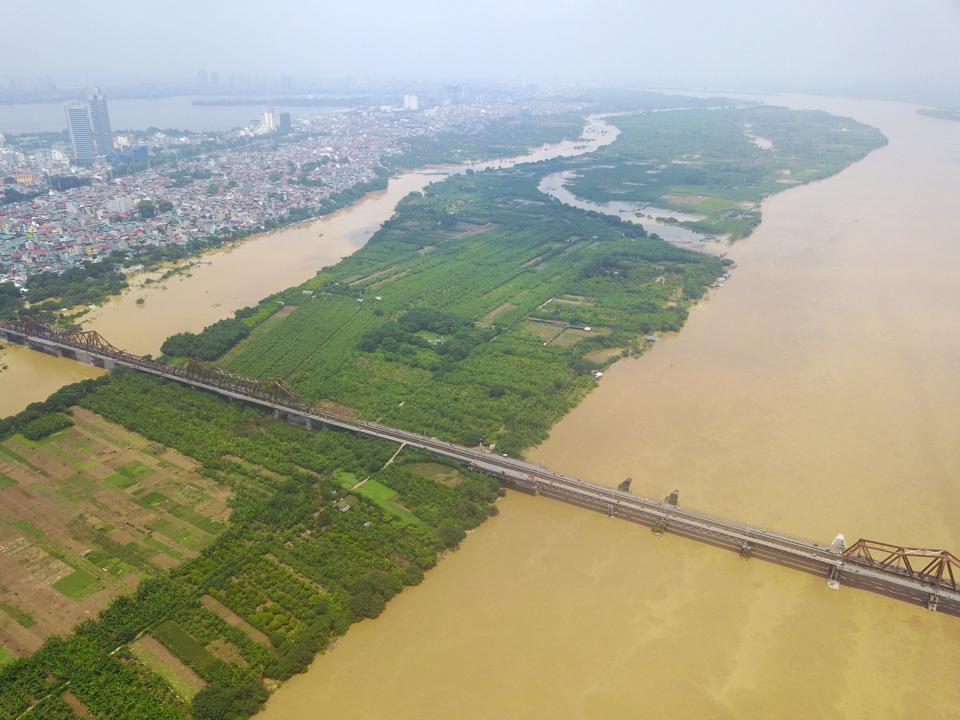
| Red River Delta from above. Photo: Hai Linh/The Hanoi Times |
The plan divides the region's economic and social activities into two sub-regions: the North of the Red River and the South of the Red River. There will also be a national dynamic region, four growth poles, and five economic corridors.
The North of the Red River sub-region will consist of seven provinces and cities: Hanoi, Haiphong, Quang Ninh, Hai Duong, Hung Yen, Bac Ninh, and Vinh Phuc.
For the sub-region of the Northern Red River, the focus will be on developing high-tech industries, high-value-added processing, and manufacturing industries, especially in electronics, semiconductor chips, digital technology products, artificial intelligence, and robotics.
In addition, the master plan stresses the importance of developing services, commerce, finance and banking, transportation and logistics, and international tourism; ensuring the region’s leading position in education and training, science-technology and innovation, culture and sports, healthcare, and public health.
As part of the development process, it remains important to promote a close link between economic development and environmental protection, social security and order, and to consolidate national defense, it noted.
The southern sub-region, comprising the provinces of Thai Binh, Nam Dinh, Ha Nam, and Ninh Binh, will prioritize the development of coastal economic zones and industrial areas to facilitate robust economic restructuring. These efforts include advancing high-tech and organic agriculture, promoting a circular economy, bolstering agro-processing and support industries, and fostering renewable and clean energy initiatives. Additionally, there will be a focus on nurturing eco-tourism, resort tourism, cultural tourism, and spiritual tourism while safeguarding coastal and aquatic ecosystems and enhancing forest ecosystems along the coastline.
In terms of development orientation, the dynamic region encompasses Hanoi and district-level areas along National Highway 5 and National Highway 18, spanning the provinces of Bac Ninh, Hung Yen, Hai Duong, Haiphong, and Quang Ninh. Hanoi stands out as the central growth pole within this region.
Efforts are concentrated on cultivating modern, high-quality service sectors such as commerce, logistics, finance, banking, tourism, telecommunications, and specialized healthcare. There's a strategic focus on attracting investment in manufacturing, electronics, information technology, artificial intelligence, and automotive sectors, as well as ancillary industries. Other initiatives aim to expand high-tech and clean agriculture, establish innovation and creativity centers, and lead in digital transformation, science, technology, and the digital economy at large.
A pivotal objective of the master plan is to strengthen Hanoi's position as the leading economic hub of the Northern region and the entire nation, fostering international competitiveness. At the same time, the plan envisages the transformation of the Haiphong - Quang Ninh region into a modern maritime economic center, serving as a gateway to international trade via Lach Huyen port. This transformation includes the development of maritime transportation, port services, island tourism, marine science and technology, and emerging marine economic sectors. Additionally, the plan aims to create development axes along the Red River, integrating economic, commercial, and cultural tourism activities with the distinctive landscape axis of Hanoi and urban areas on both sides of the Red River.
The planning of the Red River Delta region includes four growth poles. Among them, Hanoi leads the development process of the region and the country; Haiphong takes the lead in developing industry and port services; Quang Ninh province is the locomotive driving the development of the region with service sectors, tourism, and industry; Bac Ninh province is the node on the industrial corridor of National Highway 18.
Five economic corridors are planned, including the North-South economic corridor within the region (Bac Ninh - Hanoi - Ha Nam - Ninh Binh), the Lao Cai - Hanoi - Haiphong - Quang Ninh economic corridor, the Hanoi - Thai Nguyen - Bac Kan - Cao Bang economic corridor, the Quang Ninh - Haiphong - Thai Binh - Nam Dinh - Ninh Binh coastal economic corridor, and the Dien Bien - Son La - Hoa Binh - Hanoi economic corridor.
The Red River Delta region's planning objectives for 2030 are as follows:
|