Vietnam to enhance national defense and security education in schools
Students can read and listen to traditional stories, and participate in contests designed to teach about national defense and security.
Vietnam's Ministry of Education and Training (MoET) has issued a circular to strengthen national defense and security education for students from primary to high school.
Accordingly, national defense and security education will be integrated into subjects and textbooks selected by each school to suit the cognitive abilities of students in each locality. The subjects include literature, civic education, history, geography, arts (music and fine arts), experiential activities, and career guidance activities.
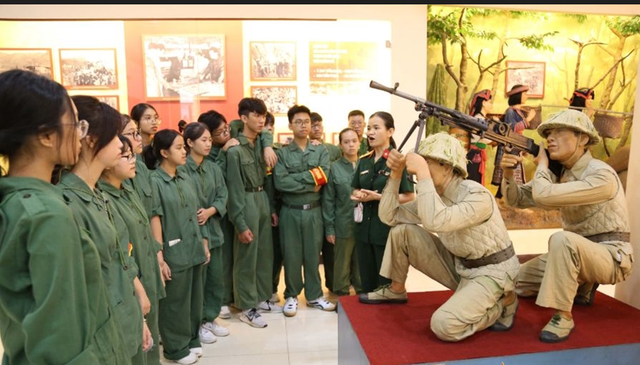
Students in Hanoi visit historical sites, museums, traditional houses, and armed forces. Photo: VGP |
The purpose of the subject for grades 6-9 is to teach the solidarity and patriotism of the Vietnamese people in building and defending the country throughout history; safeguarding the sovereignty of the sea and islands; protecting the sovereignty, territory, and national borders; the rights and duties of citizens for the cause of building and defending the motherland.
The content of national defense and security should be inspiring, concise, easy to understand, and suitable for students' psychological, physiological, age, and cognitive characteristics. Information technology should be used in the integrated content.
Visits to historical relics, museums, traditional houses, and armed forces are also part of the content. In addition, students can read and listen to traditional stories, and learn about national defense and security through competitions.
Students are required to understand the nation's tradition of fighting foreign invaders through the historical periods of building and defending the country; the traditions of the Vietnam People's Army, Vietnam People's Police, and Militia.
Teaching about national defense and security must be aimed at making students aware of their responsibility for the task of protecting the motherland and maintaining security, order, and social safety. They will have a sense of discipline and solidarity, and voluntarily comply with the provisions of Vietnamese law.
Previously, national defense and security has been a subject in Vietnamese high schools, vocational schools, and higher education institutions since 2014.
The Law on National Defense and Security, which was passed by the National Assembly in June 2013 and came into force on January 1, 2014, stipulates that these two areas will be officially taught to students enrolled in schools and institutions.
This means that your National Defense and Security scores will be valid for evaluating student performance at the end of the academic year.
However, there are still shortcomings in the education of students on national defense and security in terms of building up a contingent of teachers, organizing teaching, and providing materials and training grounds. In particular, some students do not fully grasp the true significance of this subject and consider it merely a requirement for promotion to the next grade or graduation.