Vietnam to raise wage for civil servants by 7.3% in 2020
The base wage is the reference for calculating salaries of employees in the state-run sector by multiplying with their corresponding coefficient.
The Vietnamese National Assembly (NA) on November 12 approved a government proposal to raise wages for civil servants by 7.3% from July 1, 2020, local media reported.
Accordingly, the monthly base wages of civil servants and public employees will be hiked from VND1.49 million (US$64) per month to VND1.6 million (US$69) per month. This will be the boldest wage hike in the past eight years. The previous wage raise was a 7.2% hike, effective from July 1, 2019.
| Source: luatvietnam.vn |
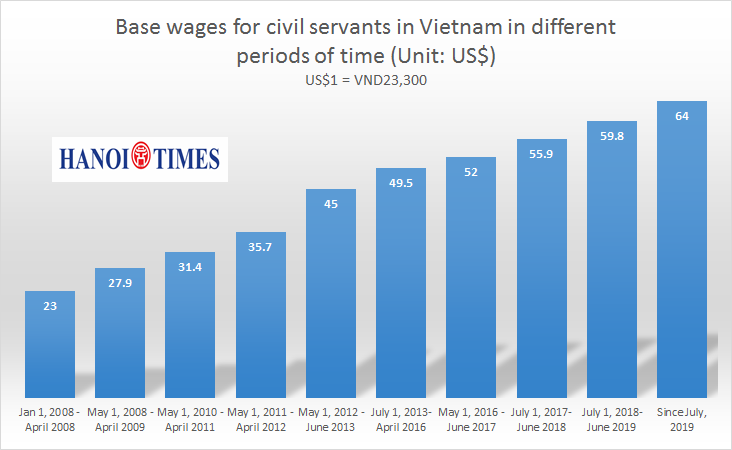
The base wage is the reference for calculating salaries of employees in the state-run sector by multiplying with their corresponding coefficient.
Besides, the Vietnamese government will adjust pensions, social insurance allowances, prescribed monthly allowances and preferential allowances for people with meritorious services in accordance with the base wage increase.
Earlier, on October 21, the Vietnamese government proposed that monthly base wages for civil servants be increased by some 7% in 2020.The proposal was mentioned by Minister of Finance Dinh Tien Dung while reporting to the NA on national budget implementation in 2019 and planning for 2020.
However, Nguyen Duc Hai, chairman of the NA's Committee on Finance and Budget, drew attention to a counterproposal that a raise be reconsidered because it could "shift budget spending into consumption than investment in development."
"Vietnam will have to use 50% of revenue increase compared to local budget estimates and 40% increase in State budget revenue for salary reform", Hai told VnExpress.
Public sector employees have complained for years that their earnings are too low. The starting coefficient for a university graduate in the public sector is 2.34.
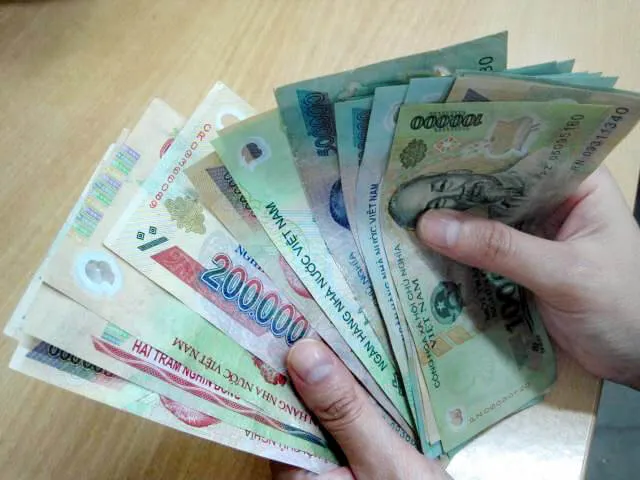
| Illustrative photo |
Data from the General Statistics Office shows that at the end of 2017, there were more than 5.2 million people working in the public sector.
The size of Vietnam’s public sector compared to the population is among the biggest in Southeast Asia, according to the World Bank.
Currently, Vietnam’s minimum monthly wage is divided into four different levels, depending on location - VND4.18 million (US$179) for region 1, VND3.71 million (US$159) for region 2, VND3.25 million (US$139) for region 3, and VND2.92 million (US$125) for region 4.
The four different minimum wage regions reflect the cost of living in each area. Region 1, including largest cities like Hanoi and Ho Chi Minh City, has the highest minimum wage, while region 4 (rural areas) has the lowest.
Businesses will calculate their workers' salaries by multiplying the minimum wage rates with a coefficient determined by qualification and experiences.
Some representatives of businesses told VnExpress that the minimum wage increase will affect business results of companies, especially small and medium ones.
According to a survey released by employment website Jobstreet.com late last year, salaries in Vietnam are rising faster than in any other Southeast Asian country. The average annual growth rate of Vietnam's payroll stands at 20-24%, compared to 14-20% in Thailand, the Philippines, Indonesia, Myanmar and Singapore.
However, despite the rapid growth, wages in Vietnam are still low. Vietnam raises minimum wage every year. The increase in 2019 was 5.3%, but only meets 95% of laborers’ living costs. Vietnam's per capita income in 2018 was US$2,587.