Without Tao Quan, Lunar New Year's Eve doesn't feel the same again
On the last night of the lunar year, Tao Quan is normally the most anticipated TV show for a majority of the Vietnamese. What if the show stops being broadcast? Does the night feel the same again? Let's find out in today's Words on the Street article on The Hanoi Times.
THE HANOI TIMES — For many families in Hanoi, the possible absence of the Tao Quan television show means more than losing a familiar comedy, as it signals the disappearance of a quiet pause that has long marked the final night of the Lunar New Year.
In Vietnamese and broader East Asian belief, Tao Quan (Kitchen Gods) oversee household affairs and record each family’s good and bad deeds to report to heaven on the 23rd day of the 12th lunar month each year. This belief inspired the Tao Quan television show.

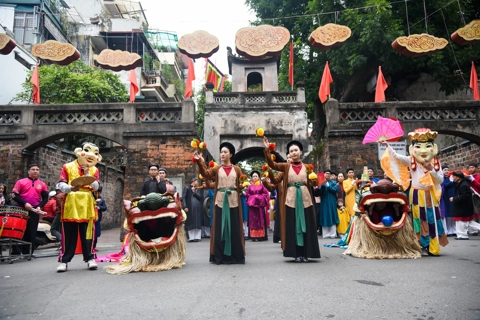
An AI-generated photo shows the artists performing in a Tao Quan show.
Tao Quan takes the form of political satire presented through comedy. Performers bring the country’s most pressing issues from the past year onto the stage, turning current affairs into humor. Beyond laughter, the show offers reflection and insight into social, economic, cultural and educational changes over the previous 365 days.
From 2003 to 2025, Tao Quan shaped the rhythm of Lunar New Year’s Eve for many Vietnamese families. Broadcast on New Year’s Eve night, the show became a moment when family members gathered together, sharing laughter at the threshold between the old year and the new one.
The show plays as conversations unfold. People talk, comment, disagree and laugh together. At times, Tao Quan becomes the center of attention. At other moments, it fades into the background while hands remain busy with last-minute preparations.
That short stretch of Tao Quan has always felt intentional. It creates a moment when the evening seems to exhale before time accelerates toward midnight. Without it, the night feels as though it misses a beat.
Every culture has seasonal viewing rituals. Christmas has films such as Home Alone, while Halloween brings its own set of iconic horror movies. In Vietnam, Tao Quan plays a similar role, anchoring memory to a specific moment each year.
Tao Quan never functions as simple entertainment. The show creates a shared space where people can look back on the year together, even when opinions differ. It gives shape to conversations that might otherwise never take place.
The jokes aim for recognition rather than surprise. A nod of agreement. A pause that suggests shared understanding. In many households, that moment of recognition matters more than the punchline itself.
That feeling grew stronger during the years I spent Tet away from home. During those times, I searched actively for livestreams and links, determined to watch Tao Quan from afar. The timing rarely worked well and the quality often disappointed, but missing the show felt worse.
Watching from a distance was never about the jokes. It was about timing. Knowing that at that exact hour, my family in Hanoi would be watching too. Sitting alone in another city, or another country, yet sharing the same moment.
It felt like a thin, invisible thread connecting us. Fragile, yet strong enough to make Tet feel present rather than delayed. For many people, Tao Quan exists as cultural knowledge rather than a lived ritual.
Tao Quan resonates more strongly in Hanoi and the North for reasons beyond language or the origins of its performers. Taste plays a role. The humor relies on dialogue, satire and social and political references. It assumes an audience willing to listen closely, read between the lines and reflect while laughing.
Most of Vietnamese living in the southern region know Tao Quan. They recognize the characters and understand the references. Many follow highlights through short clips or memes on social media. Few, however, sit down to watch the entire show.
For them, Tao Quan exists more as awareness than experience. This difference feels natural. Humor varies by region and Tet habits differ, as do evening routines and the meaning of gathering around a television late at night. In many southern households, New Year’s Eve unfolds outdoors, through visits and movement.
That context explains why news that Tao Quan would not be produced this year triggered quiet regret. People did not mourn a television program. They felt the loss of a familiar marker in time, something that helped them understand where they were and when they were.
Industry insiders say the decision had little to do with declining interest or fading relevance. Instead, it reflected the show’s demanding rehearsal process and the increasingly complex schedules of long-time performers. Tao Quan requires months of preparation, coordination and creative focus, especially during a period when many artists already face heavy workloads.
When those conditions cannot be met, stopping feels preferable to continuing without care. For a show so closely tied to memory, a half-hearted version would undermine its meaning.
I do not see Tao Quan as outdated. I have watched it since childhood, as have many others. What changes is the viewer. Each stage of life brings a different way of understanding what unfolds on stage.
As a child, you laugh because adults laugh. Later, you begin to grasp the meaning behind the jokes. As an adult, recognition arrives, sometimes mixed with discomfort or self-reflection. That layered experience has kept Tao Quan relevant across generations.
If Tao Quan no longer returns to the screen on Lunar New Year’s Eve, people will adapt. Life will continue and new habits will form. That outcome feels inevitable.
Yet the regret surrounding its absence this year reveals something deeper. For many families, especially in Hanoi and the North, Tao Quan represents more than a television show. It serves as the full stop before transition. A moment to look back. And a quiet signal that Tet has truly begun.