70 years after Capital's liberation: Urban planning becomes vital
Over the past 70 years, Hanoi's authorities have taken many steps to improve the city's urban landscape.
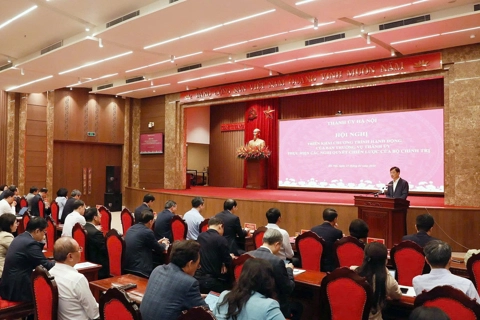
After extensive research and insightful deliberation, the Politburo issued a conclusion in May on the Master Plan for Hanoi's Development from 2021 to 2030, with a Vision to 2050, as well as the General Adjustment of the Master Plan for Hanoi's Development to 2045, with a Vision to 2065.
| Part of the Hoa Lac Hi-Tech Park in Thach That District, Hanoi. Photo: Cong Chien/The Hanoi Times |
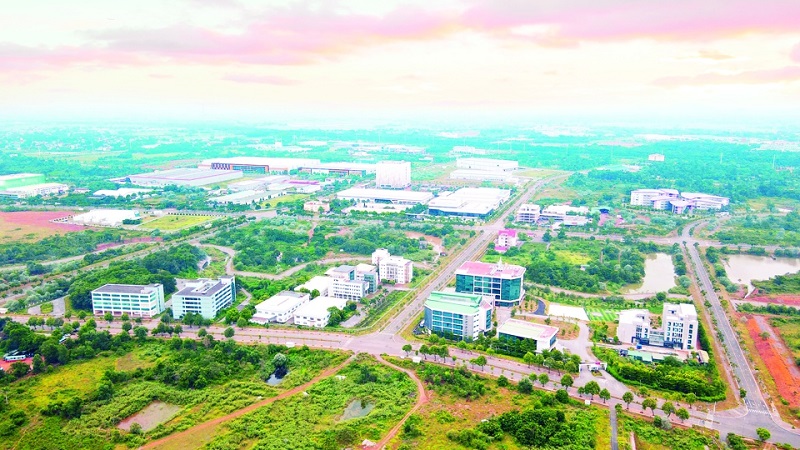
Experts said the two plans, along with the Capital Law recently approved by the National Assembly, provide a legal framework for Hanoi to achieve its key goals. According to Politburo Resolution 15, the two master plans are essential for the development of the capital.
Architect Dao Ngoc Nghiem, Vice Chairman of the Vietnam Association for Urban Planning and Development, noted that while Hanoi has achieved significant milestones in urban planning and development over the past 70 years, challenges and obstacles remain.
According to him, the capital has achieved impressive development goals, especially with the approval of the two aforementioned master plans, which are considered cornerstones for future expansion.
Recently, the National Assembly also approved amendments to the Capital Law in 2024. As a result, Hanoi will simultaneously implement new laws and plans in the coming period, including more than 70 special policies for Hanoi, Nghiem said.
With this planning orientation and Hanoi's unique characteristics, the nation expects the city to drive breakthroughs and adopt new methods, especially after the 2008 administrative boundary adjustment.
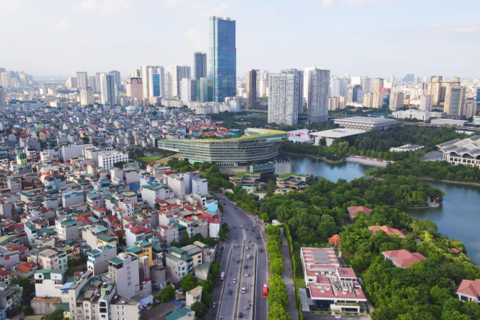
Hanoi is now the largest city in Vietnam by area and the second largest by population after Ho Chi Minh City. Worldwide, Hanoi ranks among the 12 largest capitals by area and is one of the 10 capitals with a history of thousands of years.
According to the central government, the upcoming master plan will continue to implement a multi-center urban model, consisting of a central city, five satellite towns, and eco-developments connected by green corridors.
This urban model will be adapted to practical needs. The five satellite towns proposed in the 2011 plan will be adjusted in population size and special policies to suit current conditions.
This urban cluster plan will transform eco-townships-especially five to seven rural districts-into urban districts. In the next stage, a "city within a city" plan will be implemented, including a western city in Hoa Lac-Xuan Mai Science City and a northern city in Dong Anh, Me Linh and Soc Son districts.
It is imperative that this "city within a city" concept be implemented as Hanoi faces a major challenge in the near future, one that requires both state and central support as well as successful economic plans that maintain regional ties.
Hanoi will serve as a catalyst for regional growth, while creating opportunities for neighboring provinces to develop simultaneously. This means reorganizing areas at regional hubs, especially in terms of transportation.
In addition, the city will play an important role in the development of the regional cultural industry by connecting its ancient, thousand-year-old sites with contemporary ones. This will revitalize the city and connect the cultural attractions of Son Tay Town with neighborhoods such as Ba Vi, Tay Ho, and Dong Anh.
According to Nghiem, Hanoi has vast areas, a long history, and unique features such as the Old Quarter, French colonial-era districts, scenic landmarks such as Hoan Kiem Lake, West Lake, Ba Dinh political center, and traditional craft villages.
Although Hanoi has renovated these heritage sites in recent years, their full potential remains untapped. Therefore, Hanoi must ensure that new development is consistent with the renovation and restructuring of existing urban areas, committing to preserving the villas, the Old Quarter, and Ba Dinh Center, while using its more than 120 lakes to protect the environment.
Maintaining a balance between urban and rural development is a unique goal for all urban centers, but especially for Hanoi. Traditional village spaces and former agricultural areas continue to define Hanoi's central urban region, which includes both the old city and new development areas. The planning, construction and development of a balanced strategy between urban and rural areas is therefore crucial.
By 2030, 70% of Hanoi is expected to be urbanized, while the rest will remain rural. When it comes to creating new and exemplary rural areas, Hanoi is setting the standard for the nation. It is figuring out how to connect rural and urban areas through roads and infrastructure and improve the living standards of rural people. This will allow rural areas to make economic contributions and encourage the expansion of tourism, especially ecotourism.
Relocating government offices to reduce urban congestion
For a long time, Hanoi's urban space has been considered too cramped, with a growing population density.
| Top view of the Gia Lam train factory in Long Bien district. Photo: Ngoc Trang/The Hanoi Times |
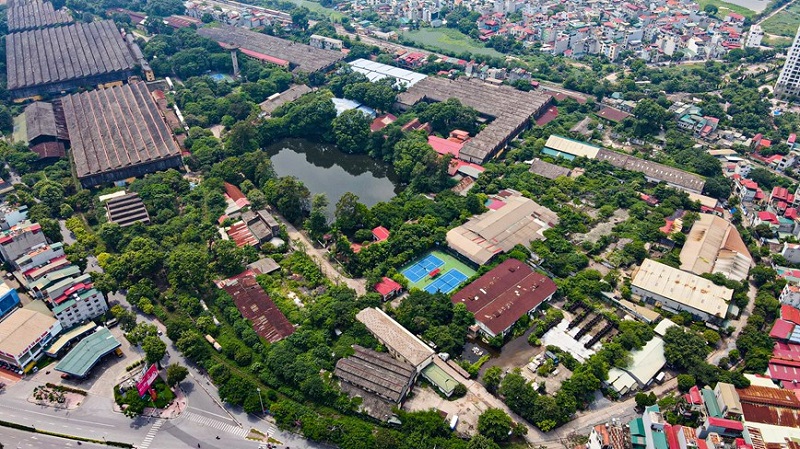
The mushrooming of skyscrapers downtown and unfinished plans to move government buildings and educational institutions out of the central city have challenged the implementation of plans to decongest the central city.
Nghiem said that since Hanoi's master plan was approved in 1998, the relocation of public institutions, some ministry offices and educational facilities has been carried out. The government set a target to relocate almost all agencies and schools by 2025. However, this goal does not appear to have been met due to legal constraints.
Under the 2013 Land Law, individuals and organizations with stable, long-term land leases retain the right to decide whether to relocate. Going forward, future master plans will need to designate areas for ministries and promote regional connectivity to attract universities, particularly to establish Hoa Lac Hi-Tech Park as a science and university city, which would facilitate relocation.
The Capital Law 2024 now allows Hanoi to independently manage the relocation of ministries and industrial facilities. Institutions will be required to return their vacated sites to the city after relocation.
In the upcoming master plan, Hanoi has identified at least four zones for central agencies, which provide favorable conditions for realizing these goals. However, actual implementation will depend on coordinated support from various ministries, agencies, and budget allocations.
Deputy Chairman of the Hanoi People's Committee Duong Duc Tuan said that once the General Adjustment Master Plan for Hanoi to 2045, with a vision to 2065, is approved by the Prime Minister, the city will issue relevant guidelines for its implementation, including those for central urban areas, satellite cities, communes, district-level development, and urban zoning.
In line with the capital's master plan, Hanoi will continue to push forward projects to urbanize the north and northeast, with key projects such as Kim Quy Park, the National Exhibition Center, the Smart City and Software Park along the Nhat Tan-Noi Bai corridor, and the Gia Lam urban area, Tuan said.
Along with encouraging growth in the west and preparing for districts like Dong Anh, Gia Lam, and Hoai Duc to soon become urban districts, the city will also concentrate on zoning plans along both sides of the Red River.
According to the deputy chairman, Hanoi will build homes for middle- and low-income groups and draw in investment to satellite towns including Hoa Lac, Xuan Mai, Son Tay, Phu Xuyen, and Soc Son.
Recently, Hanoi has focused its resources on building transportation infrastructure, including the urban rail systems (Cat Linh - Ha Dong, Nhon - Hanoi Station) and expanding public transportation throughout the city. The city is also working with the Ministry of Transport to implement several major projects in this area.