A journey back in time: Hanoi's subsidy era recreated in Truc Bach Ward
A new attraction is open to the public, offering a glimpse of life in the old days in Hanoi.
It is impossible to talk about Hanoi during the subsidy era from the 1950s to the 1980s without mentioning the tram lines, which became an essential feature of daily life in the capital.
Built by the French at the beginning of the 20th century, these means of public transport were a testament to the city's historic period. The distinctive clanking of the trams is etched in the minds of Hanoi's residents and evokes countless nostalgic memories of a peaceful, bygone time in the capital.
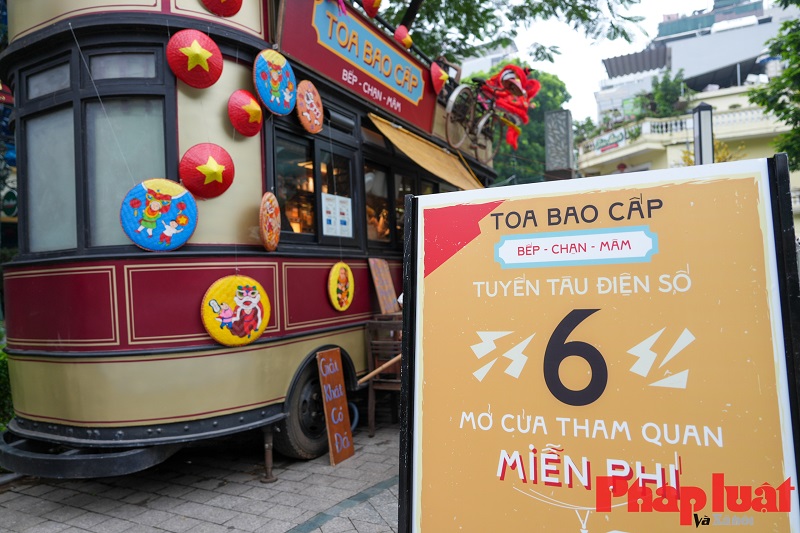
| The replica tram car evokes memories of the subsidy era in Hanoi. Photo: Khanh Huy/The Hanoi Times |
Today, many people in Hanoi still harbor deep nostalgia for the subsidy era - a time when the country was at war, under a trade embargo, and marked by hardship. Yet it is still remembered as a time of family values and community spirit.
To preserve and honor these values, a unique cultural space called "Tram line No. 6 – the carriage of subsidy era: Kitchen - Cupboard - Tray" is now open to the public in Truc Bach Ward, Ba Dinh District.
This cultural space is a new attraction in Ba Dinh District, part of the Leng Keng Heritage Project, which aims to nurture Hanoi's cultural values during the subsidy era.
"The space recreates the culture in Vietnam of those days when everything was provided by the government," Nguyen Dan Huy, Chairman of the Truc Bach Ward People's Committee, told The Hanoi Times.
"It gives visitors the opportunity to experience and gain a deeper understanding of the lives of Hanoi's people during this challenging yet meaningful period," he said.
The tramcar is transformed into a unique cultural space where people can chat and reminisce about the past. Inside the tramcar, everything is kept in the style of the past: from kerosene stoves and kitchen cupboards to simple trays of food, it all captures the spirit of Hanoi in the old days.
"All the items on display are real artifacts, collected and donated by local residents, each telling their own stories and memories of Hanoi families from the past," said Huy.
The 'Kitchen - Cupboard - Tray' space is a place where visitors can view artifacts from the subsidy era and enjoy meager but heartfelt meals that bring back memories of family meals during tough times. Salted eggplant, jute soup, and braised fish are authentically recreated, depicting typical Vietnamese meals where family members gather around humble and loving meals.
There is also a bulletin board to keep locals informed of the latest government policies and news, and a mobile cinema showing documentaries and films about Hanoi. Of particular interest are the electric poles planted on Hanoi's sidewalks over a hundred years ago.
The attraction resonates not only with older generations who lived through the subsidy era but also with younger people and tourists from other provinces who feel the warmth, familiarity, and emotional connection when experiencing this space.
Nguyen Dan Huy, chairman of the Truc Bach Ward People's Committee, said more tramcars would be set up along Truc Bach Lake to show more of Hanoi's past.
"We hope Truc Bach Ward will become a place where the old and true values of Hanoi are preserved and promoted. This could be a highlight of Hanoi tourism".
Preserving and promoting cultural values
The tramcar project is not only a space for recreating history but also an effort to preserve and promote the capital's cultural values. It helps the younger generation understand more about a challenging period in the nation's history.
This area attracts visitors not only for sightseeing but also for experiencing and feeling history. In the midst of today's booming development of the city, cultural and historical values from the past, displayed in the attraction "Tram Line No. 6 - The Carriage of the Subsidy Era", become a unique highlight, attracting the interest of both local residents and international tourists.
"I only heard about the subsidy period from my grandparents and my mother when I was barely able to think," said Nguyen Ngoc Phuong Ly from Quy Nhon when she visited the site. Ly said when she touched the objects, she was overcome with emotion.
"It's like living in the old days again. All my memories just come back," she said. "The food is very similar to what I ate as a child, especially the jar of salted eggplant."
Ly promised to take her grandparents and mother to the place soon. "I'm sure they will be thrilled to relive their childhood memories," she said.
In this special space, the past and present seem to intertwine. The images of the subsidy era, though long gone, are vividly and authentically recreated in a modern context.
The clanging of the tram, the aroma of dishes reminiscent of old Hanoi, and the rustic simplicity of the artifacts on display create a space full of nostalgia, yet infused with newness.
Lane Kivrin Dunn, an American tourist, said it was nice to see how people lived in Hanoi in those days. "It's very informative," he said.
Visitors not only relive old memories but also gain a deeper understanding of Hanoi's cultural and historical values. This is also a way of bridging the generations, helping the younger generation to appreciate and value what their ancestors went through while giving older generations the opportunity to share and pass on their precious memories and experiences to their descendants.
Lane thought that people would be very interested in visiting such an attraction.
"When you come to another country, you want to know about the local life. You want to see some of the historical aspects," he said, crediting the locals with creating a fascinating place for tourists.
Even Hanoi locals feel a deep connection to the space. Chu Van Thinh expressed his support for the idea of creating an open museum in the neighborhood.
He said the site reminded him of those days. Thinh was struck by the memory of the clanking sound of the tram, saying "It's the most delightful part."
"When I was a student, I used to take the tram from Cau Giay to Ha Dong to bring my mother lunch. The clanging sound of the tram holds a treasure trove of fond childhood memories for me," he said.
The carriage is both a cultural space and a time capsule, where past and present meet. In the heart of modern, bustling Hanoi, this place offers a moment of quiet reflection, reminding us of the value of memories and the beauty of the simple things in life.
In the endless flow of time, the site is a stop where we can pause, reflect, and cherish the past, then continue on our journey with hearts full of love and gratitude.