Amended Capital Law urged to promote priority fields essential for Hanoi’s development
The amendment of the 2012 Capital Law becomes imperative to introduce innovative and groundbreaking mechanisms, pool all available resources, and harness potential and strengths effectively for the development of Hanoi.
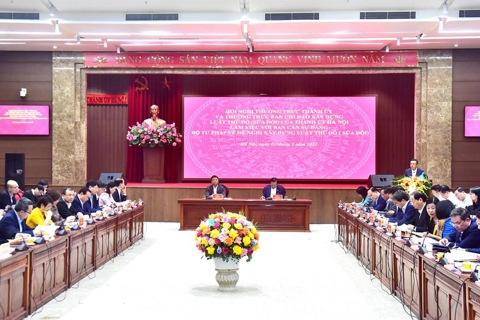
Amended Capital law should include fields that could spur Hanoi’s development in the long term, Vice Minister of Justice Dang Hoang Anh shared the view during a meeting discussing the amended Capital Law on August 16.
| Vice Chairman of the Hanoi People's Committee Le Hong Son (l) and Deputy Minister of Justice Dang Hoang Anh (r). Photos: Thai San/The Hanoi Times |

A report from the Ministry of Justice noted the 2012 Capital Law serves as a significant legal framework that delineates the position, roles, responsibilities, and policies governing the construction, development, and safeguarding of the capital.
The specific policies outlined in this law have facilitated the establishment of a relatively comprehensive set of legal tools in Hanoi for planning, construction, and management. These tools have been instrumental in ensuring the consistent execution of the Capital Construction Master Plan until 2030 and the vision for 2050, noted the ministry.
Hanoi's technical infrastructure and transportation network have undergone substantial growth in terms of scale, encompassing numerous key projects and structures that are interconnected smoothly and cohesively. This development has fostered socioeconomic links among provinces and cities within the Capital Region, giving rise to modern urban areas and the preservation and enhancement of cultural and historical heritage.
Despite these achievements, the realization of certain goals, solutions, and regulations stipulated in the 2012 Capital Law still exhibits certain shortcomings and limitations in various domains, including institutional development and management, general and specialized technical planning, land management, financial mechanisms, and regional integration policies.
Hence, the amendment of the 2012 Capital Law becomes imperative to introduce innovative and groundbreaking mechanisms, pool all available resources, and harness potential and strengths effectively for the development of Hanoi, aiming to transform it into a hub of culture, civilization, and modernity.
| Overview of the meeting. |

The objective is for Hanoi to become a central force driving the development of the Red River Delta, the Northern key economic region, and the entire nation. This transformation will propel Hanoi to a deep and international integration, making it highly competitive on both regional and global scales and striving to reach the standards set by developed capitals in the region.
During the meeting, members engaged in discussions and provided their insights on specific contents within the Draft Capital Law (amended).
The amended Capital Law project includes provisions for the decentralization of powers to the Hanoi People's Council, allowing the city to decide on the establishment, reorganization, and dissolution of specialized agencies and specific administrative organizations under the purview of the Hanoi People's Committee, districts, towns, and urban areas. This decentralization is designed to meet the demands of management tasks while enhancing initiative, flexibility, autonomy, and self-accountability for Hanoi.
In order to finalize the documentation for the amended Capital Law, Deputy Minister of Justice Dang Hoang Oanh requested the Drafting Committee to provide clear explanations regarding the scope of decentralization and delegation of authority. The focus areas should be selected in alignment with the specific conditions and socioeconomic development of Hanoi to create breakthroughs for the capital. Additionally, mechanisms for inspecting and supervising the implementation of powers and duties of city authorities at all levels should be researched and included.
Furthermore, Oanh also urged the Drafting Committee to consider and incorporate various issues raised by members of the Appraisal Council, including the assessment of resource availability to ensure the feasibility of the Law Project and matters related to legislative authorization.