Business community looks to 14th Party Congress for stronger legal framework
Vietnam’s business community is looking to the 14th National Party Congress for decisive policy directions that strengthen legal frameworks, unlock private-sector potential and set the foundation for sustainable, innovation-driven growth in the country’s next development phase.
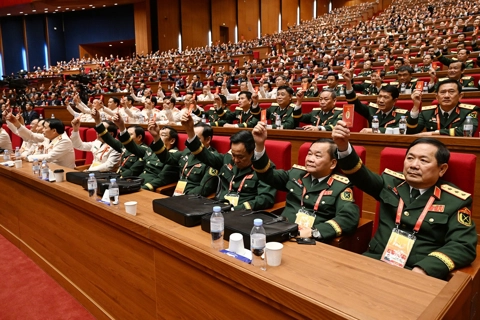
THE HANOI TIMES — Vietnam's business community is placing high expectations on the 14th National Party Congress to deliver breakthrough policies, creating a more enabling legal environment and unlocking the full potential of the private sector.
Trinh Thi Ngan, Head of the Advisory Board of the Hanoi Small and Medium Enterprises Association (HANOISME), shares her views with Cong Thuong (Industry and Trade) Newspaper.

Production at garment and textile producer Garco 10 Corporation. Photo: Hoai Nam/The Hanoi Times
How do you assess the significance of the major resolutions issued in 2025 for businesses and what does the 14th National Party Congress mean for Vietnam in this new development phase?
The year 2025 marks a turning point, with the issuance of a series of strategic resolutions issued by the Politburo. They are widely described as the “four pillars” of Vietnam’s new development phase.
These include Resolution 57 on breakthroughs in science, technology, innovation and national digital transformation, Resolution 59 on international integration in the new context, Resolution 66 on reforming lawmaking and law enforcement and Resolution 68 on private sector development.
These resolutions have broad and direct impacts on Vietnam’s socio-economic strategy. They move beyond general orientations for science, technology, institutions and international integration. All four clearly position the private sector as a central driver of sustainable growth in the new era.
From my perspective, these policies act as timely and necessary catalysts. They help create a more open, predictable and transparent legal and institutional framework, giving businesses greater confidence to invest, innovate and scale in what many describe as the nation’s era of advancement.
Alongside the four pillars, the Politburo issued Resolution 79 on state-owned enterprise development and Resolution 80 on Vietnamese cultural development also deserve attention.
These policies reflect long-term thinking. They affirm that economic growth must advance with cultural values and human development, which together form the foundation for sustainable progress.
I believe the interaction among economic, cultural, institutional and technological pillars will create a strong base, enabling Vietnamese enterprises to grow more resilient and compete with greater confidence in a globalized economy.
The 14th National Party Congress opens a new and decisive phase of reform and lays a firm foundation for long-term national development. Science and technology, innovation and institutional reform will remain core pillars in helping Vietnam achieve its strategic goals.
In the 2026-2030 development strategy, what concrete directions have small and medium-sized enterprises identified?

Trinh Thi Ngan, Head of HANOISME's Advisory Board. Photo: Hoang Anh/The Hanoi Times
We have identified three core development pillars for the coming period. The first is the economic pillar, which focuses on stable and efficient business growth while improving adaptability to market changes.
Second, corporate culture involves preserving ethical values, business credibility and corporate identity built over nearly eight decades. It shapes how enterprises build trust with partners, employees and society.
Political alignment is also important as it reflects the close connection between business operations and Party-building efforts, ensuring clear orientation, transparency and consistency in enterprise governance.
With these three pillars, we hope the 14th National Party Congress will continue to introduce strategic decisions that ensure effective implementation of major resolutions.
The business community strongly expects these resolutions to move quickly from policy to practice, with synchronized actions that reach daily operations and deliver tangible improvements in the investment and business environment.
A double-digit growth target has been set for the coming period. In your view, is this a challenge in the current context?
A double-digit growth target, meaning over 10% per year, is ambitious and demanding as it reflects strong determination to lead the country into a more dynamic and prosperous stage of development.
For businesses in Hanoi, the challenges are clear due to a volatile global economy, persistent geopolitical tensions and intensified competition among major economies. Meanwhile, consumer markets shift rapidly and remain unpredictable.
To sustain growth above 10%, Vietnamese enterprises must change their mindset. They need to raise productivity, accelerate technology adoption, expand markets and strengthen risk management.
That said, if timely policy support, transparent institutions and a stable legal environment are provided, I believe enterprises and society as a whole can gain lasting value from this ambitious growth agenda.
Thank you for your time!