Hanoi
Capital adjusts master planning to 2030
The Hanoi People`s Committee has issued a decision approving the partial revision of the Capital’s construction master plan to 2030 with vision to 2050.

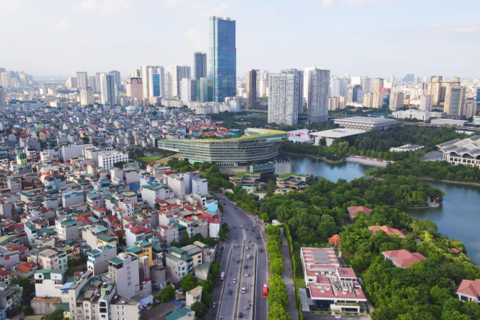
Hanoi from above.
|
The land area for new residential units increased by 25.32ha (bringing the total to 122.2ha, accounting for 28.83%); project land in the green belt decreased by 35.72ha (its total is down to 63.15ha, accounting for 14.89%); urbanized rural areas increased by 3.16ha (its total is up to 8.13ha, accounting for 1.92%); land for defense and national security increased by 0.92ha (bringing its total up to 4.22ha, accounting for 1%); technical infrastructure focal area increased by 4.18 ha (accounting for 0.99%); roadways increased by 7.97ha (up 53.93%, accounting for 12.72%).
As such, the revised plan has increased the land area available for public use, common services, residential units, defense and national security, roadways and technical focal areas, and reduced park and project land in the green belt.
In addition, the People's Committee of Hanoi also adjusted the direction of space development. Specifically, the urban development area is reserved for the construction of modern high-rise buildings (with the number of floors from 20 to 36, plus a landmark 45-storey high-rise building) with synchronized social and technical infrastructure.
Urban railway No.8 will be constructed along the Dong Du-Duong Xa route, with a station at the heart of the project. Accordingly, the land use planning of Gia Lam Urban Zone will be based on the TOD development principle: within 400-500m to the station the city plans to raise city-class public commercial service projects, high-rise office buildings, and high-rise residential buildings to ensure that the urban railway is fully utilised.
The area’s planned population was adjusted to 89,500 people, an increase of about 64,243 compared to the previous planning. With this increase, the population of the urban land strip north of the Red River shall reach 2.034 million people by 2050 (from the previous estimate of 1.97 million).