Capital Law 2024 fuels urban planning vision along Red River
Hanoi is envisioned to develop a cultural industry hub along the riverbanks and other areas with cultural spatial advantages.
The amended Capital Law, which introduces several new provisions on special policies and mechanisms, serves as a catalyst for Hanoi to direct resources toward a breakthrough in Red River urban development, according to Hoang Thanh Tung, Chairman of the National Assembly's Law Committee.
He further noted that, with regard to policies for the development, management, and mobilization of resources for the Capital, the National Assembly's Standing Committee has refined regulations on land use and management along riverbanks to ensure alignment with flood control planning.
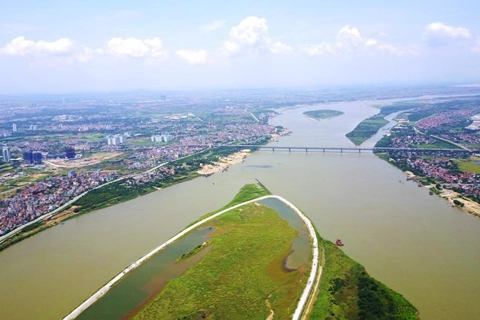
| The Red River's alluvial islet. Photo: Pham Hung/The Hanoi Times |

“The amended Capital Law, recently approved by the National Assembly, prioritizes resource allocation and the execution of zoning plans for the Red and Duong rivers. Hanoi is envisioned to develop a cultural industry hub along the riverbanks and other areas with cultural spatial advantages, which aligns with urban planning,” Tung said.
Specifically, new dikes may be constructed to conform to flood control plans and improve land use. Existing residential areas along the riverbank are allowed to remain, and new developments can be built with appropriate ratios, while other areas will be designated for public spaces without raising the riverbanks to avoid obstructing water flow, he said.
Hanoi is also empowered to adjust environmental zoning, urban planning, and other technical infrastructure plans as needed and report the results to the Prime Minister. The Hanoi People's Council will be responsible for detailed procedures for these adjustments.
For areas already covered by regional or sectoral plans, district-level land use plans are not required. Instead, annual district land-use plans will be based on existing zoning and land allocation targets from the capital's master plan, he added.
Harmonious urban development along riverbanks
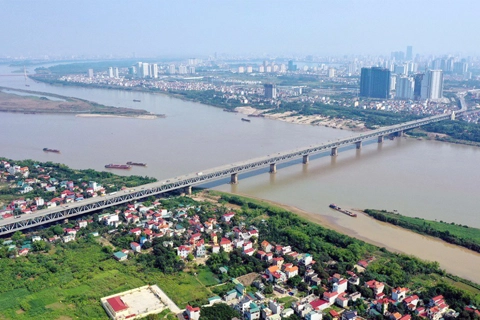
| Residential areas along the Red River. Photo: Thanh Hai/The Hanoi Times |

Voter Bui Thi Dinh from Cau Giay District praised the decentralization in the revised law which gives Hanoi more autonomy in urban planning and management, in line with the Party's Resolution 15-NQ/TW, which focuses on stabilizing residential areas along the Red and Duong rivers, expanding green and public spaces, and ensuring urban flexibility.
"This is a significant change from previous laws, transferring project approval authority from the Prime Minister to Hanoi and empowering local governments to leverage agricultural land while maintaining flood control and disaster prevention goals," Dinh said.
Experts view this as a "golden opportunity" for breakthrough development along the Red River. However, they stress the importance of strategic planning, under central oversight, to ensure sustainable and harmonious urban development on both sides of the river.
Legal expert Le Quang Vung emphasized that under the Law on Planning, the Prime Minister retains authority over the capital's master plan. The recent review of the Capital Plan by the 15th National Assembly ensures a comprehensive and strategic approach that reflects the unique characteristics of the capital’s planning.
The revised Capital Law, officially passed by the National Assembly and set to come into force in early 2025, consists of 7 chapters and 54 articles, an increase of 3 chapters and 27 articles compared to the 2012 version. Key highlights include the reorganization of Hanoi's government structure to be streamlined, professional, modern, and highly efficient.
The law emphasizes a strong delegation of power from the central government to the city across various areas such as investment, urban planning, culture, healthcare, education, and science and technology. It introduces a new governance model that increases the autonomy and accountability of the capital's government in managing Hanoi's socio-economic development.
To improve the effectiveness and quality of the activities of the People's Council at all levels and meet the demands of the new era, the law stipulates that the Hanoi People's Council will now have 125 deputies, an increase of 30, of whom at least 25% will be full-time representatives.
| North of the Red River. Photo: Trung Nguyen/The Hanoi Times |