Vietnam applies satellite data to air quality monitoring
Researchers highly recommended application of multi-source approach and computational model data from satellite images to monitor air quality.
Vietnam has applied satellite data to monitor the situation of PM2.5 fine dust in localities nationwide in the 2019-2020 period that gives a more complete picture of air pollution in both space and time.
According to WHO, PM2.5 is defined as ambient airborne particulate that measures up to 2.5 microns in size, just a fraction of the width of a human hair. Exposure to PM2.5 has been linked to negative health effects like cardiovascular disease, respiratory illness, and premature mortality.
The application of satellite data in monitoring pollution is a part of the projects "Join hands for clean air” and “Improving air pollution monitoring and management of Vietnam with satellite PM2.5 observations”.
At an online conference held in Hanoi this week, researchers presented a report on the above-mentioned application. This was the first report that provides information on the situation of PM2.5 fine dust in all localities nationwide with data collected and analyzed by standard monitoring stations, sensors, and satellites.
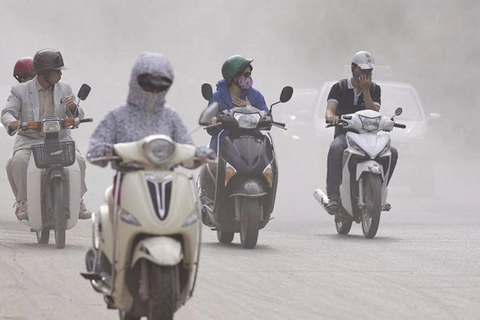
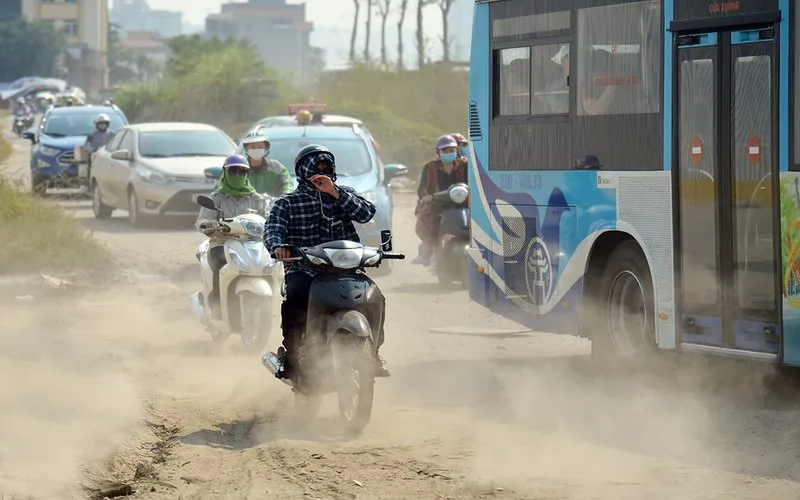
Citizens of Hanoi are suffocated by heavily polluted air. Photo: Pham Hung |
Based on the report’s findings and referring to international experience, researchers discussed and proposed specific recommendations.
In particular, Dr. Nguyen Thi Nhat Thanh from the University of Engineering and Technology under the Vietnam National University in Hanoi highly recommended the application of a multi-source approach and computational model data from satellite images to monitor air quality and the development of detailed distribution maps of PM2.5 fine dust in districts and township in provinces and cities affected by PM2.5 fine dust pollution.
Thanh stressed that all Vietnamese localities, especially big cities like Hanoi, surpassed the safety thresholds during the 2019-2020 period. Therefore, localities need to determine PM2.5 sources, among other pollutants, to devise appropriate measures to deal with them.
Dr. Falguni Patadia, an expert in project of SERVIR between NASA and USAID, emphasized that Hanoi needs to promote solutions to apply information technology to environmental management, develop environmental management software for production and service facilities to strictly control air pollution.
Hanoi’s authorities need to encourage businesses to apply clean production models, develop environmental management software for production and service establishments, Falguni Patadia said.
She added that the capital city needs to control air pollution caused by industrial activities, strictly punish violations on environmental protection, speed up the progress of waste-to-energy plant construction for the city's garbage treatment and promote urban greening.
Furthermore, Hanoi needs to quickly develop public transport network to curb private vehicles in the downtown and accelerate the relocation of universities and offices out of the inner city to reserve land for green space, Falguni Pâtdia noted.
For his part, Hoang Duong Tung, president of the Vietnam Clean Air Partnership, said the fact that social distancing due to the Covid-19 pandemic has partly helped improve the air quality in the whole country, especially in big cities like Hanoi.
Tung’s figures showed that strict measures to reduce the spread of Covid-19, including mass quarantines, restrictions on mass gatherings and mobility contributed to an 8% reduction in pollution exposure in Hanoi.
“The clean air was a positive side effect of the lockdown. The periods of social distancing also provided researchers with an unprecedented natural experiment setting to investigate the trade-off between economic activities and air quality,” Tung told The Hanoi Times.
Vietnam’s economic cost due to air pollution amounts to between US$10.82 billion and US$13.63 billion per year, Tung quoted a study by the National Economics University Hanoi as saying.
Regarding the causes of air pollution from an economic perspective, Tung specified that there are several causes of air pollution in Vietnam, including the inefficient use of energy resources, the heavy dependence on fossil fuel (90% of total energy used in Vietnam).
The wave of low quality foreign investment is also blamed for air pollution, Tung said, adding that backward and contaminating technologies have been relocated in Vietnam and air pollution mainly results from economic activity. Therefore, efficient policies are vital to reduce pollution.
"More research is needed to assess the impact of air pollution on the economy. Only when our issue is accurately assessed then can policy proposals be effective," Tung said.