Cuu Village: A 500-year-old heritage site once known as the “Village of the Rich”
The rapid deterioration of the village renowned for its hybrid villas and tailoring heritage requires Hanoi’s huge cultural preservation efforts.
THE HANOI TIMES — Just 40km south of Hanoi, where the Nhue River slips quietly past the fields of Chuyen My Commune, Cuu Village appears like a place time forgot, a rare pocket of elegance and memory that still breathes with the rhythms of another century.
Once famed as “the village of the rich,” this nearly 500-year-old community built its prosperity on exceptional tailoring skills and a remarkable collection of villas where Vietnamese craftsmanship blends seamlessly with French architectural grace.
A gate into the past
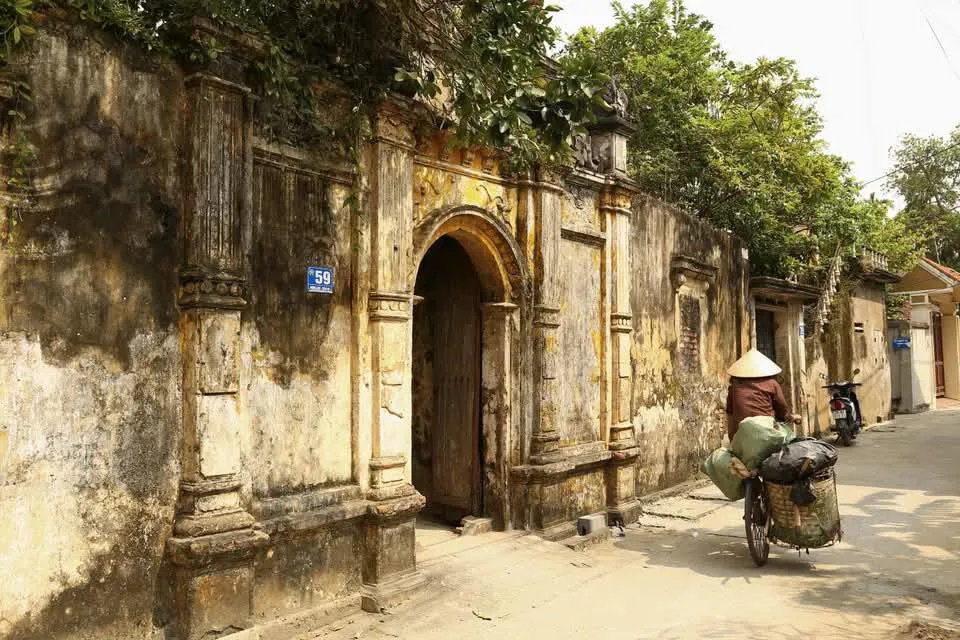
The timeless charm of Cuu Village in the outskirts of Hanoi. Photo: Around Vietnam
The visit to Cuu Village begins at its iconic arched gate, where stone unicorns and guardian dogs have watched over generations. With its second-floor gazebo, curved tiled roofs and winding staircase opening onto moss-covered walls, ancient banyan trees and narrow alleys shaped by centuries of craft, the gate serves as an entryway into another era.
Cuu Village rose to prominence during the French colonial period thanks to its reputation for producing “Hanoi’s number one tailoring,” a craft that transformed the rural community into a prosperous settlement marked by elegant villas that still stand today.
A walk through the village feels like exploring an open-air museum of early 20th-century architecture. Its old houses impress with medieval-style terracotta roofs, ironwood columns, carved wooden doors and spacious courtyards arranged according to traditional feng shui.
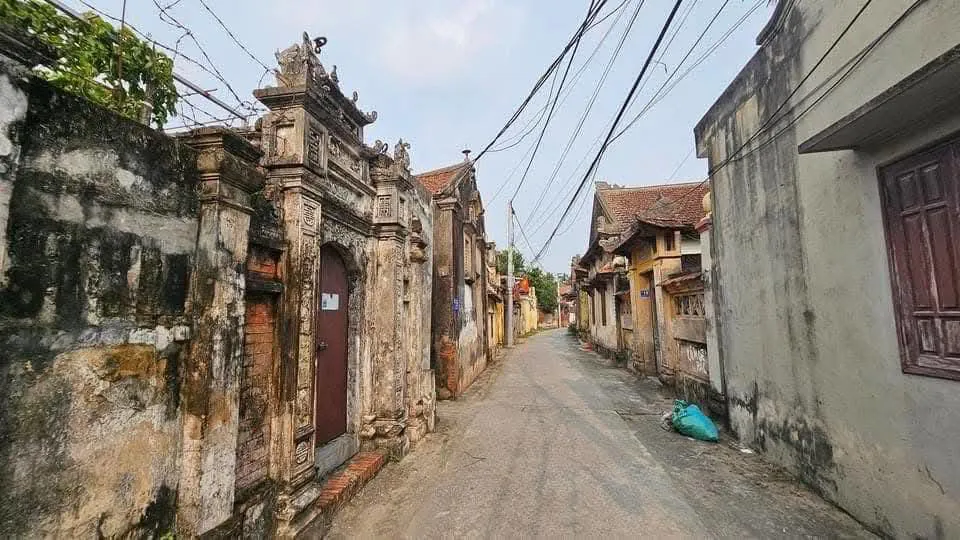
Cuu Village still preserves the quintessential features of an old Vietnamese settlement, with ancient banyan trees, a communal well and the village communal house anchoring daily life much as they did generations ago. Photo: Lang Viet Xua & Nay
What sets Cuu Village apart is its subtle dialogue between East and West. Traditional Vietnamese features, yin-yang roof tiles, lotus motifs carved in wood and stone and spacious courtyards harmonized with nature, blend seamlessly with French architectural elements.
Arched windows, wrought-iron balconies, Roman-inspired columns and the clean geometric lines of Art Deco façades appear throughout the village, integrating gracefully into the rural landscape.
Many villas were built by Cuu’s master tailors who returned from Hanoi in the early 20th century, inspired by European mansions they had encountered in the capital. Their creations, shaped by memory, aspiration and craftsmanship, form a unique collection of architectural hybrids unmatched elsewhere in the region.
As visitor Vu Bich Huong from Ho Chi Minh City noted: “I’ve visited many ancient villages in northern Vietnam, but Cuu feels different. There’s a quiet elegance here. The mix of Vietnamese warmth and French sophistication in the old houses makes every corner feel like a story waiting to be uncovered.”
Rise from ashes
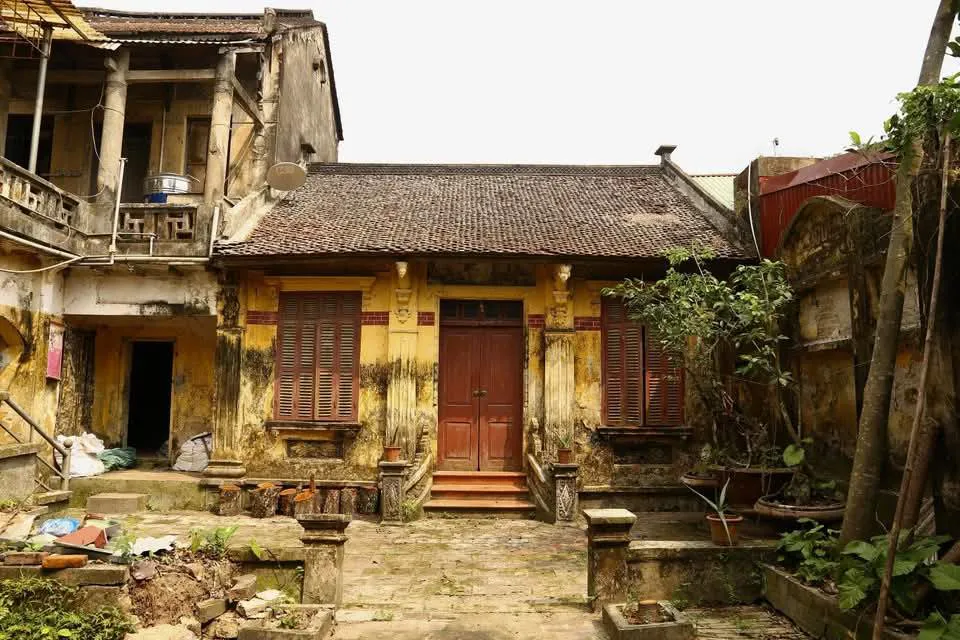
An old house in Cuu Village with Art Deco architecture. Photo: Around Vietnam
The village’s grandeur emerged from hardship. Around 1920, a fire destroyed nearly two-thirds of Cuu’s bamboo houses. Coupled with crop failures and famine, many villagers moved to Hanoi, where they mastered European tailoring and became highly sought after by Western patrons and affluent Hanoians. Prestigious brands such as Duc Loi, Phuc My and Phuc Hung were founded by Cuu craftsmen, establishing the village as the cradle of first-class tailoring.
By the 1940s, the wealth they earned allowed pioneers to return and rebuild Cuu Village with elegant villas infused with Western aesthetics. Their success inspired the community, earning Cuu its nickname, the “village of the rich.”
Despite its location near National Route 1A, Cuu Village has preserved much of its rural character. Ancient banyan trees, stone wharves and communal houses remain, while old residences, some over a century old, continue to tell stories of resilience and prosperity.

Preserving a fading heritage
Today, Cuu Village faces the challenge of survival. More than half of its 49 historic houses are abandoned or home to only one or two elderly residents. The once-thriving tailoring craft has given way to mass-produced clothing, and the artisanal legacy is fading.
Nguyen Thien Tu, a fourth-generation resident of a house built in 1905, recalls that Cuu Village’s history spans more than 700 years. Many early-20th-century homes have lost their original features, worn down by time and minimal maintenance. Only the narrow alleys retain the large bluestone pavings, now moss-covered but still evoking the village’s former elegance.
“In 1996, the main road was concreted and the slate pavements disappeared. Many houses with traditional Vietnamese or French architecture have deteriorated because they were never properly cared for,” Tu said.

Far from the noise and bustle of modern life, Cuu Village feels like a place where the wheel of time has come to a gentle pause. Photo: Bich Huong
A short walk from his home stands a once-stunning French-style villa, its doors rotting and walls cracked. Its owner, Thong, has no immediate plan for restoration. Some households have attempted repairs without expert guidance or funding, unintentionally eroding the historic charm. Today, Thong’s villa functions as a shoe workshop, and he fears it may soon need to be demolished for safety reasons.
A local government representative echoed these concerns, noting that despite proposals and visits by cultural survey teams, funding has not materialized, leaving villagers to shoulder the burden of preserving the sites alone.
Local authorities encourage residents to preserve rather than replace ancient structures. With state support and growing interest from travelers seeking authentic cultural experiences, there is hope that Cuu Village can reclaim its place on the tourism map.
For visitors, Cuu Village offers more than scenic houses and quiet lanes. It is a journey through Vietnam’s layered past - a story of hardship, creativity, prosperity and the fragile beauty of heritage. Walking its sunlit courtyards and weathered villas, one senses that this “village of the rich” remains rich in spirit, waiting to be rediscovered.