Digitalization and automation make a change in Hanoi's artisan villages
By posting pictures and videos of the tailoring process on Zalo and Facebook, craftsmen have built a sizable consumer base.
Craft villages in Hanoi have accelerated digitization and automation to expand their consumer markets, using social media, building websites, and opening stores on e-commerce platforms.
Nguyen Xuan Mao, owner of a fine woodworking workshop in Lien Trung Commune, Dan Phuong District, told The Hanoi Times that he sees digital transformation as inevitable for effective production and business development. He can update new product designs and provide information on wood materials, designs, sizes, and home delivery through online platforms.
Nguyen Xuan Mao is making fine wooden furniture in his workshop in Hanoi's Dan Phuong District. Photo: Anh Kiet/The Hanoi Times |
.jpeg)
“Our cabinets, tables, chairs, and mattresses are bulky and difficult to ship. For this reason, offering the products online saves money and time for consumers who want to explore the items before buying. As a result, both buyers and sellers benefit from the lower product price," Mao said.
Nguyen Van Dau, a well-known tailor in Phu Xuyen District's Van Tu Commune who specializes in suits and blazers, noted that many households in the craft village have turned to social media and e-commerce platforms, considering them as important as investing in modern machinery.
By posting pictures and videos of the tailoring process on Zalo and Facebook, they have built a sizable consumer base. The village's younger generation has been the most adept at using social media platforms as a selling channel, with online sales accounting for about 30% of the trading, according to Dau.
Nguyen Trong Vinh, Vice Chairman of the Phu Xuyen District People's Committee said that the district is currently home to 154 traditional craft villages and clusters, of which 78 craft villages are under strong development, another 43 have been recognized by the Hanoi People's Committee as traditional craft villages.
"Recently, the district government set up an e-commerce store, expecting it to open up new avenues of digital transformation for craft villages. Instead of searching for Phu Xuyen Craft Village products through a maze of channels, customers now only need to access the district's e-commerce store to find products and suppliers," Vinh told The Hanoi Times.
To catch up with digitalization and automation, Bat Trang village in Hanoi, famous for its 700-year-old traditional pottery trade, has innovated sales methods, especially through digital technology, and speeded up digital transformation from management and operations to production and sales activities to adapt to market trends.
Bat Trang Pottery Village products in Hanoi are favorites for domestic and foreign visitors. Photo: Hoai Nam/ The Hanoi Times |

According to artisan Phung Van Hoan, without the application of technological advances, Bat Trang pottery items could only be left at home. "Nowadays, thanks to e-commerce, villagers are busy making pottery products. They realize that neglecting electronic information channels for marketing is a disadvantage," Hoan stressed.
As many workshops in Bat Trang have applied e-commerce, sales have increased. Ha Thi Vinh, Director of Quang Vinh Ceramics Co, Ltd, said that after four years of online business, the company's ceramic products have been sold to eight million consumers through Facebook alone.
"E-commerce helps Bat Trang's brand grow. Many wholesalers in other provinces know about Bat Trang's new products through websites and social networks," Vinh told The Hanoi Times.
She emphasized that the application of digital transformation is bringing changes to village tourism. Bat Trang is also known as one of the first handicraft villages in Hanoi to apply smart tourism development.
The local authorities have also completed a digital database with 3D movies, audio, and text of tangible and intangible cultural heritage, tourism, services, and trade of Bat Trang, Vinh added.
Foreign tourists buy silk products in Van Phuc Village in Hanoi's Ha Dong District. Photo: Duy Khanh/The Hanoi Times |
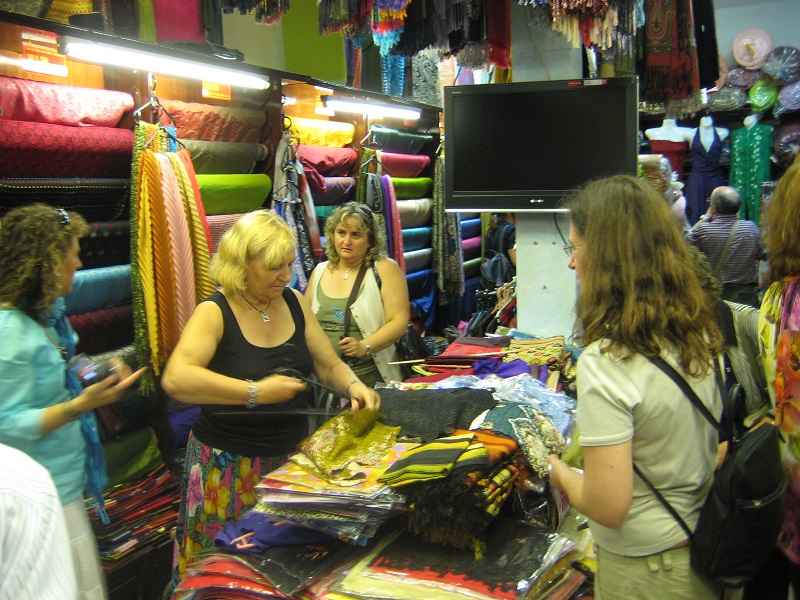
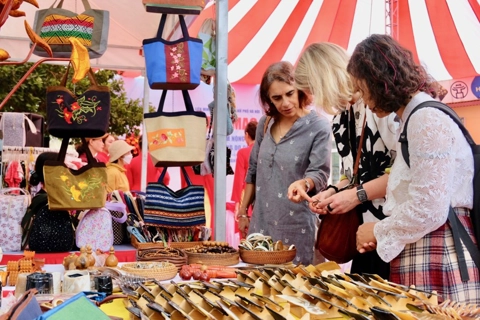
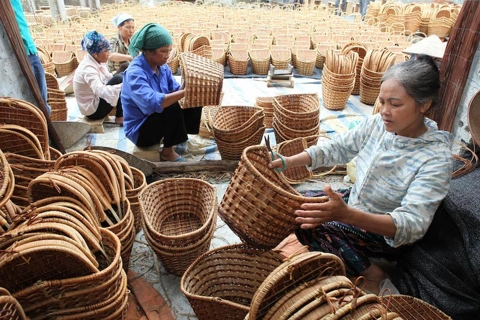
More than 1,300 craft villages are a great resource for the city's tourism development. Hanoi's traditional craft villages manufacture a wide range of gifts and souvenirs, such as Bat Trang pottery, Van Phuc silk, Phu Vinh bamboo and rattan, Quat Dong embroidery, Chuon Ngo shell inlay, Ha Thai paint, Chuong conical hat, among others.
According to Nguyen Thi Mai Anh, Deputy Director of the Hanoi Promotion Agency (HPA), in recent years, Hanoi has carried out projects to help creative startups in 2019-2025 and support digital transformation for small and medium-sized enterprises in the city for 2021-2025.
In addition, the Hanoi government has issued many strong policies on digital signatures and e-invoicing for newly established businesses.
"To be more effective, regulators and associations need to boost approaches to e-commerce among businesses and people in craft villages while working with universities to provide short-term training, retraining, or recruitment of workers in this field," Mai Anh said.