Hanoi
Finalizing the transport infrastructure foundation for Hanoi’s development
The current transport infrastructure of Hanoi is being severely overloaded.
In addition to reasons such as the rapid urbanization process, large population and individual transport vehicles, the lack of a completed transport infrastructure foundation is becoming a big challenge for the socio-economic development of the capital city.
According to the Deputy Head of Economic & Planning Office of the Hanoi Transport Department Phan Truong Thanh, the transport infrastructure foundation is not simply just roads and streets. As such, the transport infrastructure foundation of Hanoi includes ring roads, inter-provincial roads and the center roads; major transport hub of the static transport network and urban railway. “It is called the transport infrastructure foundation as its role is to be the main frame of the whole Hanoi transport infrastructure”.
Mr. Thanh clarified more clearly with regard to each component of the transport infrastructure foundation. Such as the ring roads No. 1; 2; 2.5; 3; 3.5 4 and 5 are considered the essential parts, and meet the transport demand of not only Hanoi but also other provinces going through Hanoi to other destinations. Or 4 inter – provincial bus stations waiting to be constructed such as Yen So, Co Bi, Son Tay and Dong Anh; 6 underground parking lots (in the Ring road No. 3) along with other kinds of parking lots under the static transport network. However, these are seen as the receptive components, which coordinates a large part of movements going in and out of the city. Urban railway is also considered as a component of the transport infrastructure foundation, due to its difference to bus. As such, the urban railway has its own infrastructure system; the amount of transport demand for each route is significant higher than bus, which is the direct supply and coordinate the operational frequency of other public transport modes.
The importance and urgent needs to finalize the transport infrastructure foundation have bene specified in the Hanoi transport master plan until 2030, with vision to 2050, which is approved by the Prime Minister. The Minister of Transport Truong Quang Nghia said: ”Hanoi is not only a big urban area, but also the center for Red river delta development, which has a big influence to the development of Vietnam. As such, the city should finalize the transport infrastructure foundation as soon as possible, with a view to ensure the internal connection, and especially to connect with other regions in the country”.
Some experts said, in reality, the transport infrastructure foundation of Hanoi is in preliminary phase, which is still fragmented and inefficient. Chief designer of TEDI consulting firm TEDI Dang Hoang Hiep said: “Hanoi set an objective of constructing 7 big ring road, but currently only the ring road no. 3 is completed, while others are still fragmented, which need to be connected to ensure smooth transportation”. Mr. Hiep said, at present, the ring road no.3 is under big pressure from other vehicles going to Hanoi or to other destinations such as inter – provincial bus, trucks and individual vehicles. Mean while, some other ring roads such as No. 3.5, 2.5 and 4 are invested in phases and intercepted by the red river. “Recently, Hanoi proposed to build 6 bridges over the Red river and Duong river, which are aimed to connect ring roads with each other. In which the most important are bridges: Me So (ring road no. 4), Thuong Cat (ring road no. 3.5)” – Mr. Hiep said.
During a recent meeting with the Ministry of Transport, the Chairman of Hanoi People’s Committee Nguyen Duc Chung said: “Hanoi identifies the development of transport infrastructure foundation is an important task for the socio – economic development of the city”. Recently, the Hanoi People’s Committee has issued “the proposal of constructing transport infrastructure foundation in Hanoi for the period 2017 – 2021, with vision to 2030”. Leaders of Hanoi People’s Committee said, at present, the priority is to specify the Hanoi master plan, which is approved by the Prime Minister; update and systemize the list of projects under the mid term investment plan in period 2016 – 2020.
With regard to road transport, Hanoi is striving to complete ring roads no. 1, 2, 2.5, 3 and 3.5, and constructing some sections of the ring road no. 4. The city will focus on investing bridges over Red and Duong river including: Tran Hung Dao, Thuong Cat, Tu Lien, Vinh Tuy phase 2, Giang Bien, Duong 2, among others.

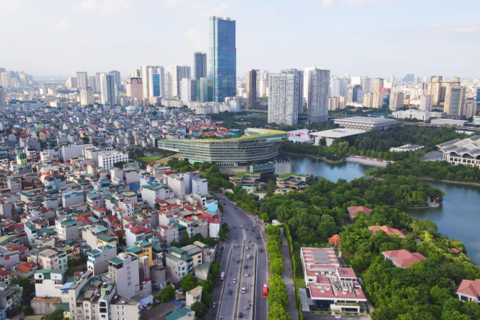
Ring road No. 3 in Hoang Mai District.
|
Mr. Thanh clarified more clearly with regard to each component of the transport infrastructure foundation. Such as the ring roads No. 1; 2; 2.5; 3; 3.5 4 and 5 are considered the essential parts, and meet the transport demand of not only Hanoi but also other provinces going through Hanoi to other destinations. Or 4 inter – provincial bus stations waiting to be constructed such as Yen So, Co Bi, Son Tay and Dong Anh; 6 underground parking lots (in the Ring road No. 3) along with other kinds of parking lots under the static transport network. However, these are seen as the receptive components, which coordinates a large part of movements going in and out of the city. Urban railway is also considered as a component of the transport infrastructure foundation, due to its difference to bus. As such, the urban railway has its own infrastructure system; the amount of transport demand for each route is significant higher than bus, which is the direct supply and coordinate the operational frequency of other public transport modes.
The importance and urgent needs to finalize the transport infrastructure foundation have bene specified in the Hanoi transport master plan until 2030, with vision to 2050, which is approved by the Prime Minister. The Minister of Transport Truong Quang Nghia said: ”Hanoi is not only a big urban area, but also the center for Red river delta development, which has a big influence to the development of Vietnam. As such, the city should finalize the transport infrastructure foundation as soon as possible, with a view to ensure the internal connection, and especially to connect with other regions in the country”.

Ring road no. 2- Nhat Tan bridge is an important route contributing to the socio-economic development of Hanoi.
|
During a recent meeting with the Ministry of Transport, the Chairman of Hanoi People’s Committee Nguyen Duc Chung said: “Hanoi identifies the development of transport infrastructure foundation is an important task for the socio – economic development of the city”. Recently, the Hanoi People’s Committee has issued “the proposal of constructing transport infrastructure foundation in Hanoi for the period 2017 – 2021, with vision to 2030”. Leaders of Hanoi People’s Committee said, at present, the priority is to specify the Hanoi master plan, which is approved by the Prime Minister; update and systemize the list of projects under the mid term investment plan in period 2016 – 2020.
With regard to road transport, Hanoi is striving to complete ring roads no. 1, 2, 2.5, 3 and 3.5, and constructing some sections of the ring road no. 4. The city will focus on investing bridges over Red and Duong river including: Tran Hung Dao, Thuong Cat, Tu Lien, Vinh Tuy phase 2, Giang Bien, Duong 2, among others.