Financial aid for the unemployed: A game-changer for elevating vocational training
Experts urged local authorities to provide more incentives for vocational training in Hanoi.
Hanoi authorities should provide lunch and travel assistance to those enrolled in unemployment insurance, according to Vu Thi Thanh Lieu, Deputy Director of the Hanoi Employment Service Center.
| Specialists at the workshop on vocational training for the unemployed. Photo: Duy Khanh/The Hanoi Times |
.jpg)
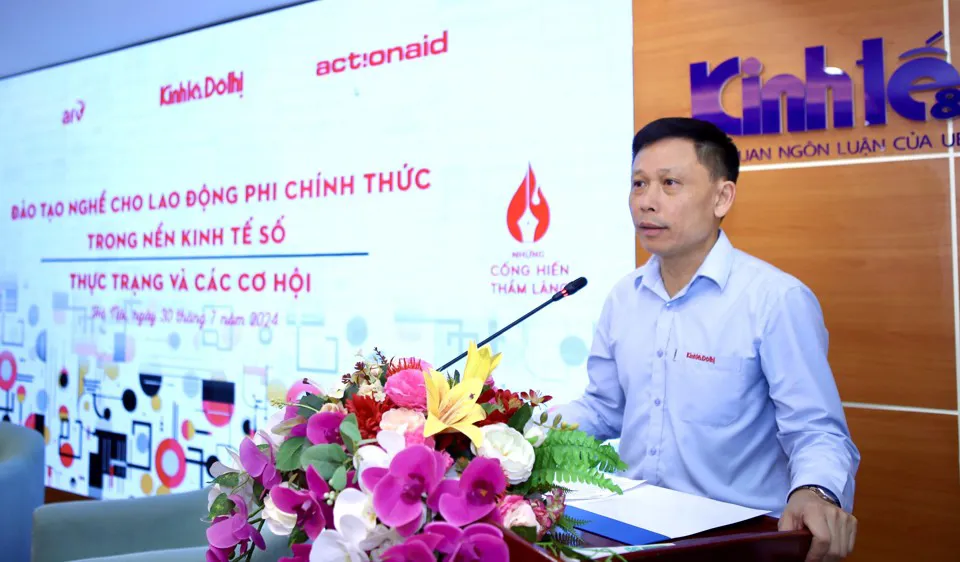
At a seminar on vocational training for informal workers in the digital economy hosted by Economic & Urban Newspaper/The Hanoi Times today (July 30), Lieu noted that unemployment insurance beneficiaries come from different provinces.
According to her, many find Hanoi's vocational training programs appealing and come here for training and job opportunities.
"Many workers told me that they would like more support to alleviate their difficulties. Unemployment puts them in a precarious position, as the unemployment insurance benefit is 60% of what they would have earned on average in the six months before they lost their jobs," Lieu said.
Lieu added that the Hanoi Employment Service Center provides free vocational training for workers who receive unemployment insurance. Through job fairs, the center collects labor market data to help job seekers find employment sooner. The partnership between her center and vocational schools is essential because the majority of unemployed workers do not have degrees or certificates.
She said that in addition to helping job seekers, career education institutions can use the information from job fairs to better align their curricula with the demands of the job market.
Ton Gia Hoa, Vice Chairman of the Vietnam Craft Village Association, suggested that experienced artisans and craftsmen should be allowed to participate in job training programs even without professional licenses.
Their real-world expertise frequently exceeds that of certain vocational instructors, he said.
In response, Dao Trong Do, Director of the Department of Continuing Education under the General Department of Vocational Training, said that the Ministry of Labor, Invalids and Social Affairs will soon propose amendments to training regulations, including vocational and handicraft training, to bring them in line with the training of craftsmen.
Regarding financial support for training, including meals, travel, and training costs, Do said the ministry has proposed to the government that the level of support be increased.
Short-term vocational training for workers in enterprises, the informal sector and those receiving unemployment insurance has long been a policy, he said.
| Ta Viet Anh, Chairman of the Foundation for Aiding Social Protection Program in Vietnam (AFV). Photo: Duy Khanh/The Hanoi Times |

According to Nguyen Thanh Loi, Editor-in-Chief of Economic & Urban Newspaper/The Hanoi Times, Vietnam had 33.4 million informal workers in the first six months of 2024, with an informal employment rate of 65%, up 0.2 percentage points from the same period in 2023.
Over 70% of the workforce has no education beyond primary school, highlighting a major challenge for Vietnam's labor market. This underscores how critical it is to raise workforce skill levels and provide access to training and certification programs in order to satisfy the needs of today's economy.
Some 35.3% of informal workers are in basic occupations, the highest proportion among nine occupational groups. Nearly 50% of female workers lack professional qualifications, especially middle-aged rural women and ethnic minorities.
Women workers in the informal sector often lack technical skills, which prevents them from changing jobs, even if their current jobs do not provide minimum living conditions. They also face challenges as the digital economy takes hold.
The Fourth Industrial Revolution has given rise to new types of informal economies, such as the "circular economy," the "sharing economy," and the "gig economy" based on online platforms. These forms of employment are growing, increasing the number of informal workers in Vietnam.
"Technology presents opportunities and barriers for workers, especially young informal workers who are untrained or have low skills. The Ministry of Labor, Invalids and Social Affairs has recognized these issues and proposed significant changes in the draft Employment Law," Loi said.
Ta Viet Anh, Chairman of the Foundation for Aiding Social Protection Program Foundation in Vietnam (AFV), emphasized that the lack of technical skills could be a major reason why informal workers struggle to transition to new jobs.
This is despite the fact that their current jobs often do not allow them to make ends meet, he said.
In addition, Anh said that the informal labor sector was under indirect pressure from the Fourth Industrial Revolution.
"In this digital age, technologies such as the Internet, digital tools, smart devices, and robots are being increasingly used in a variety of fields to replace people, help them, and meet their needs," he added.
| Economic & Urban Newspaper/The Hanoi Times Editor-in-Chief Nguyen Thanh Loi delivers his remarks. Photo: Duy Khanh/The Hanoi Times |