First three battery electric bus lines to be launched in Hanoi in December
The Hanoi People’s Committee has mapped out measures to put battery electric buses into service during the 2021-2025 period, with a view to encouraging the use of public transport among the locals.
Hanoi will start operating the first three battery-electric bus lines from December 2 and the city will add other six routes to its mass transit network by 2022, according to the Director of the Hanoi Department of Transport Vu Van Vien.
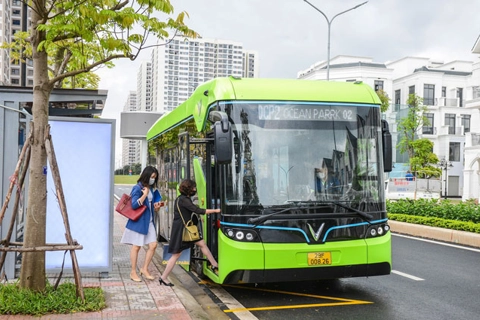
The three lines include the My Dinh (Ham Nghi)-Ocean Park, Long Bien-Cau Giay-Smart City, and My Dinh Station-Ocean Park lines, Vien said.
In the first quarter of 2022, Hanoi will continue to launch two more with one connecting Hao Nam with Ocean Park Urban Area and the other running from Giap Bat to Ocean Park Urban Area.
Four other lines would begin operation in the second quarter of 2022, including the Long Bien-Cua Nam-Smart City, Hanoi administrative building on Vo Chi Cong Street-Times City, Times City-Ho Tay Water Park, and the Smart City-Vincom Long Bien lines.
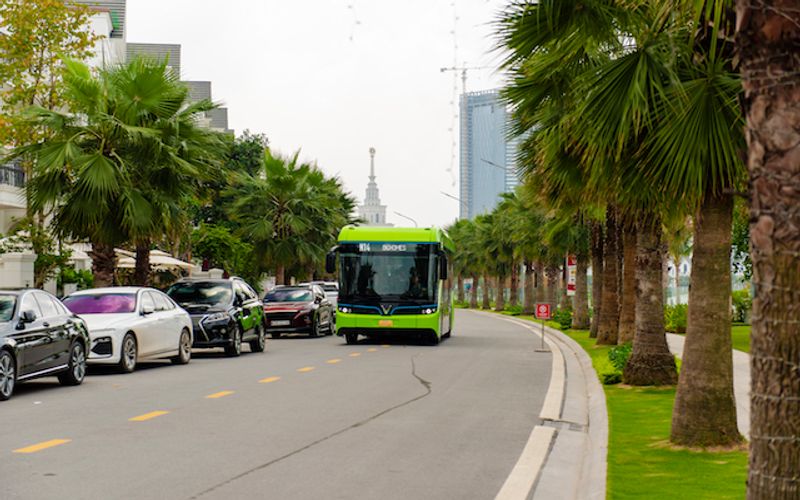
An electric bus manufactured by VinFast runs at the Vinhomes Ocean Park urban area in Hanoi's Gia Lam district. Photo: Van Trong |
"The bus fare will be the same as that of public buses using clean fuel (compressed natural gas) as approved by the municipal people's committee. The budget used to subsidize bus fare for the three lines this year would amount to over VND9 billion (over US$397,000)," the official told The Hanoi Times.
Such a pricing scheme would be temporarily applied for 12 months starting from the moment the bus lines come into use, Vien added.
Earlier, the Hanoi People’s Committee has mapped out measures to develop public transport, including a plan to put battery-electric buses into service during the 2021-2025 period, with a view to encouraging the use of public transport among the locals and deploying the plan to increase the battery-electric bus fleet.
The city will also reorganize traffic activities, giving priority to buses traveling through areas that are closed to car traffic. Besides, large capacity modes of public transport such as bus-rapid-transit units and the urban railway system will be prioritized.
Furthermore, the city will seek ways to improve public transport services, charge congestion fees, and gradually limit the entry of motorcycles to downtown districts in 2030 to increase the number of public transport users.
The Hanoi Transportation Corporation (Transerco) has proposed that 15-20% of buses operating in the city run on clean energy by 2025.
The proposal, being studied by the municipal Department of Transport, suggests increasing the number of buses in Hanoi by 90% to 3,400-3,800 by 2025, of which 15-20% operate on electricity and compressed natural gas.
The proposal, which targets to reduce emissions and air pollution in the city, expects over 25% of buses in Hanoi to run on clean energy by 2030.
Towards further development of the public transportation network, Transerco says that the city needs 13 new bus priority lanes with a total length of 60.8 kilometers. Its proposal includes setting up 1,500-2000 bus stops and 30-40 bus terminals in the new bus routes.
Hanoi currently has 126 routes using vehicles powered by fossil fuel and seven others that use buses fueled by compressed natural gas.
An electric bus service was launched in the capital city last April by VinBus Transport Services Limited Company, a subsidiary of Vietnam's conglomerate Vingroup. The service, the nation’s first smart electric bus service, runs within an urban area of Gia Lam District and will be connected to Hanoi’s mass transit network soon.