France grants EUR700,000 for Long Bien bridge restoration
The financing in the year of the 50th anniversary of diplomatic relations between France and Vietnam testifies to the close cooperation between the two countries.
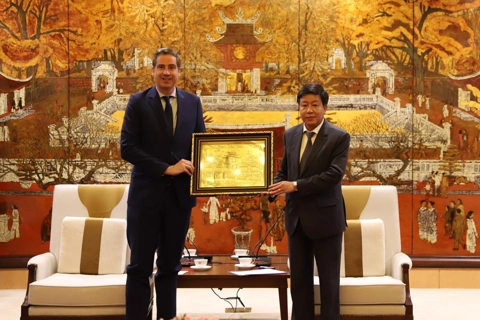
France has granted the Hanoi People's Committee over EUR700,000 (US$763,595) to conduct a feasibility study for the renovation of Long Bien Bridge - the iconic bridge in Hanoi, according to the French Embassy in Vietnam.
| Sunset on Long Bien Bridge. Photo: Duong Tran |
.jpg)
The non-refundable grant has been handed over to the Hanoi People's Committee.
The study, conducted by the French engineering firm Artelia and funded by the General Directorate of Treasury, was designed to minimize the impact of the renovation on road and rail traffic.
Conceived for rapid implementation, it will propose a renovation compatible with the future use of Long Bien Bridge, which is currently under discussion among various departments of the Hanoi Municipality. While the bridge's condition has deteriorated in recent years, the French side hopes the renovation work can begin as soon as the study's conclusions are available.
The Agence Française de Développement (AFD), which is closely involved in the project, is willing to discuss the financing of the subsequent works with the Hanoi authorities.
| The iconic bridge of Hanoi is a wonderful backdrop for photo shoots. Photo: Thu Tran |
.jpg)
Commenting on the funding of the feasibility study, French Ambassador to Vietnam Olivier Brochet said: "We hope that this study and, more importantly, the subsequent renovation work will not only secure the bridge but also transform this iconic heritage structure of our shared history into a facility that contributes to the radiance of the city of Hanoi."
Long Bien Bridge is considered an iconic structure, an integral part of Hanoi's heritage and urban landscape, and serves as a powerful symbol of the unique bond between our two countries.
The former "Paul-Doumer" bridge, designed in the Eiffel style, was built between 1898 and 1903 and suffered damage during the American bombing in 1967. It was subsequently restored by the Vietnamese authorities, in particular to ensure the continuity of traffic between Hanoi and Haiphong.
| Visitors across the bridge could still see a metal plate attached to the truss read "1899-1902 Daydé & Pillé, Paris". File photo |
.jpg)
In 2004, during his visit to Vietnam, French President Jacques Chirac announced that France would finance the rehabilitation of the Long Bien Bridge. Since then, France has funded several studies and expert missions.
According to Eric Gratton, General Director of Artelia Vietnam, Long Bien Bridge is an essential and exceptional work of art. "The company, which has been present in Vietnam for almost 20 years, will find the best renovation solutions for the benefit of Hanoi's citizens and sustainable mobility," he said.
Today, the iconic French-built bridge remains a landmark of the capital. The bridge is also the best place in the city to watch the sunrise or sunset. Many brides, grooms, and hip young locals choose Long Bien Bridge as the backdrop for their photos.
Built in 1903, the Long Bien Bridge was named after Paul Doumer, the French Governor General of Indochina. The first steel bridge built across the Red River connects Hanoi's Old Quarter with the suburban district of Long Bien. The bridge is a reminder of French technological innovation at that time. Under the guidance of French experts, more than 3,000 Vietnamese workers took on the challenge of building the bridge, using up to 30,000 cubic meters of stone and metals, including 5,600 tons of rolled steel, 137 tons of pig iron, 165 tons of iron, and seven tons of lead. The total cost of the bridge at the time was up to 6,200,000 French francs (about $70 million today). Construction of the Long Bien Bridge was originally scheduled to take 60 months, but it was completed in 45 months. Designed by the French firm of Daydé & Pillé, the bridge has a length of 2290 meters across the river and 896 meters of stone approach. Its 19 spans rest on 20 piers 40 meters high (including the abutments). The single-track railway bridge runs in the middle, while two side roads are used for motorcycles and bicycles (about 2.6 meters wide) and pedestrians (about 0.4 meters wide). The direction on Long Bien Bridge is left-hand traffic instead of right-hand traffic like other bridges. Meanwhile, cars are banned on the bridge. The Long Bien Bridge was almost destroyed by the US bombing from 1965 to 1968 and was rebuilt in 1973. In its more than 100-year history, the Long Bien Bridge was once the second longest bridge in the world (just after the Brooklyn Bridge spanning the East River in the US). It is sometimes referred to as "Hanoi's horizontal Eiffel Tower". ”. |