Fukuoka students begin homestay exchange program in Hanoi
The exchange program is part of the cooperation between Hanoi and Fukuoka Prefecture.
Forty-nine students from Japan’s Fukuoka Prefecture began living with Vietnamese host families in Hanoi today (August 7) as part of a cultural exchange program.
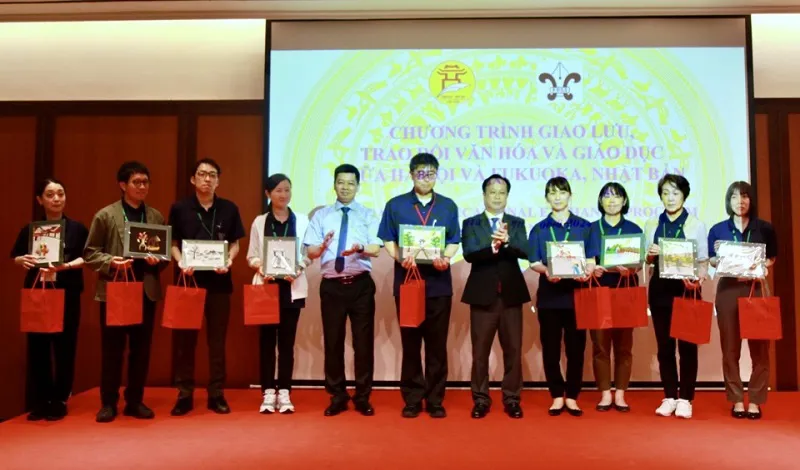
| Fukuoka students receive gifts from the Hanoi Department of Education and Training. Photo courtesy of the department |
For three days (August 7-9), the Japanese students will engage in cultural, educational, and historical exchanges at various schools in Hanoi through a homestay format.
They will also participate in sports activities, explore Hanoi's culinary culture, and visit famous landmarks and historical sites in the capital.
This is the sixth edition of this cultural exchange program between Hanoi and Fukuoka. Five participating schools in Hanoi are Viet Duc High School, Tran Phu High School, Phan Dinh Phung High School, Newton Secondary & High School, and Phenikaa Secondary & High School.
Representing Fukuoka Prefecture are Hakata High School, Mika Tsutsumi High School, Nakamura Gakuen Sanyo High School, Kyusyu International University, Iiduka High School, Nishi Nippon Junior College, and others.
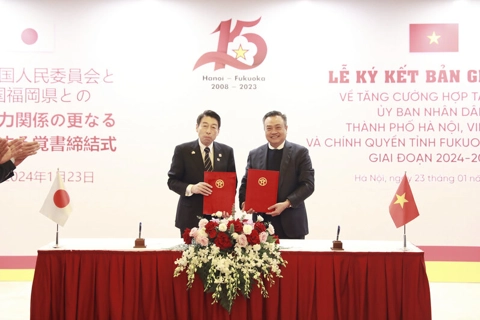
According to Tran The Cuong, Director of Hanoi's Department of Education and Training, the program aims to strengthen cooperation and friendship between his agency and Fukuoka's Private Education Association and expand bilateral relations between Vietnam and Japan, following the Memorandum of Understanding signed by between the two sides on January 23.
The program also facilitates the exchange of information and experience in educational management and teaching, especially in Vietnamese and Japanese, he said.
Japanese students will have the opportunity to learn more about Vietnam, develop their affection for the country and promote Hanoi's image to international friends, Cuong said.
"This program will further enhance mutual understanding and friendship between the two nations, especially among students and schools in Hanoi and Fukuoka," said Tran The Cuong.
Tomoyuki Mizoguchi, head of the Fukuoka delegation, said it was a precious opportunity for Japanese students to learn about Vietnamese culture, including its cuisine.
This valuable activity strengthens cultural exchanges between the two cities and provides Fukuoka teachers with an opportunity to visit Hanoi schools and gain insight into Vietnam's progress in education.
The Japanese official believed that Fukuoka students would be warmly welcomed by schools and families and that both Vietnamese and Japanese students would deepen their understanding of each other's cultures.
The true meaning of the exchange program is to enable the young generations to overcome their barriers and limitations and seize potential opportunities to achieve a bright future, he said.
Speaking on behalf of the Hanoi students, Ha Phuong from Phan Dinh Phung High School expressed her excitement and eagerness to spend time with Japanese friends.
"I am honored and excited to welcome Japanese friends to my home for a few days. This will surely be a beautiful memory in my school life," she said.