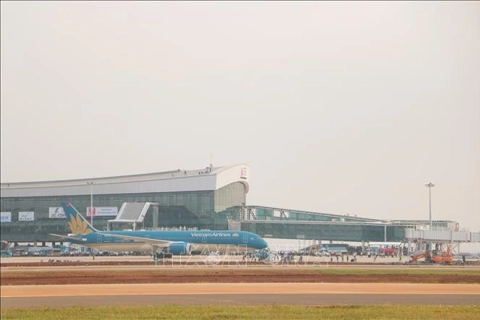
Gia Lai Province to build $228-million seaport
Phu My Port, worth an investment of US$228 million, is one of the nine ports to be built in the central coast province of Gia Lai by 2030.
THE HANOI TIMES —The Vietnamese government has approved a VND6 trillion (US$228 million) investment plan to develop the first phase of Phu My Port project in the central coast province of Gia Lai.
The development of Phu My Port is part of a national plan that aims at shaping up all industrial and sea ports until 2030.
According to the Ministry of Construction, the facility will span 205 hectares in Phu My Dong Commune, including 60 hectares of land and 145 hectares of sea surface.
Its construction will begin in September 2026, with operation expected by October 2028.
The port will be directly connected to Phu My Industrial Park, facilitating the transport of goods, materials, equipment, containers, and liquid or gas commodities.
Phu My port is expected to handle between 3.8-4.4 million tons of cargo annually by 2030, processing diverse categories including liquid goods, containers, materials, equipment, bulk cargo, and specialized energy equipment.
Initial operational capacity from 2028 is projected at 2.4-3 million tons per year for general and container cargo, with an additional 1.4 million tons annually dedicated to liquid and gas shipments.

Cai Mep - Thi Vai deep-water port in Gia Lai Province can receive two large tonnage ships at the same time. Source: Gemalink
The seaport system of Gia Lai Province is expected to handle 17.6 -18.7 million tons of goods per year by 2030. The system will comprise nine ports and 20 wharves, with a total quay length of over 5,100 meters.
The total land use demand for Gia Lai seaports by 2030 is about 217 hectares, excluding the area allocated for industrial parks and logistics.
Phu My owns the Cai Mep - Thi Vai deep-water port, which is the 19th largest port in the world. It is also one of the fastest-growing ports in Vietnam, handling nearly 35% of Vietnam's total container cargo and 50% of the southern region's cargo.
Especially, it is one of two port complexes in Vietnam which is capable to receive ultra-large container ships going directly to Europe and the Americas without transshipment.
Vietnam will need more than VND359 trillion (US$14 billion) to develop its seaport system by 2030, including numerous new projects in the central province of Gia Lai.
Under the Ministry of Construction's new plan, this investment capital demand is allocated for public maritime infrastructure and for ports providing cargo handling services.
The total demand for seaport land nationwide by 2030 is around 34,000 hectares, of which 17,500 hectares are designated for seaports, with the remainder allocated for industrial parks and logistics associated with ports. These figures represent a notable expansion compared to earlier plans.
The demand for water surface is about 606,000 hectares, excluding 900,000 hectares of managed water areas without maritime works.
This signifies a significant expansion compared to previous planning, indicating the growing scale of maritime activity and the need for enhanced infrastructure.
The expansion is driven by the anticipated growth in cargo volume and the need to modernize Vietnam's seaport infrastructure to handle larger ships and increased trade.
The planning adjustment is expected to help the Vietnamese seaport system, especially in Gia Lai Province, to develop synchronously, improve capacity for goods handling, and support the country's economic growth.