Vietnam’s aviation sector sees solid recovery in Jan-Jul
Airports across Vietnam bustle with both passenger and cargo operations in the first seven months of this year.
THE HANOI TIMES — Vietnam’s aviation industry posted robust growth in both passenger and cargo traffic in the first seven months of 2025, driven by surging international demand, according to the Civil Aviation Authority of Vietnam (CAAV).
From January to July, airlines carried over 42 million passengers, representing an 11% year-over-year increase. International travelers accounted for over 23 million, up 13% from the same period last year.
Cargo operations also saw double-digit gains. Total freight volume reached nearly 750,000 tons, a 15% increase year-over-year, with international shipments rising 18% to approximately 600,000 tons.
These positive figures indicate a steady recovery and growth trajectory for Vietnam’s aviation industry, particularly in international transport, following the disruptions caused by the Covid-19 pandemic and global instability.
Airlines requested to tighten aviation safety and security
Prime Minister Pham Minh Chinh, in Directive No. 21/CT-TTg dated August 12 asked the aviation sector to enhance measures to ensure safety and security.
In the directive, the prime minister noted that that Vietnam’s civil aviation industry has rebounded strongly since the Covid-19 pandemic, serving 75.5 million passengers and handling 1.29 million tons of cargo in 2024, up 4% and 21% year-on-year, respectively.
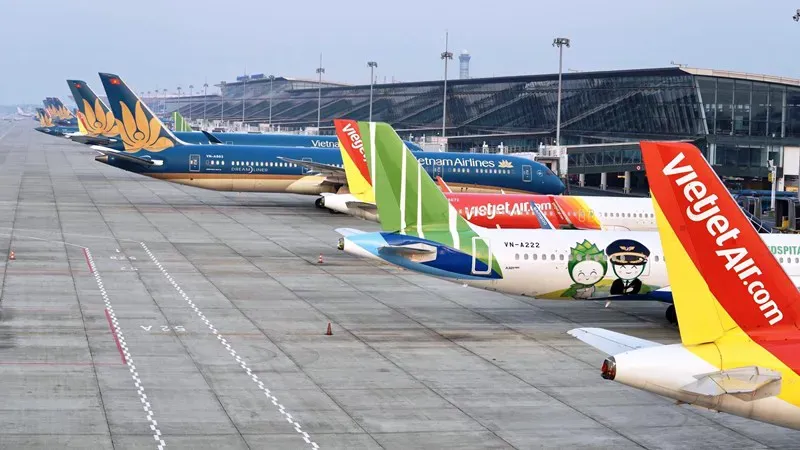
Aircraft at Noi Bai International Airport in Hanoi. Photo: Viet Hung/The Hanoi Times
However, recent incidents, most notably a collision involving two aircraft at Noi Bai International Airport, have raised concerns about operational safety. Besides, the government cited prolonged flight cancellations and delays that have disrupted airport security and public order, alongside cyberattacks on airline websites leaking customer data.
Therefore, airlines have been requested to strictly comply with regulations and safety standards while ensuring on-time departure.
The Ministry of Public Security (MPS) has been tasked to preside over and coordinate with ministries and localities to effectively implement measures to ensure aviation security, along with inspecting and supervising aviation security control forces.
High-tech solutions such as artificial intelligence (AI), biometric identification must be promoted to improve the effectiveness of aviation security inspection.
The Ministry of National Defense is responsible for updating regulations on the management of unmanned aerial vehicles (UAVs), tightening control over restricted airspace, and responding to unauthorized drone activity.
PM Chinh also requested the People's Committees of provinces and cities with airports to resolutely implement solutions to prevent the use of large-capacity light sources, laser lights, kites, drones, and other flying vehicles.
Strictly handling violations for aviation safety
Prime Minister Pham Minh Chinh ordered that the aviation safety and security management system must meet international standards while complying with domestic legal frameworks.
The government leader's request calls for the upgrade of aviation infrastructure to ensure operational safety, and enhanced safety inspection mechanisms, including improving the capacity of aviation safety inspectors in line with the International Civil Aviation Organization’s standards.
It stressed regular and surprise safety inspections of airlines, flight service providers, and airports to improve service quality and ensure aviation safety.