Green consumption for sustainable development in Hanoi businesses
Hanoi's businesses are increasingly aware of the green transition, from ideas to concrete actions.
Businesses in Hanoi have embraced the trend of green consumption and are embarking on a green transition to stay afloat and seize opportunities to move toward sustainable development.
Due to the increasing awareness of green products, many enterprises in Hanoi promote green consumption and have made significant progress in the green transition. They have seized the opportunity to improve business efficiency and dominate the market by building trust in brands through a commitment to social and environmental responsibility.
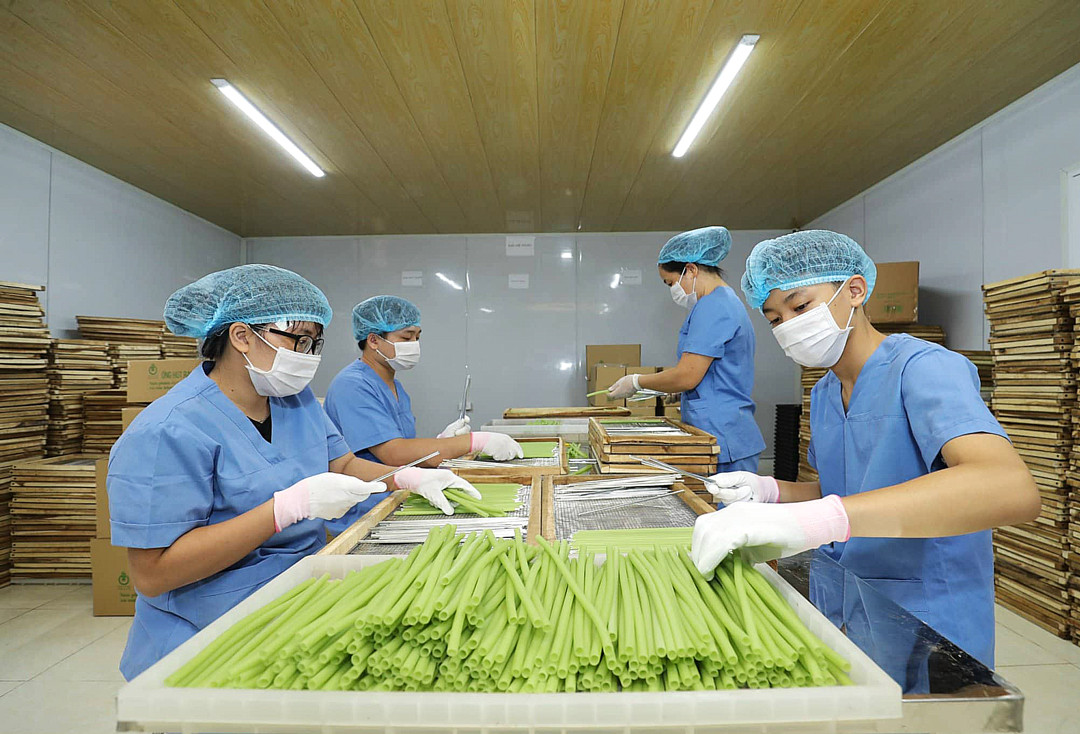
Production of straw from agricultural products at the Song Hong Agricultural Service Cooperative in Hanoi's Dong Anh District. Photo: Hanoimoi |
Nguyen Doan Ket, deputy general director of Rang Dong Light Source and Vacuum Flask Joint Stock Company, told The Hanoi Times that during the development process, the firm always focuses on investing in modern machinery and equipment for sustainable development.
"Currently, we use electric furnaces, which have no dust, no smokestack, no CO2 or SO2 emissions, and use energy very efficiently. Thanks to digital technology, our production system is becoming green," said Ket.
As one of the Vietnamese vegan cosmetic brands, Herb n' Spice products use carefully selected natural ingredients such as pine oil from Da Lat pastures, goat milk from Ninh Thuan pastures, U Minh forest honey, Cau Dat green tea, and others. The products are made locally, reducing CO2 emissions and being environmentally friendly.
Similarly, TimTay is a "purely Vietnamese" designer fashion brand that has been pursuing a sustainable and eco-friendly lifestyle for nearly 10 years, using natural materials such as pure silk, cotton, and linen to minimize the negative impact on the environment and bring a sense of comfort to the wearer.
According to NielsenIQ Vietnam, a global data analytics and measurement company headquartered in the US, consumers are increasingly attaching importance to sustainability. About 55% of consumers surveyed by the firm in 2023 valued the sustainability factor in consumption. "Important factors when consumers choose a brand were reasonable price, safety and hygiene, good for health, reliable brand, sustainability, and environmental friendliness," it said.
As evidence, it added that 49% of consumers bring their own bags or use recycled bags when shopping. 47% buy only essential items to reduce waste. 45% of consumers consciously sort recyclable waste and save electricity at home.
Specifically, 59% of consumers choose to eat green vegetables and grains more often, 61% prioritize using natural light as much as possible, and 44% reuse old clothes instead of buying new ones unnecessarily.
The study also shows that consumer segments are increasingly aware of green consumption, with 24% saying they live green to save money and 22% saying they do so for health reasons.
For manufacturing companies, NielsenIQ Vietnam offers short-, medium-, and long-term solutions, suggesting companies replace or reduce plastic in packaging, develop carbon-neutral factories and farms, use electric vehicles, and develop regenerative agriculture.
NielsenIQ Vietnam's analysis showed that Hanoi's businesses are increasingly aware of the green transition, from ideas to concrete actions. Many companies have proactively innovated and promoted in-depth model transformation related to both sustainable and green development.
A product with an environmentally friendly production or packaging process is often more competitive. According to a recent report by BigC supermarket in Hanoi, 31% of customers are willing to pay more for products that support environmental protection.
Le Manh Phong, General Manager of Hanoi Go/BigC system, spoke to The Hanoi Times: "We are aware of the changes in customers' attitudes. Environmentally friendly products bring competitiveness to businesses. Sales of eco-friendly products have increased, which is a good sign. To speed up this process, we expect synchronization between government policies and the actions of businesses and consumers.
As the economy grows, people's living standards are improving, and so is the demand for high-quality and safe products and services. Promoting green consumption is the driving force for companies to quickly shift to sustainable production and catch up with market demand and the green consumption trend," Phong stressed.
Appropriate support mechanisms and policies needed
Nguyen Dinh Tho, director of the Institute of Strategy and Policy on Natural Resources and Environment, said the digital economy and green economy will help Hanoi rapidly become a developed high-income city by 2045.
Many shoppers buy vegetables wrapped in banana leaves at the Big C Thang Long supermarket in Hanoi. Photo: Anh Kiet/The Hanoi Times |
.jpeg)
"To seize the opportunities, Hanoi needs a green transition strategy with specific and synchronized targets and roadmaps. Therefore, enterprises need to think innovatively and invest in technology in production and business to improve competitiveness," Tho said.
He added that regulators have completed mechanisms and policies to help enterprises access capital and resources to reduce production costs and improve competitiveness.
"The Hanoi government has implemented various activities related to sustainable production and consumption. To build trust and encourage consumers to use green products, the authorities have vigorously promoted communication efforts aimed at helping people understand the benefits and values that green products bring to their lives, both in the short and long term," Tho said.
He emphasized that the next step is to formulate and implement policies aimed at encouraging and supporting enterprises and manufacturers to adopt and invest in the application and research of green product manufacturing technologies, including reducing the cost advantage of non-environmentally friendly products over green products.
"Hanoi has also paid attention to strictly control the use of polluting energy sources (firewood, coal) and littering behavior; encourage the research, exploration and possible use of alternative energy sources in the future, while saving resources and protecting the environment, while promoting green consumption," Tho said.
In particular, he emphasized popularizing energy-saving products and guiding people to choose energy-saving and affordable electrical equipment to replace existing electrical equipment, such as compact fluorescent lamps instead of incandescent lamps, and automatic circuit breakers.