Hanoi accelerates efforts to promote sustainable transportation
Part of the plan is to set up low-emission zones where polluting vehicles will be kept out.
Hanoi grapples with growing challenges in air quality management, prompting the city's green transportation initiatives under the amended Capital Law.
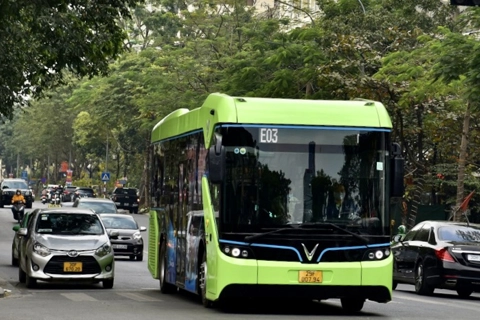
| A green bus in Hanoi. Photo: Dang Khoa/The Hanoi Times |
The city has recently been consistently ranked as one of the most polluted cities in the world, according to various environmental metrics. This situation has many reasons, including the increasing density of motor vehicles.
In response, Hanoi incorporated environmental protection policies into the Capital Law 2024, which was approved by the National Assembly last year. Specifically, to improve air quality, Clause 6, Article 3 of the Capital Law establishes low-emission zones to keep polluting vehicles to a minimum.
Capital Law 2024 strengthens the authority of the Hanoi People’s Council, granting it the power to enact special policies and breakthrough solutions for investing in underground infrastructure and easing traffic congestion. The law also sets out the fundamental principles for urban development based on transit-oriented development and the construction of mass transit systems. The priority is the urban railway system, supported by preferential mechanisms and policies.
Vice President of the Vietnam International Law Association Nguyen Hung Quang said the transit-oriented development model was particularly suitable for large cities like Hanoi.
“This approach will help redistribute the population from the city center to the surrounding areas, increase the use of public transportation, reduce reliance on private motorized vehicles, and thereby mitigate pollution, congestion, and road accidents while promoting sustainable urban development,” he said.
| Cat Linh - Ha Dong metro line. Photo: Cong Hung/The Hanoi Times |

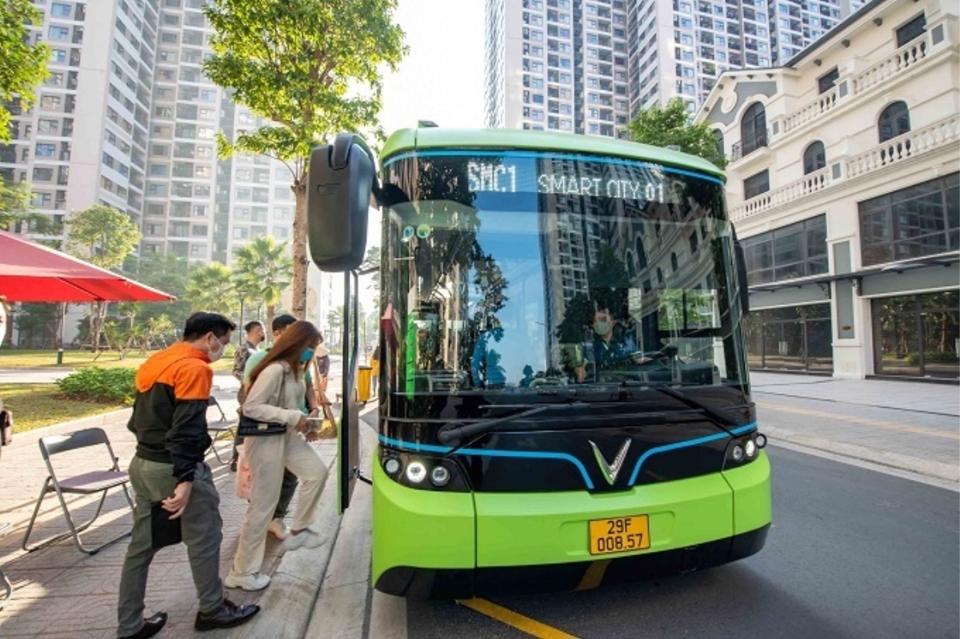
To achieve sustainable air quality improvements, Hanoi will establish low-emission zones and accelerate the transition to green transportation, aiming to curb CO2 and other harmful emissions. The municipal government has recently approved a project to develop a public transport system using electric and green energy buses.
This project outlines the roadmap for transitioning to electric and green-energy buses, following the plan approved by the Prime Minister in Decision 876/QD-TTg dated July 22, 2022. It also proposes solutions to achieve a 100% transition to electric and green energy buses by 2035. In 2025, Hanoi will replace large diesel buses that have ended their depreciation period or contract term with electric buses. The initial phase will see the replacement of 103 vehicles, accounting for 5% of the total transition.
Starting in 2026, the city plans to establish technical and economic standards, along with a full pricing framework for various types of electric buses. Operators will systematically replace buses that have exceeded their ten-year depreciation period. Between 2026 and 2030, Hanoi aims to convert 1,813 buses to achieve a conversion rate of 93.4% by 2030. In the final phase, from 2031 to 2035, a further 238 more buses will be replaced to ensure, a 100% conversion by 2035. The total estimated cost for this initiative is approximately US$1.93 billion, with about $1.43 billion coming from the city budget and $500 million from private enterprises.
Associate Professor Bui Thi An, a former member of the National Assembly's Committee on Science, Technology, and Environment, recognizes that as environmental pollution becomes an increasing challenge, these measures will significantly transform Hanoi’s urban transport landscape and traffic culture while reducing congestion. However, she emphasizes that the city must improve public infrastructure, ensure better connectivity among bus routes, and strengthen the integration between transportation and urban planning to encourage public transit use.
“Only then can Hanoi become a greener, healthier, and more livable city,” An said.