Hanoi artisans keep the fire of blacksmithing
Through many ups and downs of history, the talented smiths of Hanoi’s old Hoe Thi craft village in Hanoi’s suburbs have still persistently kept their ancestor’s trade.
Located on the bank of the Day River, Hoe Thi ancient village or today’s Phuong Canh Ward, Nam Tu Liem District is famous for its two traditional crafts, blacksmithing and tin soldering.
| Blacksmithing and tinsmithing are hereditary professions in Hoe Thi village. Photos: Suc khoe & Doi song |
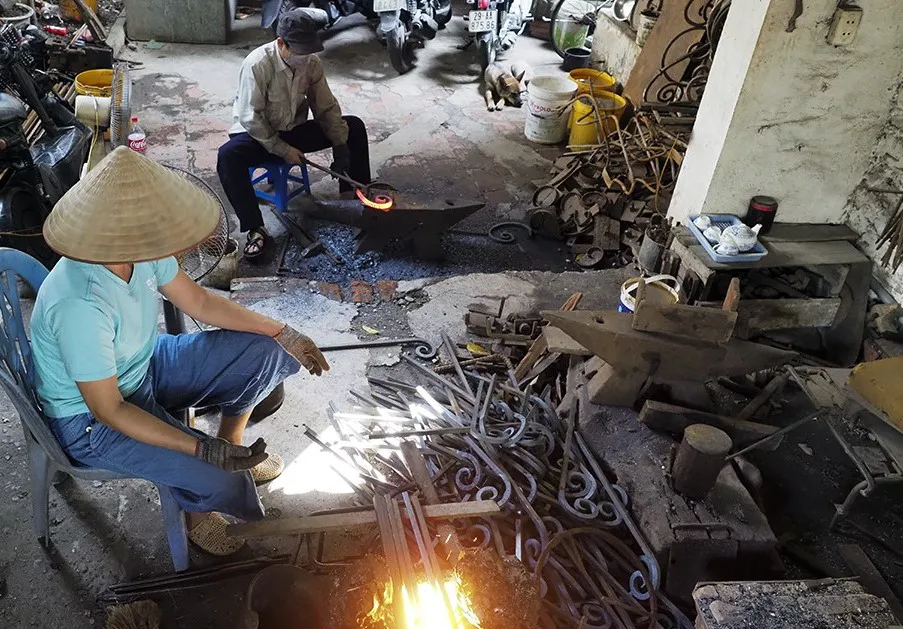
According to Dr. Bui Xuan Dinh from the Vietnam Academy of Social Sciences, since ancient times, blacksmiths in Hoe Thi village have carried their furnaces and working tools everywhere to forge knives, scissors, sickles, hoes, and shovels, around Thang Long Citadel or today’s Hanoi.
By the end of the 19th century, the talented workers of Hoe Thi craft village settled down on Sinh Tu Street or nowadays Nguyen Khuyen Street and Lo Ren Street in Hanoi's downtown.
“The craftsmen of Hoe Thi village used to set up a communal house in the attic at house No. 1 Lo Ren Street for the tinsmiths and blacksmiths dwelling in the area to worship their ancestors on the occasion of Lunar New Year or ancestors’ anniversaries,” he stated.
“The products of the blacksmithing craft in Hoe Thi village are cutlery, duc chang or wood chisels, hinges, door hooks, and pliers, among others. Meanwhile, the goods of the tinsmithing trade are all kinds of barrels, water jugs, among others,” he added.
Ancient trade on modern streets
In today’s Phuong Canh Ward, formerly known as Hoe Thi Village, the residents are still keeping the trade of making forged items of various types and sizes, most of which are hand-crafted.
At present, the village has taken on the appearance of bustling streets, and forges can only be seen in a few houses. Asking the residents - mostly from other places, only after a while were we able to find someone who knows the smithy of Nguyen The Thang (54), the well-known scissors smith in the village.
| There are only some households in the ancient Hoe Thi Village or Nam Tu Liem District today still keeping the trade of blacksmithing. |
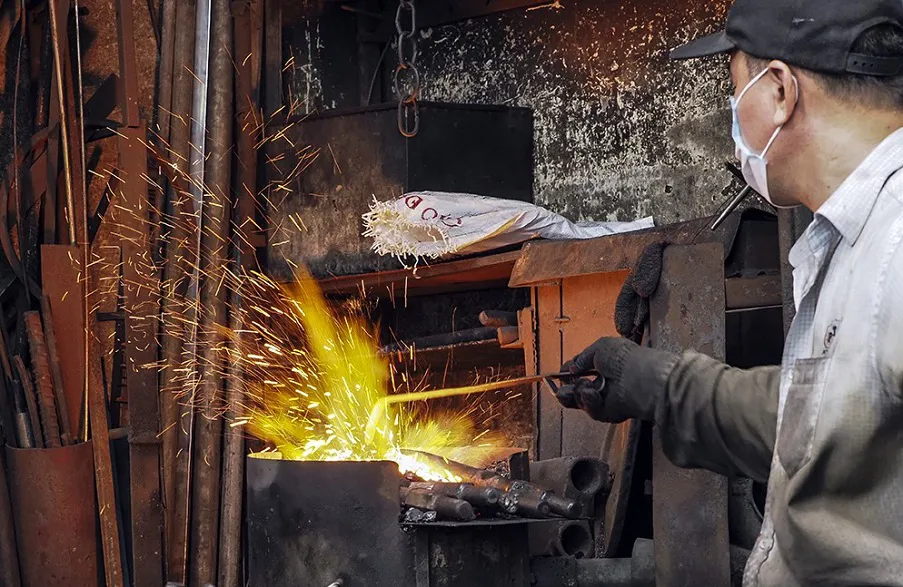
The bellows are placed in front of his house, which is close to the communal house - a rustic and familiar space with ancient and sacred features, further accentuating the portrait of one of the rare blacksmiths who still preserve the craft.
Thang slowly told the story of the skilled blacksmiths who still keep the fire of passion. Despite their advanced age, they not only carry on the work in the home village but also went to other markets in the region to sell and repair farm tools and household items for people.
They make up the typical traits of each market. Thang’s story carried vague regret, but also glimmers of love for the work, which no one does alone.
In fact, each group of blacksmiths usually consists of three people: a foreman, a hammersmith, and an assistant squeezing bellows, sharpening and brightening products. There is no specific recipe or pattern for these craftsmen. Skilled ones must have a talent for observation, good sense, as well as a lot of experience to be able to control the temperature, and determine the heat of a piece of steel to make products that are hard but not brittle, pliable but not soft.
Like many handicrafts, the prestige of blacksmithing is earned through relentless efforts, besides the creativity and talent of an artisan.
The desire to pass on the fire
| Ironworks made by blacksmiths from Hoe Thi village used to be very famous nationwide. |
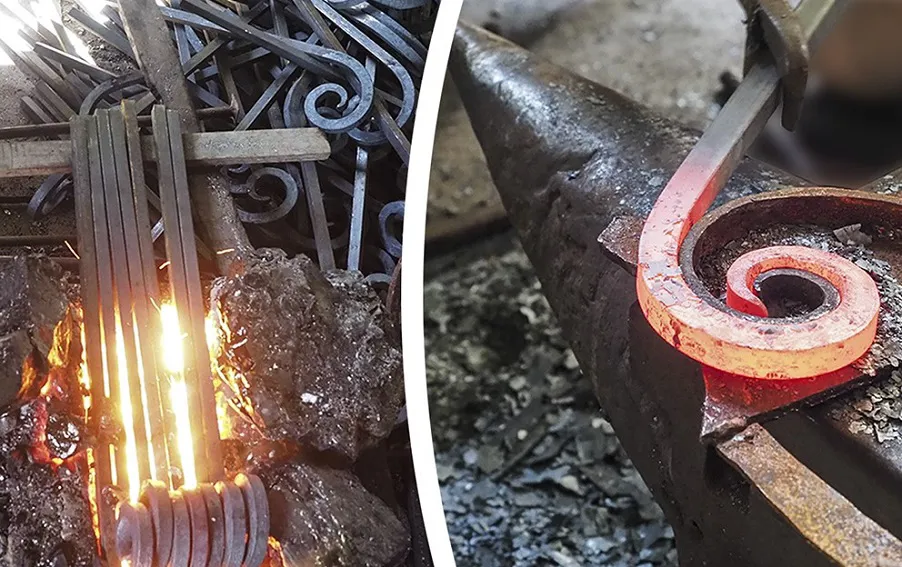
The issue of passing on the craft of blacksmithing arises many years ago, but until now it is still a question that even the most passionate smiths don’t know the answer to.
From independent household businesses, the family of Thang’s father and others enthusiastically joined Xuan Tien Handicraft Cooperative, established in 1959.
As a member specializing in forging farm tools, cutlery, and mechanical tools for the State, his father passed down all the know-how, passion, and memories to his descendants.
The atmosphere of working together, sharing the joys and hardships among blacksmiths during the time they worked for a cooperative still remains in each story Thang tells today.
In 1984, the cooperative was dissolved, leaving wistfulness in the minds of the craftsmen.
Decades have passed, from a young man passionately squeezing bellows and hammering to a gray-haired man, Thang is still involved in forging knives and scissors since early in the morning for shop owners in Nguyen Khuyen and Thuoc Bac streets.
The glimmer of joy in smith’s story is that many famous, multi-generational tailoring brands only use Hoe Thi scissors, due to their firm grip, precise cutting, durability, and small tips. Some of them are still sold for millions of VND on the market, and skilled tailors will recognize the brand of the craft village at once.
The hereditary trade
| The prestige of blacksmithing is earned through relentless efforts, besides the creativity and talent of an artisan. |
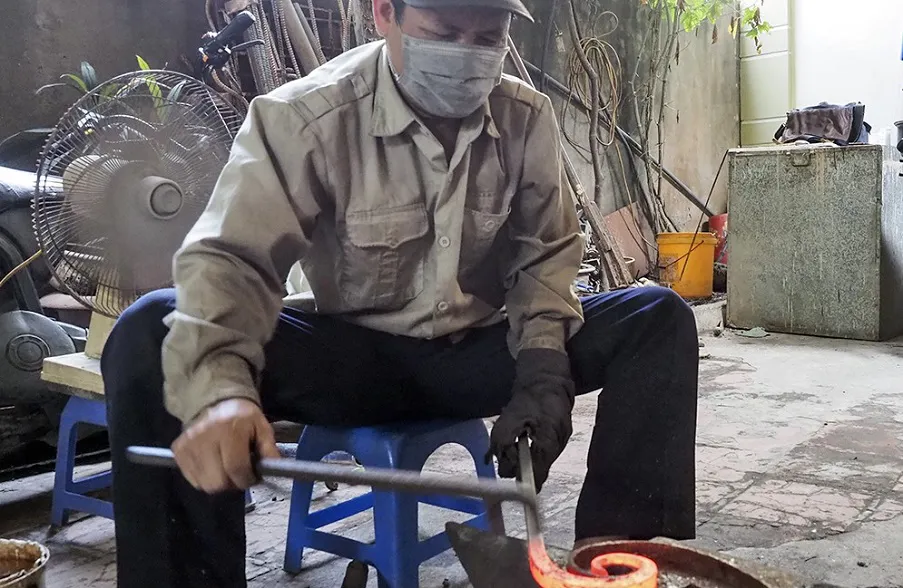
Living not far from Thang’s house is the household of Vu Dinh Cuong (55), which specializes in forging knives of all kinds. As the third generation in the profession, Cuong made no secret of his pride in his father, a skilled blacksmith who used to work for the State at Phuong Dong No 4 Cooperative at 89 Sinh Tu Street in the past.
On the issue of passing the handicraft on to the next generation, he admitted that good craftsmen are now old and will gradually retire, while the succession is not secured as the society is changing too quickly, and young people prefer new occupations that fit the times.
Nguyen Phuong Hung - one of the last manual smiths in Lo Ren Street, Hanoi, said that he still dedicated himself to the job over 10 hours per day, earning about VND1-1.5 million or some US$80.
The New York Times once run an article about him, praising the strong, persistent craftsman who stays with his work amidst the changes of life.
| For centuries, Hanoi artisans keep the fire of blacksmithing in Hoe Thi Village. |
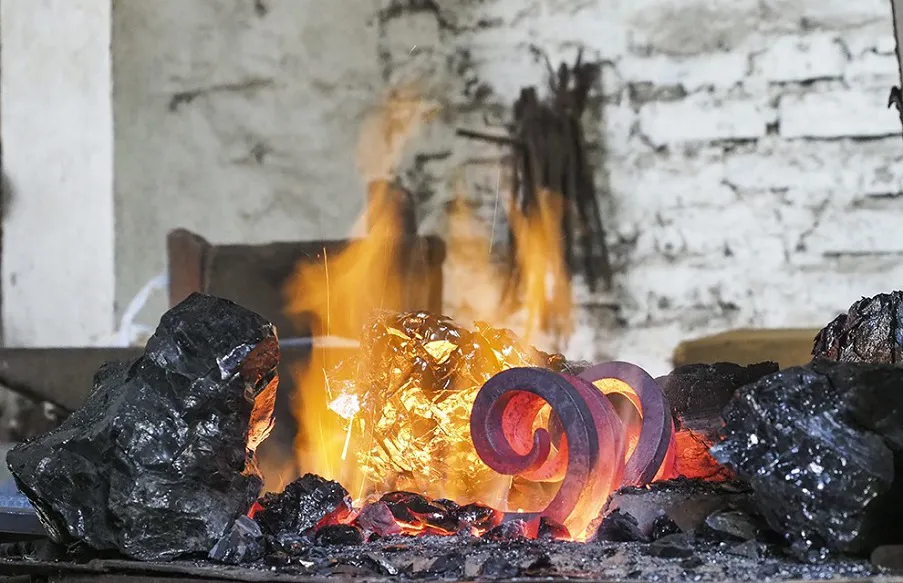
Not only for the purpose of making a living, but his genuine desire is also to keep the glorious blacksmithing in the past alive. Wherever he goes, he always proudly tells the people that he is a villager of Hoe Thi forging village. Talking with smiths like him, we realized that deep in their quietness was a sparkling pride in the profession they inherited from their predecessors.
In the small corners of chaotic modern life, the practical and spiritual values that handmade products bring are still undeniable.
For craftsmen who love their hammer-handling work, as long as there are tailor shops looking to buy Hoe Thi scissors, families carefully choose irreplaceable agricultural tools despite the mechanized agriculture – the fire sparks still flash, and the passion that the smiths carry from their youth still shines.