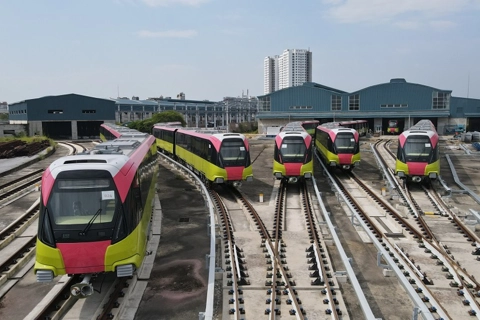
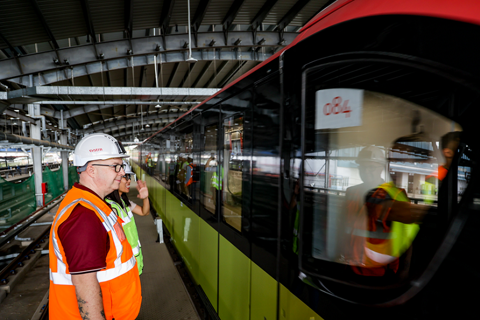
Hanoi earmarks US$55.4 billion to build 600-km metro network by 2045
The completed metro system is projected to carry around 3.2 million daily trips, making up 35-40% of public transport in urban hubs and 20% in suburban zones.
Hanoi has finalized its plan to build a 600-kilometer metro system by 2045, using innovative strategies and legal mechanisms to secure $55.4 billion in funding.
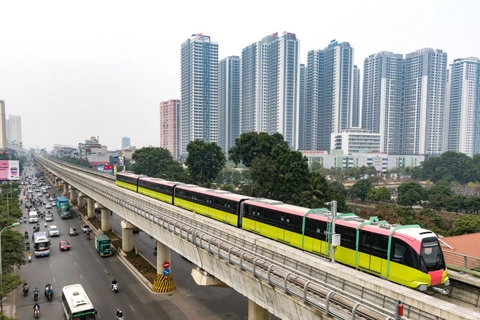
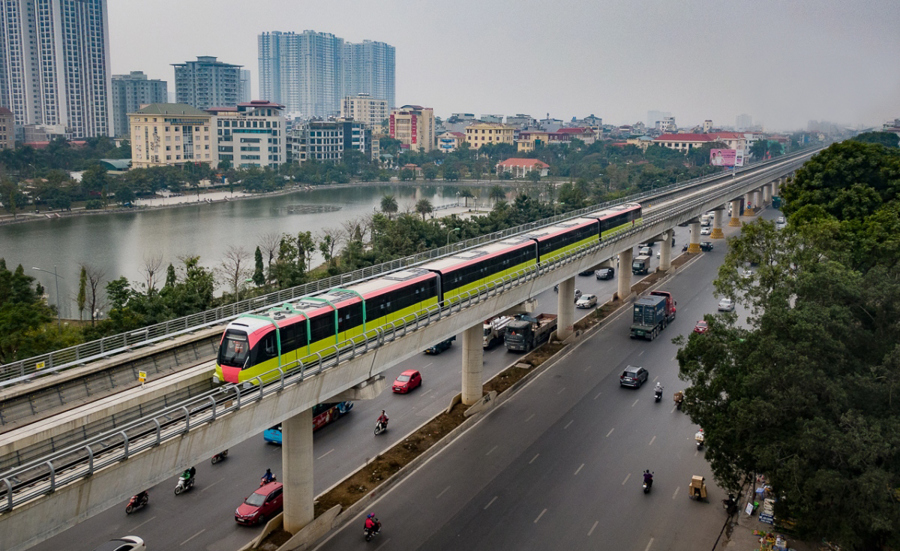
| Hanoi - Nhon Station metro line. Photo: Hai Linh/The Hanoi Times |
Ambitious plans
According to Capital Transport Planning, the market share of public passenger transport in central urban areas should reach 50 - 55% by 2030 and around 65 - 70% after 2030.
“This goal cannot be achieved without the development of a comprehensive metro system,” noted the plan.
Once operational, the metro system is expected to carry approximately 3.2 million passengers per day, accounting for about 35 - 40% of the public transport market share in central urban areas and around 20% in suburban areas.
Hanoi, on the other hand, has set itself the goal of becoming a modern city, with public transportation development (following the TOD model) as the basis for urban planning. The main objective of TOD is to build a modern city integrated with metro lines.
Transport expert Vu Hoang Chung said that the role of the metro is crucial and indispensable, contributing to solving traffic congestion, reducing environmental pollution, and boosting economic and social development, thus enhancing the city's competitiveness.
However, for many years, metro projects have faced numerous difficulties, especially regarding mechanisms, policies, and funding.
“Hanoi's metro projects lack a specific implementation plan. We are dealing with a new type of construction which has confused both the city government and the implementing units. Unforeseen difficulties and lack of preparedness to cope with them have set back the progress of Hanoi's metro projects by decades," he noted.
To have a comprehensive, specific, and detailed scenario, Hanoi has developed the "Comprehensive Investment Project for the Construction of the Capital's Metro System", which serves as the basis for the development direction and experimental mechanisms and policies for investment and construction of Hanoi's metro system.
The project has set goals, a roadmap, and investment plans for Hanoi’s metro system until 2035.
Specifically, the Hanoi Metropolitan Railway Management Board has proposed a "1 plan, 3 phases" plan, including: by 2030, the city aims to put into operation approximately 96.8km of rail (24%); by 2035, complete the metro system according to the Capital's Transport Planning (10 lines with 397.8km); by 2045, complete additional metro lines as proposed in the adjusted Capital General Planning (5 lines with 196.2km).
Preliminary investment capital requirements for the total of 15 metro lines in Hanoi are estimated at around $55.442 billion. This includes about $16.2 billion from now until 2030; about $21 billion from 2030 to 2035; and roughly $18.26 billion from 2035 to 2045.
Hanoi will need to mobilize capital from ODA loans, national budget support, and city budgets to meet this huge capital demand, noted the agency.
Favorable legal environment required
Deputy Director of Hanoi Department of Planning and Investment Le Trung Hieu noted that the city has identified the difficulties regarding the policy mechanism for metro development.
“Recently, Hanoi has organized numerous workshops and conferences to listen to and absorb the opinions of managers and academics from home and abroad and to filter and learn from the experiences to shape the policy framework for Hanoi's metro development," said Hieu.
In summary, Hanoi has proposed six groups of breakthrough solutions that form the basis for opening up the metro system.
Firstly,s proposed to decentralize and delegate to Hanoi and Ho Chi Minh City the authority to issue criteria and standards for each city's urban areas as well as specific procedures for adjusting the related metro system planning, closely linked to the urban development restructuring in the surrounding urban areas (development of the TOD model), to ensure the fulfillment of the urban development goals as defined in the Resolutions of the Central Government and each city.
Secondly, it identifies metro projects integrated with TOD areas near stations as public investment projects to combine urban development, urban restructuring, and land auction revenue to invest in building the metro system.
Thirdly, it proposes organizing auctions for the right to implement TOD urban development projects after land clearance and land requisition. Auctioning the right to develop TOD urban areas, allows both cities will be able to retain the land revenue to directly invest in metro system development projects.
Fourthly, it suggests issuing local bonds, project bonds, or other legal forms of capital mobilization in excess of the public debt ceiling, applied to each city annually and throughout the period until 2035, to ensure sufficient capital for metro system development projects.
Fifthly, it proposes that the National Assembly delegate to the two cities the authority to determine the localization ratio for each component of the project according to the capacity of domestic contractors/companies, gradually increasing over time at each stage.
Lastly, it involves selecting a model and deciding to establish a General Corporation for investment management, construction, development, and operation of the metro/TOD system with multi-sectoral business functions, with financial autonomy to ensure sufficient investment budget, operation, and maintenance of the UPT system.
Transportation expert Vu Hoang Chung suggested that the six proposed solutions address the longstanding difficulties and obstacles hindering the development of the metro.
“These solutions can be seen as critical to achieving the goal of enhancing Hanoi's metro network over the next 20 years," he noted.