

Hanoi eyes resettlement for nearly 900,000 people in 20-year urban restructuring roadmap
The 20-year resettlement plan will reorganize nearly 900,000 Hanoians to reside in other areas and cost the city a total of VND64.5 quadrillion (US$2.4 trillion).
THE HANOI TIMES — Hanoi plans to relocate more than 860,000 residents during 2026-2045 to support urban restructuring, reduce pressure on the historic inner city and reorganize citywide landscape and heritage space.
The relocation will be implemented in two phases. During 2026-2035, the city will relocate about 442,000 residents, with 200,000 living along the Red River, 200,000 from the West Lake area and the remainder from inside the Ring Road 3.
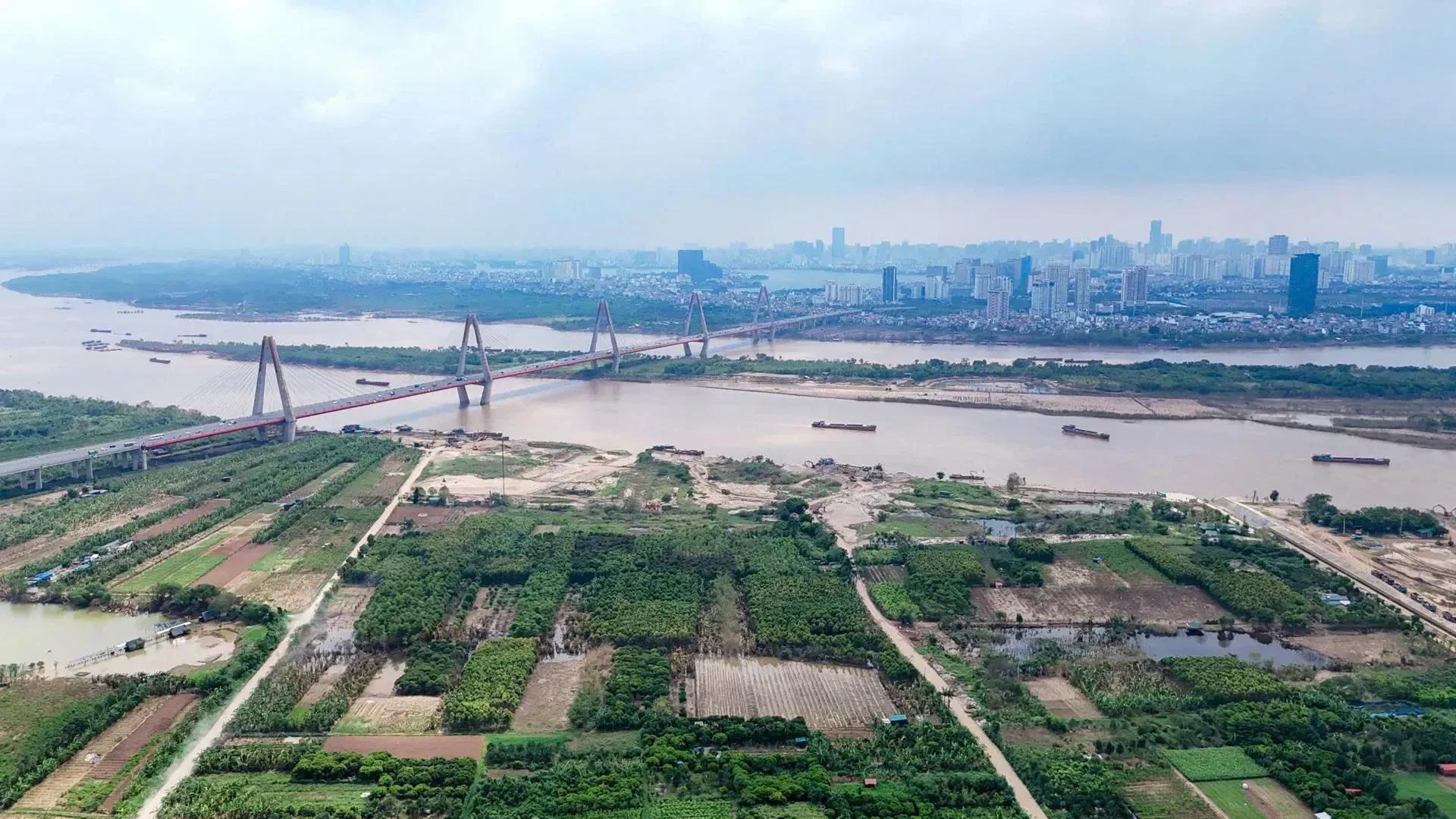
A view of the Red River and a bridge crossing the river, part of Hanoi’s plan for a riverside landscape corridor. Photo: Thanh Hai/The Hanoi Times
The city estimates capital demand for this phase at VND14.5 quadrillion ($555 billion), including nearly VND2 quadrillion ($76 billion) in public investment, while private enterprises and residents are expected to contribute VND8.8 quadrillion ($337 billion) for urban infrastructure development and restructuring.
Between 2036 and 2045, Hanoi plans to relocate 26,730 residents from the Old Quarter and around 370,000 from other areas within Ring Road 3.
Separately, 23,000 residents will be relocated from the so-called "Old Town" area, which consists of French-era neighborhoods in the former districts of Hoan Kiem, Ba Dinh and Hai Ba Trung.
Capital demand for this phase is estimated at VND50 quadrillion ($1.9 trillion), with more than VND5 quadrillion ($191 billion) coming from public funds and the remainder mobilized primarily from social resources.
The city will resettle affected residents through two arrangements. It will provide on-site resettlement within permitted limits, while others will move to new urban areas in Dong Anh, Gia Lam and Hoa Lac communes.
These areas are under development with integrated infrastructure and full amenities, including schools, hospitals and parks, to ensure living conditions improve.
Overall, the proposal envisages relocating residents to support urban restructuring and build a more sustainable capital.
In line with this direction, Hanoi aims to reduce pressure on the old core by developing multiple growth hubs that share key functions. The work will move from Ring Road 3 inward, with priority given to areas within Ring Road 1 and Ring Road 2.
This process also supports the preservation and restoration of key historical, cultural and architectural areas, including the administrative center in Ba Dinh, Ngoc Ha and Giang Vo wards, Hoan Kiem Lake, the Old Quarter, the West Lake and the Red River riverbank corridor.







