Hanoi has two more national intangible cultural heritages
The Ministry of Culture, Sports and Tourism has recently recorgnized two traditional festivals of Hanoi as national intangible cultural heritages, including “Moc villages festival” and “The sisterhood celebration ceremony between Phu My and Kieu Mai villages”.
| The three-day “Ke Moc festival” or “The festival of five Moc villages” is organized from 9th to 11st of the second lunar month. Photo: thanhxuan.hanoi.gov.vn |
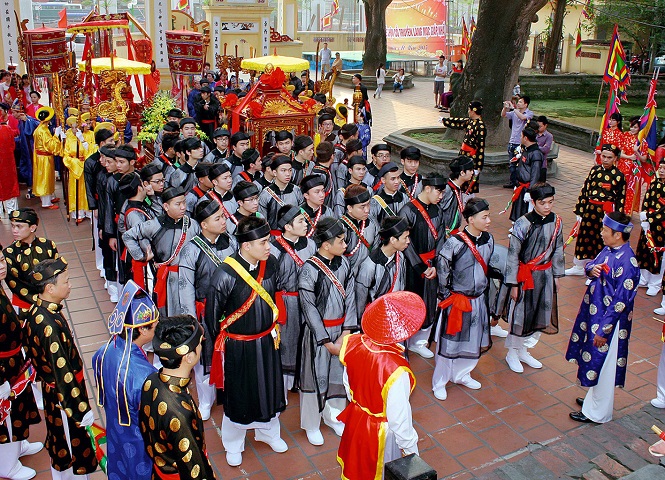
The “Moc villages festival” (or the festival of five Moc villages) is held annually in Nhan Chinh Ward, Thanh Xuan District and Trung Van Ward, Nam Tu Liem District, Hanoi on the occasion of the Lunar New Year.
The festival originated in Ke Moc, a residential area on the bank of To Lich River in the southwest of the Thang Long (Ascending Dragon) Citadel, now is Hanoi. The area covered five villages comprising of Giap Nhat, Quan Nhan, Chinh Kinh, Cu Loc and Phung Khoang. The villages are today’s urbanized wards of Thanh Xuan and Nam Tu Liem districts, Hanoi.
Apart from worshiping rituals, various folk games are also performed during the festival, including human chess games, duck-catching competitions, earthen pot-breaking games, cockfighting, and wrestling. In the evening of the main festival day, there is also a firework display and Cheo folk-singing performance. The highlight of the festival is a religious ritual to honor the tutelary gods of the five villages.
| The joyful "Ke Moc Festival". Photo: thanhxuan.hanoi.gov.vn |
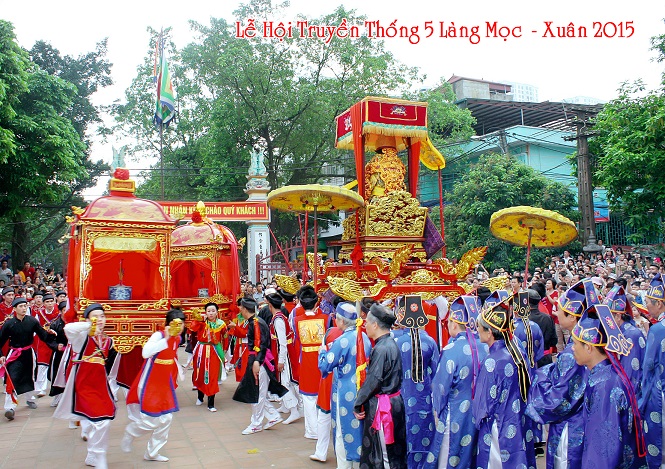
“The Sisterhood Celebration Ceremony between Phu My and Kieu Mai villages” is usually held in My Dinh 2 Ward, Nam Tu Liem district and Phuc Dien Ward, Bac Tu Liem district of Hanoi.
The ancient villages of Phu My and Kieu Mai are adjacent, located on the opposite banks of the Nhue River. In the past, both villages belonged to Tu Liem district (Hanoi). Today, Phu My village is located in Nam Tu Liem district, while Kieu Mai village is in Bac Tu Liem district.
Despite the threat of modern life and rapid urbanization, the villagers have always tried to embrace and preserve their traditional rituals and customs, including the sisterhood celebration ceremony.
According to an ancient document, the sisterhood relationship between the two villages started under the regime of Le Canh Hung King in 1745.
| The close relationship between villagers of Phu My and Kieu Mai is not only shown through the festivals but also in daily life. Photo: Nguyen Dung/ Nhip song Hanoi |
.jpg)
“At the festival of Phu My village, which takes place on the seventh day of the first lunar month (in lunar calendar), villagers of Kieu Mai have to parade to their sibling village; in return, villagers of Phu My would hold the same ritual in Kieu Mai village which takes place on the twentieth day of the second lunar month,” the ancient document stated.
Nowadays, the Phu My-Kieu Mai Village Festivals are usually held every five years in January and February of the lunar calendar. Besides the ritual, various folk games and performances are organized, including Cheo singing and Hat cua dinh (a type of Vietnamese traditional ritual performance, featuring folk singing, dancing, and rituals practicing).
“The close relationship between Phu My and Kieu Mai villages is not only shown through the festivals but also in the daily life. Inhabitants from the two villages are always willing to help each other. This covenant has been preserved intact over centuries,” said Nguyen Ngoc Dung, a resident of Kieu Mai village.