Hanoi heritage sites to be on view at Hoa Lo Prison Relics
Hanoi's iconic landmarks, such as Dong Xuan Market, Long Bien Bridge, and Hanoi Opera House, will be featured in the thematic exhibition space "A Glimpse of Heritage."
Twenty-five of Hanoi's historical and cultural relics are brought together in the Hoa Lo Prison Relics-themed exhibition space "A Glimpse of Heritage."
This is an exhibition organized by the Management Board of Hoa Lo Prison Relics on the occasion of the 25th anniversary since Hanoi was awarded the title "City for Peace" by UNESCO (July 16, 1999-2024).
Through documents and images, many relics associated with President Ho Chi Minh are presented, including the Government Guest House at 12 Ngo Quyen Street.
| On display are French buildings in Hanoi. Photo courtesy of organizer |
Built in 1918 on the site of the ancient Bao An Pagoda, the Palace is a typical work of French classical architecture with European details. The building bears witness to the long history of the Vietnamese people's struggle against the French colonialists and then the US imperialists to save the nation. It was Uncle Ho's office in 1945 when it was the Tonkin Palace.
Also on display is the heritage house at 48 Hang Ngang Street, Hoan Kiem District, which originally housed the patriotic bourgeois couple Trinh Van Bo and Hoang Thi Minh Ho. At the end of August 1945, it was chosen by the Central Committee of the Party as the place of residence and work of President Ho Chi Minh. It was here that he and the Party Central Committee made many important decisions on domestic and foreign policy, the composition of the new government, and the organization of Independence Day. In a room on the second floor of the house, President Ho Chi Minh wrote the Declaration of Independence of the Democratic Republic of Vietnam.
Not to be missed is the Presidential Palace, part of the Presidential Palace Historical Site complex, where President Ho Chi Minh lived and worked from December 19, 1954 to September 2, 1969.
The complex, which was declared a special national relics site in 2009, is likened to a museum depicting the life of President Ho Chi Minh. The compound, which includes Ho Chi Minh's house and surrounding grounds, is accessible to visitors, while the Presidential Palace is closed to the public.
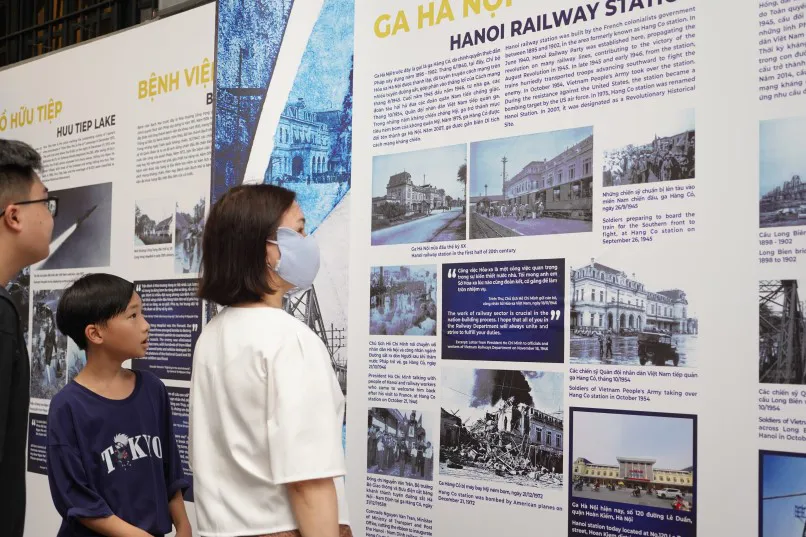
| The exhibition offers a glimpse of Hanoi's cultural heritage. Photo courtesy of the organizer |

The Presidential Palace was built between 1900 and 1906 as the residence and office of the Governor General of French Indochina. It was designed by a French architect by the name of Auguste Henri Vildieu and took about seven years to build.
After 1954, it was originally intended to be the official residence of President Ho Chi Minh. But he refused, feeling it would be inappropriate to live in such a large and opulent building while his people were homeless and starving. Instead, he lived nearby in a traditional Vietnamese house on stilts surrounded by a garden and fish pond.
The Presidential Palace is now mainly used to host foreign state guests.
At the exhibition, the public will have the opportunity to explore the many works built by the French colonialists that are now recognized as national monuments, such as Hanoi Opera House, August Revolution Square, Lang Fort, Ba Dinh Square, Dong Xuan Market, Hoa Lo Prison, Long Bien Bridge, Hanoi Railway Station, Bach Mai Hospital and Hanoi Flag Tower.
The exhibition will run from July 1 to September 5 at Hoa Lo Prison Relics, Hanoi.