Hanoi, Ile-de-France Region discuss regulatory amendments
The two localities share similar interest in refining the regulatory framework governing their cooperation, and expect to make amendments to boost their socio-economic growth.
Hanoi and the Ile-de-France region hope to strengthen mutual cooperation as the two localities aim to revamp their regulatory frameworks in the near future, officials said on April 12.
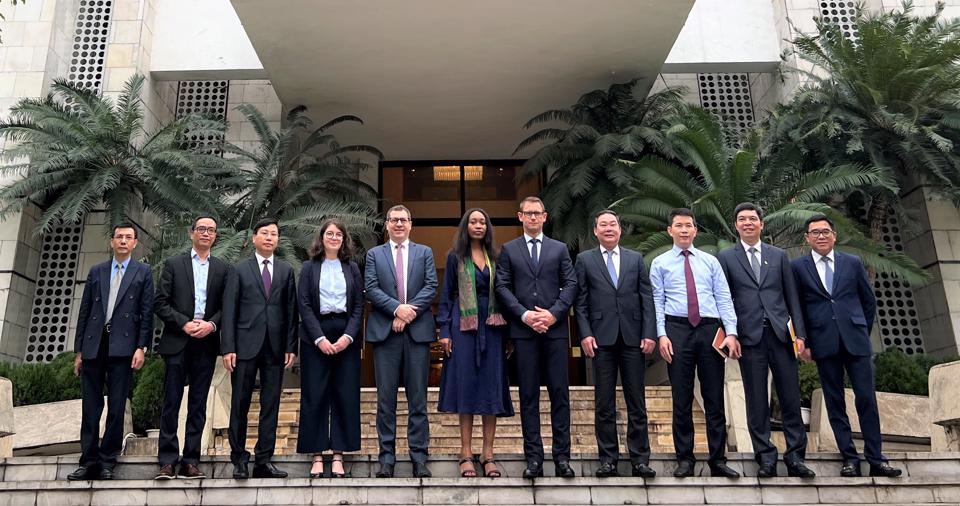
| Delegates of Ile-de-France Region take photo with Hanoi officials on April 12. Photo: Tu Anh/The Hanoi Times |
Hanoi's legislators have been working to amend the Capital Law, which will make the capital a more modern, civilized place, said Le Hong Son, permanent vice chairman of the Hanoi People's Committee.
"The new regulatory platform is expected to make Hanoi the spearhead of socio-economic development in the northern region of Vietnam," Son said at a meeting with Beaudet Stephane, vice president of the Ile de France region.
The amended law will make it easier for Hanoi to preserve and promote local cultural values while combining these values with urban planning and development, the Vietnamese official said.
The capital hopes to solve existing problems in urban transportation and environmental protection, Son added.
"The authorities and people of Hanoi look forward to maintaining and improving relations with the Ile-de-France region," he said.
Hanoi wants to discuss some specific issues with the French side in the coming days after the 12th Vietnam-France Decentralization Conference, Son added.
"We hope to reach a new agreement to strengthen our bilateral partnership and diversify mutual cooperation efforts."
Beaudet Stephane, vice president of the Ile-de-France region, said his region is one of three major French metropolitan regions whose regulations are being updated by the French government.
The French region and Hanoi face similar issues, and local authorities are working to make changes to regional planning, he said.
There is great room for more opportunities and further cooperation between the Ile-de-France region and Hanoi, especially in areas where the two sides share similar concerns, the French official said.
At the meeting, both French and Vietnamese officials agreed that the upcoming Vietnam-France local-to-local conference will provide an opportunity for the two sides to discuss and expand cooperation in a wide range of fields, especially sustainable transportation and circular economy, heritage protection and cultural preservation.
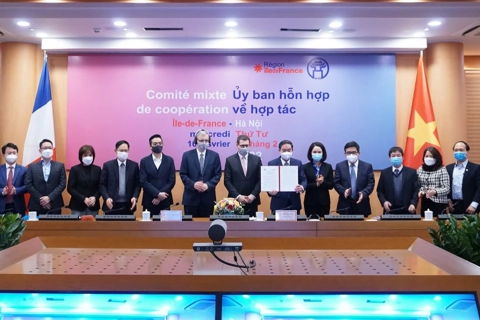
Cooperation between the two sides dates back to 1989. It is the first decentralized cooperation agreement signed between France and Vietnam and one of the Île-de-France Region's oldest international partnerships, according to the Ile-de-France Region. Quality of life, urban development, the environment and, more recently, innovation and research form the basis of this partnership.
In February 2022, Hanoi and the Ile-de-France region signed cooperation plans for the period 2022-2025, focusing on planning and urban management, the French region's strengths. In June 2018, a joint action plan was signed for the period 2018-2021. It concerned new cooperation projects with the capital of Vietnam in the field of innovation and research.
The Île-de-France Region also supported the inscription of the Hanoi Citadel on the UNESCO World Heritage List. This action has been carried out in partnership with the Ile-de-France Regional Tourism Committee (CRT) and the Provins Tourist Office since the beginning of 2010.Île-de-France is the most populous of France's eighteen regions. The region is made up of eight administrative departments: Paris, Essonne, Hauts-de-Seine, Seine-Saint-Denis, Seine-et-Marne, Val-de-Marne, Val-d'Oise and Yvelines.