Hanoi leads the country in student number
The number of school-age children in the capital city is growing faster and faster.
Hanoi will have more than 2.3 million students in the 2024-2025 academic year, continuing to lead the country, according to Tran The Cuong, Director of the city's Department of Education and Training.
Each year, between 40,000 and 60,000 new students enroll in Hanoi's schools, and the city government is working hard to find classroom space for them.
"By 2024, the city should have 35 students per class at the primary level and 45 students per class at the upper secondary level, instead of the current average of 45. These are tough targets for Hanoi because of the city's high population density," Cuong said.
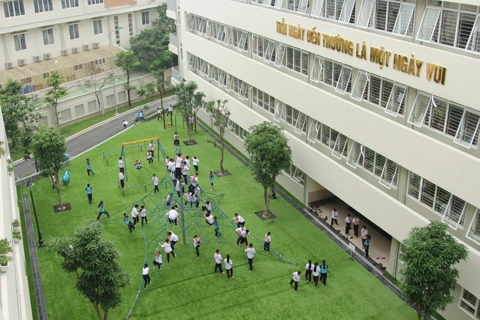
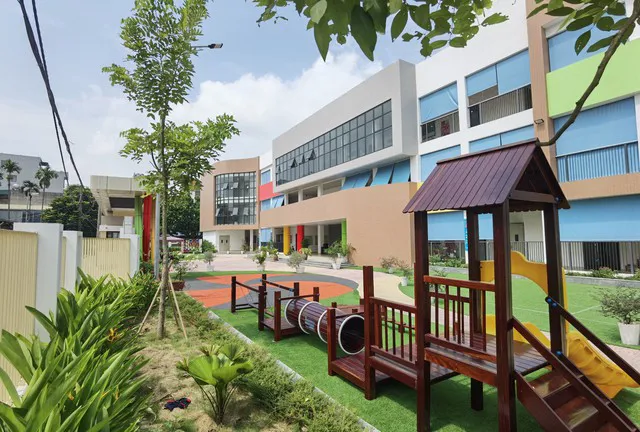
The Tran Phu Primary School in Hanoi's Hoang Mai District was inaugurated in time for the new school year. With nearly 900 students in 24 classrooms, it fully meets the requirements for teaching and learning. Photo: VGP |
"If we want 85% of all schools to meet the standards by 2025, we need to assess a total of 410 new schools and reassess 1,150 others. Achieving certification is one thing, but maintaining quality is another. In urban districts such as Dong Da, Ba Dinh, Hoan Kiem, and Hoang Mai, there is hardly any land left to build more schools," he added.
The shortage of schools and classrooms has been one of the most critical issues in Hanoi, putting pressure on existing schools and teachers from primary to upper secondary levels.
Nguyen Minh Tam, Chairman of the Hoang Mai District People's Committee, said that Hoang Mai is the most populous district in Hanoi, home to some 700,000 people. According to him, the number of school-age children is growing by 4,000 a year and now stands at nearly 100,000.
"But the district still has a deficit of about 43 schools, even though we have renovated 25 schools and built 23 new ones in the last three years to increase the number of classrooms," he said.
Le Anh Quan, Director of the Department of Planning and Investment, reported that over the past 10 years, a total of nearly 1,400 schools have been built and renovated, providing more than 21,100 new classrooms and nearly 1,800 functional rooms for local students. However, the chronic shortage of schools and classrooms is due to the frenetic pace of housing development, which does not include school construction.
According to Vice Chairwoman of the Hanoi People’s Committee Vu Thu Ha, Hanoi has earmarked more than VND51 trillion (US$2.17 billion) to build 433 national standard public schools with a total of 8,323 classrooms between 2021 and 2025.
Ha expressed concern that despite efforts to provide standard classrooms to ensure the best possible learning environment, the city's current planning for its school network is still inadequate due to uneven distribution and rapid population growth.
"New urban areas and industrial parks are being built, attracting large numbers of workers and increasing the demand for schools and classrooms," Ha said.
According to Ha, the city is in the process of reviewing vacant plots of land to ask developers to change the purpose of land use for the construction of schools.
The municipal government has also asked the people's committees to monitor enrolment in 2025 so that educational institutions cannot enroll students beyond their quotas. Queuing and jostling at schools for enrolment must be stopped, it said.