Hanoi - flexible in the face of shortage of classrooms and schools
Overpopulation and high demographic density are challenging Hanoi to build new schools.
The Hanoi Department of Education and Training and local schools are looking for ways to build more schools and classrooms. Assoc. Prof. - PhD. Chu Cam Tho, Vice Secretary General of the Vietnam Psycho-Pedagogical Association, talks to The Hanoi Times about how it should be done.
| Assoc. Prof. - PhD. Chu Cam Tho, Vice General Secretary of the Vietnam Psycho – Pedagogical Association. |

Is there a shortage of classrooms and schools in large cities in Vietnam, including Hanoi?
The development of metropolises is always accompanied by the overburdening of public and social services. This is a common issue for all big cities in the world, not only for Hanoi and other cities in Vietnam.
For years, Hanoi and other large cities have been experiencing a shortage of classrooms due to a significant increase in population. This will continue in the future as the capital's urbanization continues to grow rapidly, attracting an influx of young and highly educated workers. This is leading to a strong demand from vocational trainees and students to take courses and improve their skills, and therefore a demand for more classrooms.
From your point of view, how efficient is Hanoi in solving this issue?
With the largest student population in the country, estimated at 2.3 million, Hanoi schools enroll 40,000-50,000 students every year. There are more than 2,800 schools in the city, and an additional 30-40 schools need to be built to meet the demand. In recent years, schools in the city have been built and repaired to solve the problem.
However, school construction isn't done properly in all districts because it depends on the city's overall urban development and power decentralization scheme. Hoan Kiem, Dong Da, Ba Dinh and Long Bien are among the districts that have done well in school construction, while some others have made little progress, so the shortage of classrooms is still a headache.
The uneven distribution of population has led to an imbalanced distribution of schools in the city. In addition, the inconsistent quality of education throughout the city has resulted in a high concentration of students in some districts, while some others have empty schools.
What will you suggest to the Hanoi authorities to increase the number of classrooms and reduce class sizes?
I'm firmly convinced that some of the solutions introduced by the Hanoi authorities are good enough to solve the issues. However, the situation would not improve overnight, but the city would need a lot of time and effort to come up with a strategy and flexible models to deal with it.
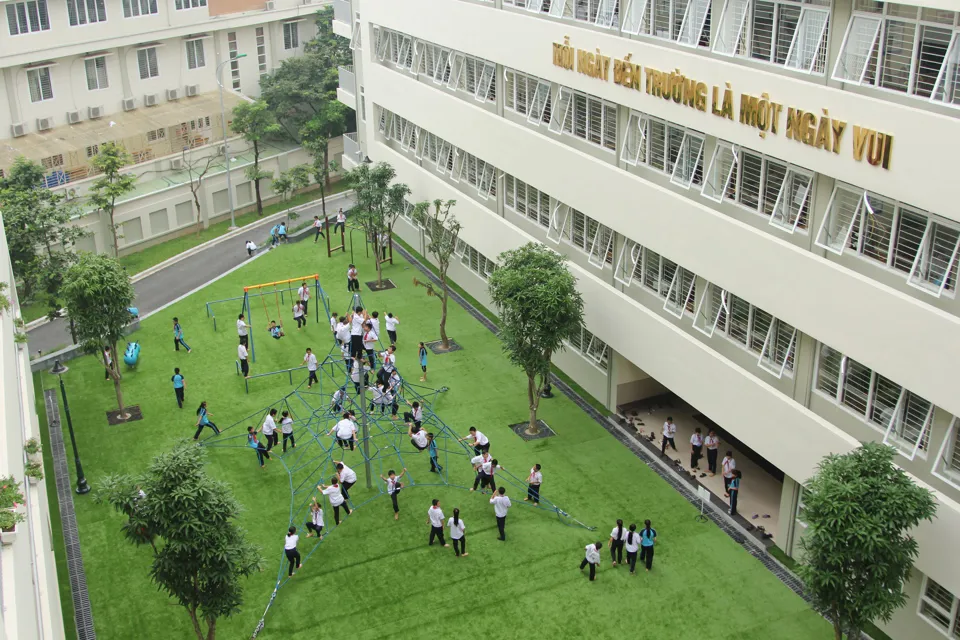
| Recess time at Nghia Tan Secondary School in Cau Giay District. Photo: Pham Hung/The Hanoi Times |
Addressing the school deficit requires a long vision, 5 or 10 years, and the criteria for building new schools must be adapted to the specific local area and not applied across the board. It's good to build new schools, but construction takes time (usually 2 to 3 years), while coping with school shortage is imperative, so district authorities need to come up with a backup plan, such as using vacant spaces for temporary schools instead of building large school buildings.
Overpopulation and high population density lead to sub-optimal class sizes and many small local schools with 2,000-4,000 students. This undermines the quality of administration and education, as overcrowded classes degrade the school's operational efficiency.
There must be specific criteria for schools in each area, neither national nor local, neither higher nor lower, but specific, taking into account the size of the population. For example, in overpopulated areas it is impossible for schools to have spacious schoolyards, so this criterion should be removed from the set of standards for classifying schools.
Parents of students are concerned that public schools are outnumbered by private schools, making the high school entrance exam extremely competitive. What do you think about this?
The classification of students is a crucial factor in the development of a nation's human resources. In developed countries, there is a wide range of school models and educational activities to meet different social demands.
The Hanoi Municipal Government has developed a good policy on universal education, where on-demand schools and other types (private) of schools can be developed only when the demand for public education is met. It is reasonable that parents want their children to enroll in public schools, but we need to change this mindset. We must ensure the equitable development of all schools in all neighborhoods.
We are familiar with the concept of the national standard school, but we neglect the importance of local standards for school development. There should be specific standards for each area, because educational activities must be in line with the local socio-economic environment and people's needs.
Meanwhile, new criteria are needed for rural and underdeveloped localities so that educational activities are accessible everywhere.
Thank you for your time!