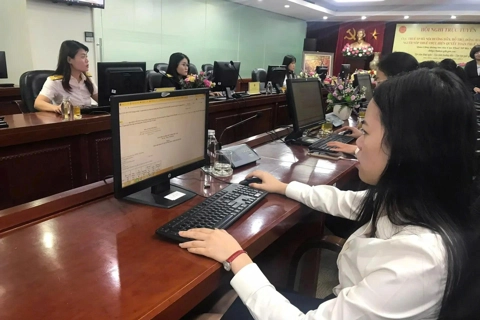
Work for the people, not for profit
Welcome to Words on the Street, where we explore how minute regulations reveal profound stories. A new rule dictates that public servants must forgo business ventures.
THE HANOI TIMES — Until recently, civil servants and public employees could dip their toes into business as long as they didn’t take on a managerial role and had written approval from their superiors. Technically, they weren’t permitted to run a company.
However, nothing prevented them from starting a company, investing capital, or having someone else register it for them. The boundary was blurry and, in practice, often ignored.

On June 17, however, the National Assembly drew a sharp line. The revised Enterprise Law expressly states that civil servants and public employees may not establish, invest in, and manage private enterprises. The only exceptions apply to scientific, technological, and digital transformation ventures that align with national policy.
To many, this move is more than just legal housekeeping; it is a long-overdue reset. "Public trust starts with public focus," said Tran Manh Tien, a retired planning officer. "You can't expect sound decisions from someone juggling duty and dividends."
The reaction on social media was swift. "This is a good thing," one user commented. "Too many people were hiding behind their relatives. It’s time to get serious.”
For older generations, the decision stirred up memories. A former official in the northen city of Haiphong recalled: "We all had side jobs. After work, I’d help my wife run a breakfast stall near the market. Nobody thought twice about it. But we were tired. You could never give your full focus to one thing.”
Today’s civil servants, especially the younger ones, face different pressures. They’re better educated, digitally savvy, and more ambitious. They're not just interested in climbing the public ladder; they're also interested in launching ideas.
Vu Minh Long, 29, in Dong Da District, Hanoi, used to be a policy analyst at a national research institute. "My team had this concept for a social impact platform to help students find scholarships and mentorships," he shared. "We even built a demo. But now, because of the law, I’d have to quit my job to move forward.”
At first, he felt conflicted. "It stung. I’ve spent years preparing to serve in the public sector. But I also believe in innovation.” After reflecting on it, though, he came to terms with the rule. "Maybe it's okay. Maybe it pushes us to contribute differently. You don't need to own a business to share your ideas."
That point resonates with others. Hanoi's citizen Mai Anh, who works in public healthcare, added: “Some friends told me to go freelance, open a consultancy. But I still want to serve. Now I’m thinking, why not advise startups instead of running one?” For many, the law fosters a new mindset. They contribute through expertise, not equity.
Of course, not everyone is buying in. "This won't stop people from playing the proxy game," someone posted online. "They'll just register the business under a sibling's name and move on." Others asked: "How do you even track these things? Bank accounts, crypto wallets - good luck enforcing it.”
Nevertheless, even imperfect regulations hold significance. From my point of view, this isn’t about catching every case. It’s about shifting the culture. Laws like this one set expectations. They make people pause. They increase the social cost of shady operations.
Besides, enforcement is evolving. As Vietnam expands its digital government systems and makes it easier to cross-check data between tax authorities, business registries, and personnel records, it will become more feasible to enforce these laws. Over time, the tools will catch up to the intent.
However, if we’re serious about integrity and innovation, perhaps the next step should be more than just enforcement. It's about flexibility. Several young civil servants have called for more clarity. A transparent review mechanism for exceptions, especially in sectors like edtech and climate solutions, could help. These are sectors where public expertise and entrepreneurial energy often converge.
One idea is to allow qualified public employees to advise or mentor startups, provided there is full disclosure and no financial involvement. Another suggestion is to create more defined pathways for individuals who want to leave public service and return later after pursuing entrepreneurial ventures. The point is not to open the floodgates. Rather, it is to avoid shutting out people who genuinely want to serve, even if they don't want a single-track career.
At the heart of this debate is a generation that wants to both work for the people and shape the future. It's not greed. It's grit. However, grit still needs guardrails.
Vietnam is moving toward a more accountable public sector that honors the trust placed in civil servants. The new rule sends a firm message. Public duty should be one's only focus. However, this doesn't mean shutting the door on creativity or ambition. Rather, it means asking the right question: How can we design a system that’s both clean and capable?
For now, the answer may lie in relinquishing certain freedoms in the name of greater responsibility. It's a trade-off worth making. It's a trade-off that benefits not just the government, but all of us.