New school construction: Big challenge for Hanoi authorities
Finding land is the most daunting task for local authorities when it comes to building a new school.
Hanoi is home to about 2.3 million students in the academic year 2023-2024, accounting for 10% of the nation's total, according to the Ministry of Education and Training.
| High school students in Hanoi celebrate the opening of the 2023-2024 school year. Photo: Ngoc Tu/The Hanoi Times |
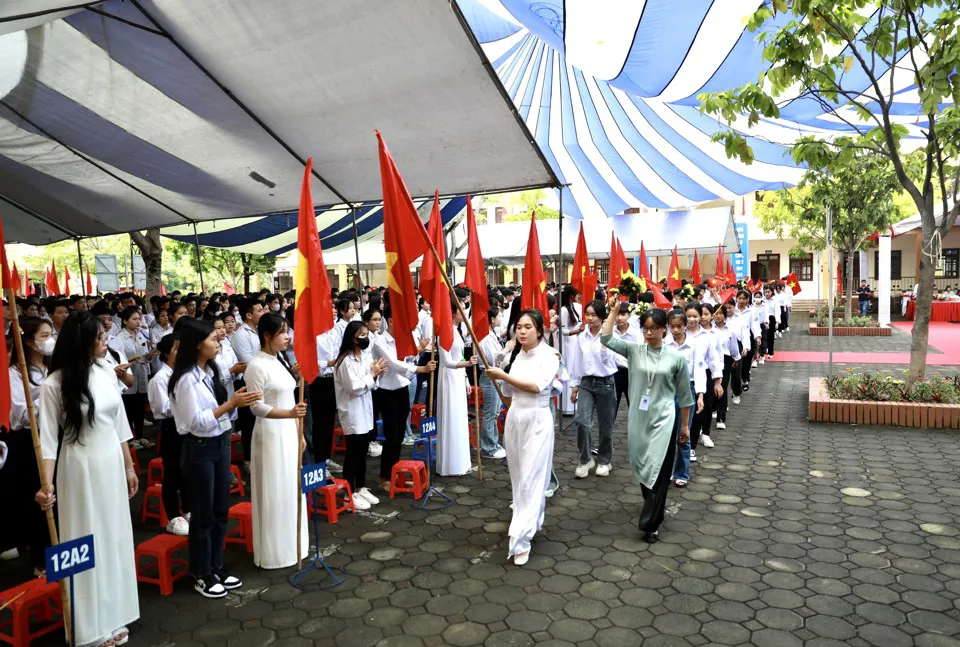
About 50,000 new students are enrolled each year in schools across the city. To provide enough classrooms for all students, Hanoi needs to build at least 40 new schools each year, including public and private ones.
Given the rapid urbanization and population density in the eight metropolitan districts, finding land to build 40 new schools each year is an insurmountable task for local authorities.
A report by the Hanoi People's Committee on October 17 showed that the city needs 49 more schools for eight urban districts.
Tran The Cuong, Director of the Hanoi Department of Education and Training, said the city aims to have 80-85% of all schools meet national standards by 2025. National standards for schools in Vietnam include having a large schoolyard, a sports field, safety against disasters, and anti-reflective boards, among other criteria.
According to the official, Hanoi had planned to have 194 schools meet national standards in 2022, but only 142 schools were able to do so. In 2023, the target was 130 schools, but the current figure is only 16. Another target was 35 students per class at the primary level and 45 students per class at the upper secondary level, instead of the current average of 45.
These are tough goals for Hanoi, he said, because of the city's dense population.
"If we want 85% of all schools to meet the standards by 2025, we need to assess a total of 410 new schools and reassess 1,150 others," Cuong said. "Achieving certification is one thing, and maintaining quality is another challenge," he added.
"In urban districts like Dong Da, Ba Dinh, Hoan Kiem, and Hoang Mai, there is hardly any land left to build more schools," he said.
The shortage of schools and classrooms has been one of the most critical issues in Hanoi, putting pressure on existing schools and teachers from primary to upper secondary levels.
Hoang Mai is the most populous district in Hanoi, with about 700,000 residents, said Nguyen Minh Tam, Chairman of the Hoang Mai District People's Committee.
The number includes about 100,000 children of school age, and it is increasing by 4,000 every year, he said.
"But the district still has a deficit of about 43 schools, although we have renovated 25 schools and built 23 new ones in the past three years to increase the number of classrooms," he said.
Le Tuan Dinh, Chairman of the Dong Da District People's Committee, said there is little land to build schools and classrooms. "We have an average of 60 classrooms per school and about 40-60 students per class."
Le Anh Quan, Director of the Department of Planning and Investment, reported that over the past 10 years, a total of nearly 1,400 schools have been built and renovated, providing more than 21,100 new classrooms and nearly 1,800 functional rooms for local students. However, the chronic shortage of schools and classrooms is due to the lack of schools in newly urbanized areas.
"Hanoi has developed about 174 residential areas in recent years. Of these, 55 projects do not provide space for school buildings. Another 119 have 393 schools planned, of which 117 schools have been and are being built," he said.
Cancellation of real estate projects key to solving school shortage
First, land for school construction must be secured in every housing project, said Hoang Mai District's Chairman Nguyen Minh Tam. "We have reviewed housing projects and canceled a number of them because they delayed school construction," he said.
The district official suggested that local authorities regulate the minimum land ratio required to build schools in residential areas.
The school development plan should keep pace with population growth, which should be included in the amended Capital Law, he said.
Meanwhile, Le Tuan Dinh of Dong Da District said local authorities have completed 13 of 33 school projects, and the district is preparing nine more. "We are also considering merging small schools into larger ones to ensure the required number of schools that meet national standards," he said.
According to Cuong, Director of the Education and Training Department, local authorities are working hard to reclaim land from delayed housing projects to build schools.
He suggested that the Hanoi government relocate industries, universities, and colleges to the suburbs to free up more land for schools in central districts. "Districts should be empowered to allocate land and build schools as needed," he said.
The Finance Department has advised the city People's Committee to convert administrative buildings into schools, said Nguyen Xuan Luu, Director of the department.
"If the administrative building is large enough, the agency's leadership should immediately hand over the facility to local authorities, and a new school can be built without being included in a new urban development plan for approval," he stated.