Hanoi makes significant progress in Nhon–Hanoi station metro line
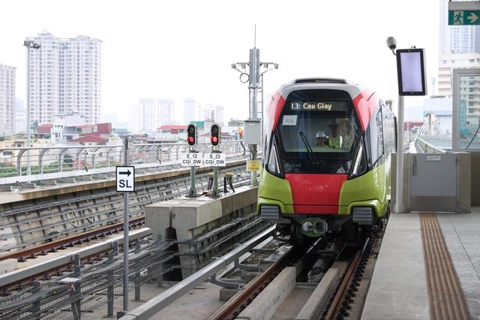
The project's elevated section is scheduled to be completed by year-end, helping the city ease the traffic congestion issue.
Local authorities have completed ahead-of-schedule compensation for land requisition and temporary settlement of all households living in the Nhon–Hanoi station metro line project in the two districts of Ba Dinh and Dong Da.
| Vice Secretary of the Hanoi Party Committee Nguyen Thi Tuyen during the visit. Photos: Pham Hung |
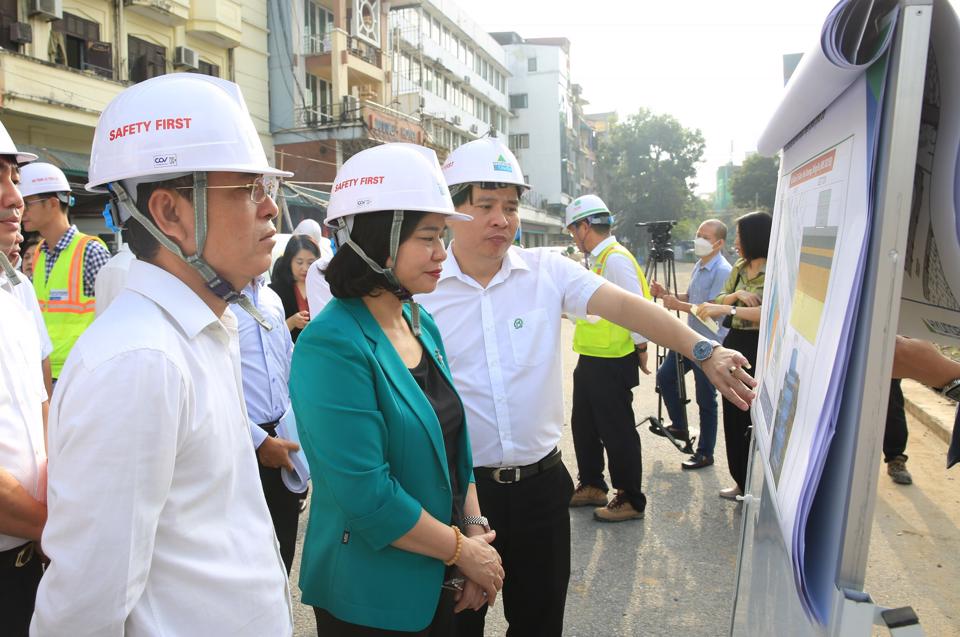
Vice Secretary of the Hanoi Party Committee Nguyen Thi Tuyen applauded the efforts from Hanoi’s Project Management Board of Urban Railways and the two districts of Ba Dinh, Dong Da, for advancing the construction of the metro line when visiting works on October 27.
At the meeting, a representative of the Project Management Board noted the agency and the authorities inwards of Cat Linh, Quoc Tu Giam, Van Chuong, and Van Mieu of Dong Da District had completed compensation payments to all 30 households in the project area.
In Ba Dinh District, the Board and Kim Ma Ward concluded the payment for all 18 households, and the latter has signed an agreement for moving into temporary houses, along with a commitment to handing over the site on time.
In addition, the Hanoi People’s Committee has approved selling resettlement apartments for households subject to land requisition in the vicinity of the S9 station.
Chairman of Ba Dinh District People’s Committee Ta Nam Chien said that the district had completed the compensation payment worth nearly VND50 billion (US$2 million) while allocating temporary houses for 13 households.
“The site clearance is completed and ready for construction,” Chien said.
Regarding 18 affected households in Kim Ma Ward, Ba Dinh District, the Project Management Board has also approved the compensation plan worth a total of VND8.2 billion ($330,378), with all households receiving the payment.
| Vice Secretary of the Hanoi Party Committee Tuyen speaks at the meeting. |
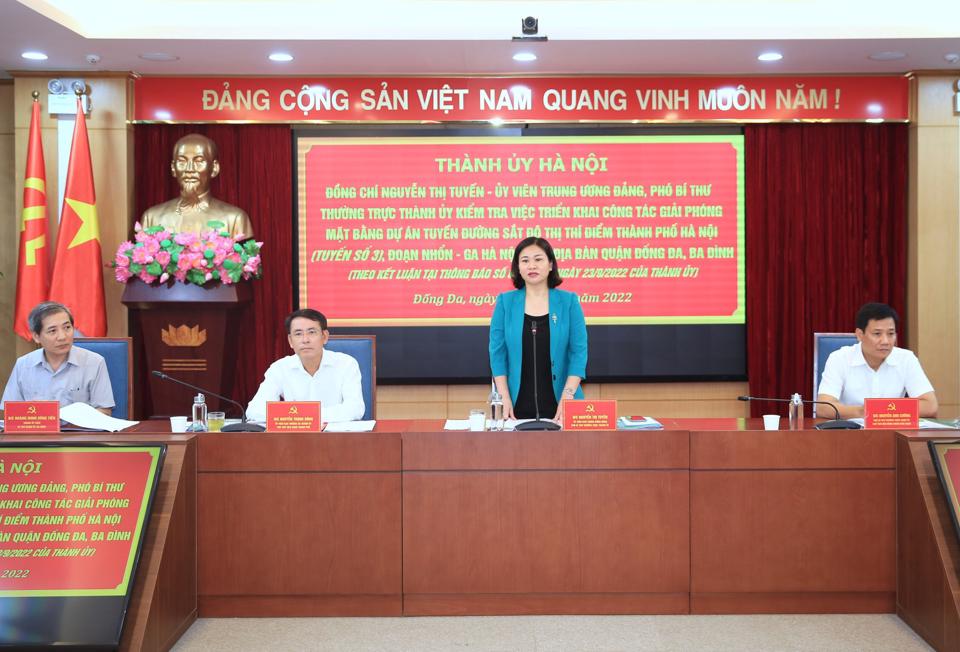
Meanwhile, the Chairman of the Dong Da District People’s Committee, Le Tuan Dinh, said a similar process for all 30 affected households in the district was completed in September.
Vice Secretary of the Hanoi Party Committee Tuyen stressed all recommendations regarding the project have been addressed by the city and urged all related agencies to continue seeking people’s consensus in the construction process.
Along with the underground components of the project, Tuyen urged the Project Management Board to put the elevated stretch into operation soon to help ease the traffic congestion in the city.
“Efforts are required to ensure the utmost convenience during the operation and maintenance of urban railway routes,” Tuyen noted.
Prime Minister Pham Minh Chinh, during a visit to the project site in August, requested the elevated section of the project (from Nhon to Cau Giay) to be completed by December 31, 2022, and contractors to halve the construction time of the underground section, which inauguration is originally scheduled for 2027.
The Nhon – Hanoi station metro project, with financial backing from the French Government, the French Development Agency (AFD), the Asian Development Bank (ADB), and the European Investment Bank (EIB), has a total length of 12.5 kilometers, running through eight elevated and four underground stations.
According to the Hanoi Urban Railway Project Management Board, work on the metro line project began in September 2010, and 75% has been completed so far, while the elevated section (Nhon - Cau Giay) has been 95% finished.
However, difficulties during the implementation process have delayed the project beyond the original 2016 deadline, and its investment costs doubled to VND34 trillion (US$1.45 billion).
The delay is attributed to the sophisticated technologies first used in Vietnam, the inexperience of the parties involved in the project, difficulties in meeting donor obligations and funding agreements, and issues related to the land clearance process.
| "Hanoi has made major improvements in transport infrastructure development, but work still needs to be done. In the current and near-future term, ADB would focus on supporting Hanoi to improve its public transport system, including the metro lines, as we are currently providing financing for the metro line Nhon – Hanoi station. From my perspective, this is a very complicated project due to its design, alignment, and other factors. So, we are working very hard with the Hanoi People’s Committee and other development partners on this project to ensure its completion on time. We will continue to support this project, which would be the priority in our engagement with the city in the immediate future," Vice ADB Country Director to Vietnam Keiju Mitsuhashi told The Hanoi Times. |
| "Hanoi and Ho Chi Minh City remain the two main pillars of Vietnam's growth, but for years, both continue to struggle with urban problems, especially traffic congestion, which hurts overall development. Experiences from other cities worldwide show that an effective combination of the metro for long-distance travel and bus lines for shorter routes would help solve these problems. In this way, metropolises such as Hanoi and Ho Chi Minh City could realize their full development potential," Principal Country Economist of the ADB in Vietnam Nguyen Minh Cuong told The Hanoi Times. |