Hanoi must lead in ethnic minority affairs: Mayor
Some VND5 trillion (US$197 million) has been spent on improving the livelihoods of ethnic minorities in Hanoi.
Hanoi must take the lead nationwide in ethnic minority affairs with effective policies and actions, said Tran Sy Thanh, Chairman of the Hanoi People's Committee.
| Individuals and units recognized for their work in caring for ethnic minorities in Hanoi. Photo: The Hanoi Times |

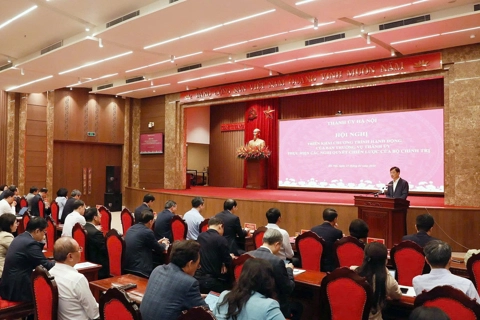
Speaking at the 4th Congress of Representatives of Ethnic Minorities on November 5, Thanh called on all levels and sectors to strengthen their knowledge and commitment to ethnic minority affairs and to be fully aware of their importance.
"It is necessary to closely follow the policies and guidelines of the central government, the city, and the practical situation to direct the timely and effective implementation of national target programs for the development of ethnic minority areas," he urged.
He called on the Hanoi government to prioritize infrastructure development in ethnic minority areas, support inclusive socio-economic growth, and close the development divide between the metropolis and mountainous and ethnic minority areas.
Hanoi needs to amend existing policies and enact new ones tailored to ethnic minorities and the city's mountainous areas, Thanh added.
He stressed the importance of building a team of ethnic minority officials, especially at the village level and utilizing the role of respected individuals.
"What we do today will determine the future, so let's nurture the aspiration to overcome hardship and achieve prosperity right here in our home village," Thanh said.
Y Thong, Deputy Head of the Government Committee for Ethnic Minority Affairs, praised the Hanoi authorities for their achievements in ethnic affairs in recent years and urged the capital to consolidate its achievements and strive for even greater success.
Besides economic development, the city should focus on education and vocational training to improve the quality of ethnic minority human resources.
In order to ensure health care, environmental sanitation, and a conducive climate for the development of tourism services in ethnic minority areas, he recommended a focus on preserving and promoting their tangible and intangible cultural heritage.
Nguyen Van Phong, Deputy Secretary of the Hanoi Party Committee, instructed Hanoi's Department of Ethnic Minority Affairs and local authorities to continue implementing key policies to improve the livelihoods of local people.
Highlighting human and cultural resources as one of Hanoi's five development engines, Phong urged localities and residents to restore and preserve cultural values unique to ethnic minorities and mountainous areas.
He suggested that Hanoi could learn from the successful model of ethnic tourism villages, such as Thai Hai in Thai Nguyen province, to transform villages in ethnic minority regions into attractive tourist destinations.
This approach would create sustainable livelihoods while preserving and showcasing traditional cultural heritage locally and internationally, he said.
Achievements, future goals
Since the 3rd Congress of Representatives of Ethnic Minorities in 2019, Hanoi has achieved important milestones, highlighting its commitment to ethnic minorities and mountainous areas.
| Tran Sy Thanh, Chairman of the Hanoi People's Committee, delivers his remarks at the congress. Photo: The Hanoi Times |

The economic growth rate in ethnic areas is more than 10% each year, while the average annual per capita income reaches VND65 million (US$2,560), and the poverty rate among ethnic minorities is now down to 0.38%. Urgent issues such as access to health insurance, clean water, job transition assistance, and stable housing have been successfully addressed.
Between 2019 and 2024, Hanoi has allocated over VND5 trillion ($197 million) from local budgets, along with other funds, for comprehensive economic, cultural, and social development in ethnic minority and mountainous areas. More than 265 infrastructure projects, such as roads, irrigation systems, schools, health facilities, and recreational areas, have been built.
Hanoi has also made progress in preserving the traditional cultures of ethnic minorities. At the same time, efforts to strengthen the Party and the political system have yielded positive results.
At the congress, participants also set tasks and directions for the next period, such as raising the average income in ethnic and mountainous areas to the level of Hanoi's suburban communes and eliminating the poverty rate.
Hanoi also aims for at least 95% of all ethnic minority schools to meet national standards, 80-85% of ethnic minority workers to complete training courses, and 95% of families to be recognized as cultured and educated. In addition, the capital expects 100% of communes to have access to national-standard health services, and 100% of ethnic minority households to to have clean water and regular garbage collection in their areas.