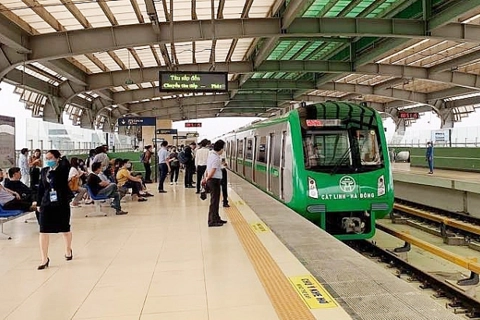
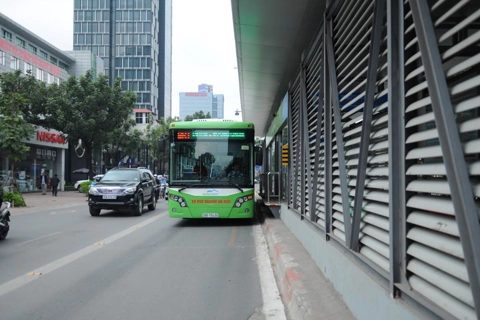
Hanoi needs innovative strategies to promote green buses
Without enough EV charging stations, it will be challenging to meet the government's timeline for transitioning from conventional to green cars.
Hanoi needs a proper roadmap and motivating factors, including energy resource planning, preferential policies, and support mechanisms to promote the development of green buses, according to Nguyen Phi Thuong, director of Hanoi's Department of Transport.
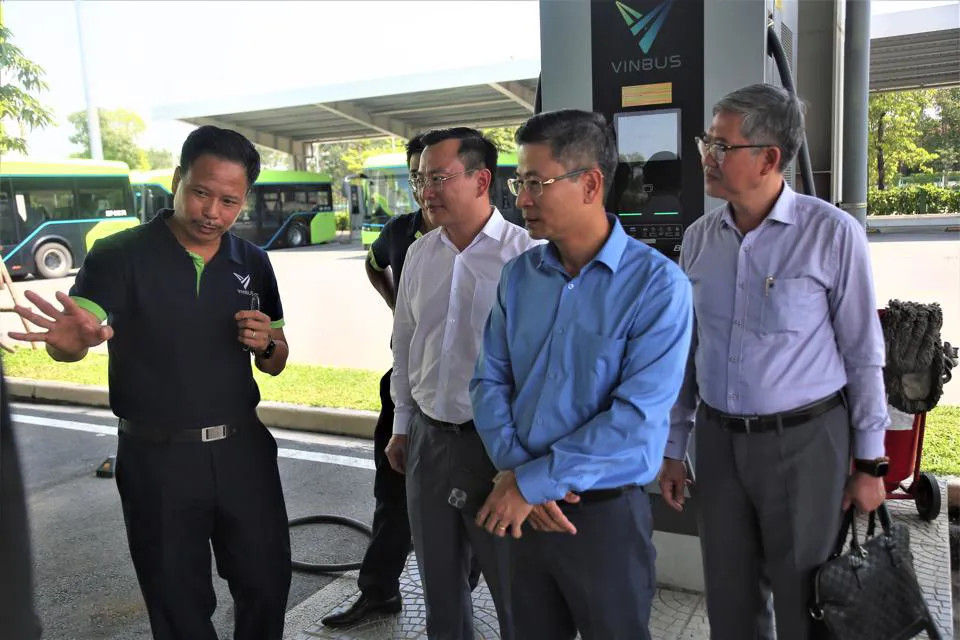
| Director of the Hanoi Department of Transport Nguyen Phi Thuong inspects an electric bus depot in Nam Tu Liem District. Photos: Pham Cong/The Hanoi Times |
Since 2021, Hanoi has conducted a pilot green mass transit network consisting of nine electric bus lines operated by Vinbus Ecological Transport Service Company. These eco-friendly bus routes have positively impacted the public transport network and the city's environment.
Nguyen Cong Nhat, General Director of Vinbus Ecological Transport Service, noted that the nine electric bus lines had traveled more than 20.3 million kilometers, reducing more than 18,000 tons of CO2 emissions. This reduction is equivalent to planting about 844,000 trees.
In addition, these electric buses have carried nearly 32 million passengers, about 80% of whom are office workers. A recent survey showed that 90% of passengers were satisfied with the quality of the electric buses, Nhat added.
Thai Ho Phuong, Deputy Director of the Hanoi Public Transport Management Center, also highlighted the application of information technology in Vinbus' nine electric bus lines, which has significantly improved operational efficiency and service quality.
However, despite the positive results achieved during the trial period, electric buses face significant challenges, mainly stemming from inadequate mechanisms and policies.
"Investors in electric buses cannot access the preferential loans offered in Hanoi. An electric bus costs 3 to 3.5 times higher than a conventional bus, making interest payment expenses approximately 10 to 11% of the total cost. The company is operating at a loss, and without substantial financial backing, its sustainability is at stake," said Nhat.
The Vinbus director added that while the two electric bus depots in urban areas have a stable energy supply, expanding the electric bus network throughout the city would be extremely challenging without proper energy resource planning.
| Electric bus is seen as a feasible solution for Hanoi to promote green public transport system. |
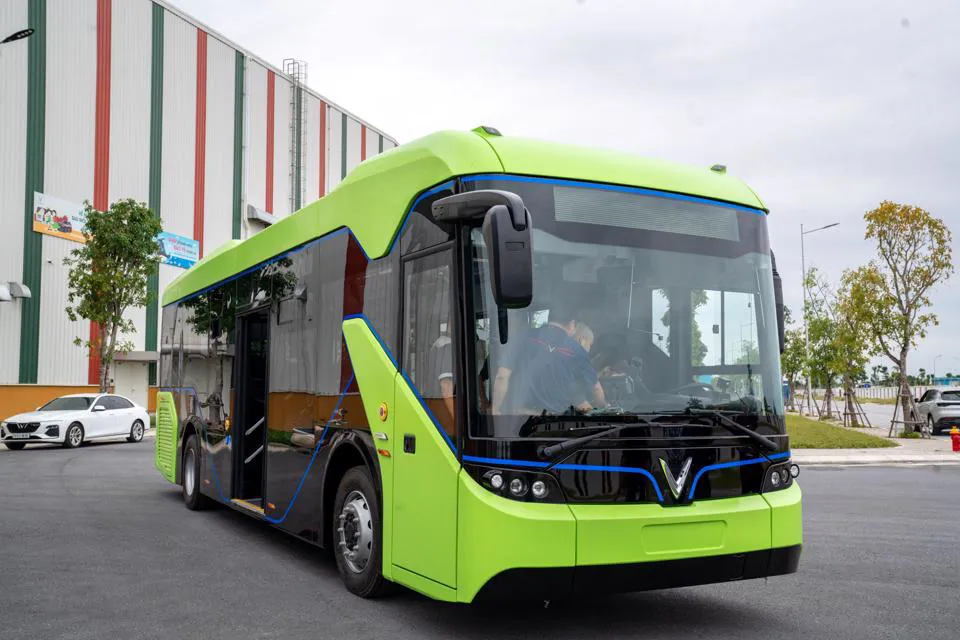
Nguyen Phi Thuong, Director of the Hanoi Department of Transportation, expressed his sympathy for the challenges faced by companies during the pilot phase of introducing green buses for public transport and praised the efforts made by Vinbus and other companies in recent years.
Thuong stressed that one of the main shortcomings of electric buses and the bus network is the lack of well-defined roadmaps. This is especially crucial regarding the transition of the bus network to the use of green vehicles under the Government's plan.
"This is the right time to review, evaluate and redesign the bus-based public transport network. With clear guidelines, companies will know how to invest. For example, priority should be given to electric buses in the city center, while compressed natural gas [a type of fuel that is more environmentally friendly than conventional diesel or gasoline] vehicles should be used in suburban areas."
It is important to establish a specific and transparent roadmap for companies that want to convert their vehicles to clean fuel buses," he noted.
He also emphasized the importance of addressing businesses' challenges and providing timely support and solutions for developing clean energy buses. "There are support mechanisms and policies that exist on paper but have not been effectively implemented, such as loans that are difficult to access, discouraging companies from investing in vehicle conversion."
In addition, ensuring adequate power supply for clean energy buses requires the involvement of the Ministry of Industry and Trade and related departments. This issue must be integrated into overall network planning to prepare for a future in which Hanoi and other cities will have thousands of electric buses.
"Without sufficient energy infrastructure, it will be difficult to meet the Government's roadmap to replace conventional vehicles with green alternatives," Thuong said.
"The critical issue now is to set an accurate and comprehensive unit price for electric buses while ensuring fair calculations. It is crucial to use the State budget effectively without disadvantaging enterprises and to remove disincentives for vehicle conversion," Thuong said.
| According to the planned timeline, between 2025 and 2030, all new or replacement buses in Hanoi must use green energy, while the market share of public transport should reach 45-50%. By 2030, at least 50% of vehicles should be powered by electricity and other forms of green energy. By 2050, the goal is for 100% of buses and taxis to be powered by electricity and green energy sources. |